Unchecked Fury
Legend of the Five Rings card from Aftermath
Open in Oracle of the Void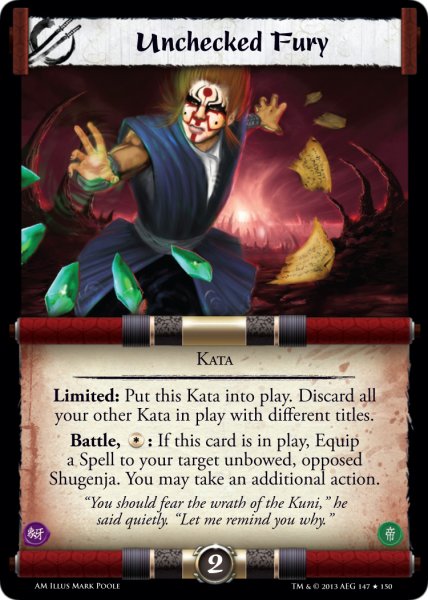
- Card Type
- Strategy
- Gold Cost
- 0
- Keywords
- Kata
- Card Text
- Limited: Put this Kata into play. Discard all your other Kata in play with different titles.
Battle, : If this card is in play, Equip a Spell to your target unbowed, opposed Shugenja. You may take an additional action.
- Focus Value
- 2
- Legality
- A Brother's Destiny (Ivory Edition), Age of Conquest (Emperor)
- Deck
- Fate
Printings
Aftermath
- Rarity
- Rare
- Flavor Text
- "You should fear the wrath of the Kuni," he said quietly. "Let me remind you why."
- Artist
- Mark Poole
- Card Number
- 147
- Publisher
- Alderac Entertainment Group
Rules Q&A
- Q: With ALitS the wording of the action bringing the Kata in play changed from: "Open: Put this Kata into play. Discard all your other Kata in play." to "Open: Put this Kata into play. Discard your other Kata in play."
As it seems that the plural of Kata is Kata (like Yojimbo), the question is: Is Kata used in plural or in singular in the latest action? If it is used in singular, can I then put into play 3 Unchecked Fury and discard only one of them each time I play any of the ALitS Kata (possibly ending with 3 different Kata on my side of the table)?
Thanks!
A: Kata is plural on this card. Functionally there's no difference between the two; if it intended to only discard one Kata, it would say "Discard another Kata in play". Jon Palmer, "New wording on Kata", 24 Sep 2014 - Q: But wouldn't the spell be discarded, so you could see the gold cost needed? Because of the change in rules caused from Paneki's mask exploit.
A: You may be misunderstanding the change to the rules that "fixed" Paneki's Mask exp.
That change involved clarifying taking actions on cards that are not in play: they are now played like Strategies, entering a Resolution area when the action is announced, and, if they are still in that Resolution area when the action ends, being discarded. Cards that enter play are placed in an Entering Play area before actually entering play, and return to their previous location if the entering play fails. Thus, a Strategy, or other card that's being played for its own action, returns to the Resolution area if it fails to enter play (or stays there all the time if no such attempt is made), and is discarded from the Resolution area after the action; a card which is entering play from hand via an action on another card or in the rulebook is placed into the Entering Play area from hand, and returns to hand if the attempt fails, where it is safe from being discarded, and if the entire Equip effect is prevented, no card is ever placed in the Entering Play area.
When paying the cost of Unchecked Fury, or any other Equip action, you must have at least one suitable attachment in hand, and you must pay at least the cost of one such suitable attachment, to satisfy Good Faith. You do not, however, need to select that attachment until you resolve the effects of the action; if the action's effects are prevented, you never make that selection. Alex Jones, "Unchecked Fury + Negation", 3 Jan 2014 - Q: ...when my opponent pays gold in step 2, he has to pay at least as much as the goldcost of the spell he will be equipping, correct?
A: Correct. Ben Higgins, "Unchecked Fury + Negation", 1 Jan 2014 - Q: Secondly, if that's the case, as I will never see the spell he is attempting to equip when I negate the actions' effects, how am I supposed to ascertain if my opponent actually paid the correct amount of gold for the spell?
A: The Good Faith Rule and the tournament Floor Rules are what covers this aspect of the card interactions. If you feel you are being mislead by your opponent, call a judge. The judge can then verify that there was a legal Spell card in your opponents hand. Ben Higgins, "Unchecked Fury + Negation", 1 Jan 2014