Hojatsu Sensei
Legend of the Five Rings card from Ivory Edition, Promotional–Ivory
Open in Oracle of the Void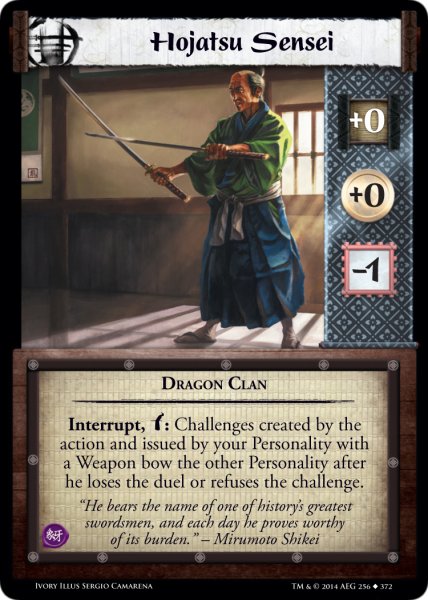
- Card Type
- Sensei
- Province Strength
- +0
- Gold Production
- +0
- Starting Family Honor
- -1
- Keywords
- Dragon Clan
- Card Text
- Interrupt, w: Challenges created by the action and issued by your Personality with a Weapon bow the other Personality after he loses the duel or refuses the challenge.
- Legality
- A Brother's Destiny (Ivory Edition)
- Deck
- Pre-Game
Printings
Ivory Edition
- Rarity
- Uncommon
- Flavor Text
- "He bears the name of one of history's greatest swordsmen, and each day he proves worthy of its burden." - Mirumoto Shikei
- Artist
- Sergio Camarena
- Card Number
- 256
- Publisher
- Alderac Entertainment Group
Promotional–Ivory
- Rarity
- Promo
- Flavor Text
- "He bears the name of one of history's greatest swordsmen, and each day he proves worthy of its burden." - Mirumoto Shikei
- Artist
- Sergio Camarena
- Publisher
- Alderac Entertainment Group
Rules Q&A
- Q: Please could you tell me: 1) Do you need to be winning the duel to "choose to lose" it? Or can you be losing, and still "choose to lose"? 2) The phrase "consequences of losing": does this include all consequences? eg: my opponent used Hojatsu Sensei on me and I lost the duel: is the bowing effect also negated, as well as the other consequences of losing the duel? 3) If an effect states that it happens if you win (eg: Kokujin, and you choose to take control of the other personality) then is this still an effect of losing, since it affects the loser in some way? 4) Can you choose to rehonor 1 personality, and take 1 attachment back to your hand? 5) If taking 2 attachments back to your hand, is the total cost 4 or 6? Many thanks. Sorry for all the questions, but most of these came up in game play, leading to... a spirited dispute...
A: 1) Do you need to be winning the duel to "choose to lose" it? Or can you be losing, and still "choose to lose"? You may always make the choice; it need not have any effect.
2) The phrase "consequences of losing": does this include all consequences? eg: my opponent used Hojatsu Sensei on me and I lost the duel: is the bowing effect also negated, as well as the other consequences of losing the duel? Anything which is dependent on the outcome of the duel is a consequence of the duel.
Note that this does not include effects which are dependent on the consequences, so that an effect triggered by a Personality dying as a consequence of a duel is not itself a consequence of the duel.
3) If an effect states that it happens if you win (eg: Kokujin, and you choose to take control of the other personality) then is this still an effect of losing, since it affects the loser in some way? Consequences of winning which are applied to the loser are consequences of winning, not consequences of losing,
4) Can you choose to rehonor 1 personality, and take 1 attachment back to your hand? No. See here and here.
5) If taking 2 attachments back to your hand, is the total cost 4 or 6? 4, as described above. Alex Jones, "Spirited Dispute", 6 Aug 2014 - Q: I'm a bit fuzzy on the power of Hojatsu Sensei because of the plurality.
Interrupt, w: Challenges created by the action and issued by your Personality with a Weapon bow the other Personality after he loses the duel or refuses the challenge.
Do I target a Personality when he issues a duel and then any time he issues a duel that turn it will have the added effect of the bowing? Or is it a one off? The part where it says Challenges (plural) makes me wonder.
---
Into the Wastes (Event) Timing question' Engage: You have the first opportunity in this battle to pass or take a Battle action, which must come from a card in a unit.
If my opponent is attacking me and I have this event ready to go but then he uses sneak attack. If I then pop it does my action take precedence over his since I acted last? Also while I'm here Defender always acts first by default correct? Even in engage. (This is no doubt in the rulebook somewhere)
---
Kata's
I couldn't find them in the rule book. Do they stay in play the rest of the game until I replace them?
A: Interrupts are only taken to interrupt another action, and (generally) all effects of an Interrupt will refer only to that action: Hojatsu Sensei only effects challenges created by the action it interrupts. Note that it doesn't require you to target anyone, it just checks whether the Personality issuing such a challenge has a weapon. Note also that an action can create more than one challenge, for example Heroic Sacrifice.
If more than one Engage action attempts to change who gets the first opportunity to act in the Combat Segment, only the last such effect will be applied. Your Into the Wastes will trump your opponent's earlier Sneak Attack - although he could play another Sneak Attack and regain the first opportunity.
As described on p8 of the Reference Rules, the Defender has the first opportunity to act in the Engage Segment.
Katas have no special rules. Cards which enter play generally stay in play until some effect removes them from play. The only rulebook effect which does this is the "Discard Terrains" step at the end of a battle, where Strategy cards (Terrains and, in Legacy, Formations) in play at the battlefield at discarded. Katas, however, enter play in your home, so they are not affected. Alex Jones, "Hojatsu Sensei, Into the Wastes, and Kata?", 17 Mar 2014