Hidden Strength
Legend of the Five Rings card from Twenty Festivals, Promotional–Twenty Festivals
Open in Oracle of the Void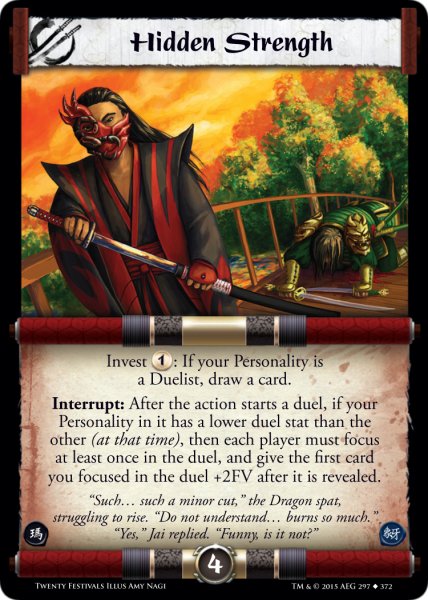
- Card Type
- Strategy
- Gold Cost
- 0
- Card Text
- Invest
 : If your Personality is a Duelist, draw a card.
Interrupt: After the action starts a duel, if your Personality in it has a lower duel stat than the other (at that time), then each player must focus at least once in the duel, and give the first card you focused in the duel +2FV after it is revealed. - Focus Value
- 4
- Legality
- A Brother's Destiny (Twenty Festivals), War of the Seals (Onyx Edition)
- Deck
- Fate
Printings
Twenty Festivals
- Rarity
- Uncommon
- Flavor Text
- "Such… such a minor cut," the Dragon spat,
struggling to rise. "Do not understand… burns so much."
"Yes," Jai replied. "Funny, is it not?" - Artist
- Amy Nagi
- Card Number
- 297
- Publisher
- Alderac Entertainment Group
Promotional–Twenty Festivals
- Rarity
- Promo
- Flavor Text
- "Such… such a minor cut," the Dragon spat,
struggling to rise. "Do not understand… burns so much."
"Yes," Jai replied. "Funny, is it not?" - Artist
- Amy Nagi
- Publisher
- Alderac Entertainment Group
Rules Q&A
- Q: Suppose I take an action that creates a duel, in which my Personality is a Duelist whose duel stat is not lower than the other Personality's. Can I use the Interrupt on Hidden Strength, pay the Invest, not get any of the Focus-related effects, and still draw a card at the end from the Invest?
EDIT: And an additional question - if I play a card such as Stand or Run, with a challenge that may be refused, when do I play Hidden Strength? Am I required to do so before my opponent chooses whether to accept the challenge? If so, am I correct in thinking that I would not draw the card from the Invest if they then refused the challenge?
EDIT 2: And a final question, I hope - if I create a duel in which my personality has a lower duel stat and play Hidden Strength, my opponent and I both Focus, and then my opponent plays Smoke and Mirrors, is the bonus +2FV from Hidden Strength then lost with the discarded focused card?
A: An "if" in an action's effects only indicate that the condition following the "if" must be true for the action to be announced, if that "if" starts the ability's text. See the Good Faith Rule, item 3.
For example, the "If" in the ability on Hidden Storehouse of House Rafiq begins the text, so if you will not have fewer cards in hand after playing it, you may not declare the action. On the other hand, Hidden Strength's text begins with "After", so you may play it to Interrupt any action.
However, the Invest trait's phrase, "your Personality", relates only to the Personality who is "your Personality" in the duel. If the action does not create a duel - for example, if there is no challenge, or the challenge is refused - the phrase "your Personality" has no meaning, so the Invest trait fails to create an effect. On the other hand, if a duel is created, the phrase has meaning, so the Invest trait will draw you a card if your Personality is a Duelist, regardless of the relative Chi stats.
You must play Hidden Strength in the action's Interrupt Action Round, which, as step D of the Action Sequence, comes before step E, the Effects step, which is when the challenge occurs, and is accepted or refused.
The first card focused gets the bonus. If it is discarded by Smoke and Mirrors, it gets the +2FV when it is turned face-up. Alex Jones, "Hidden Strength (20F)", 30 Mar 2015 - Q: Based on the previous answer, I would like some additional information on the Invest trait on Hidden Strength. More specifically, to whom does the "If your personality is a Duelist, draw a card." refer to?
Considering I can use Hidden Strength to Interrupt a random action, what happens in the following situations:
- I control a Duelist personality. I announce a Lobby action, targeting my Duelist, and Interrupt the action with Hidden Strength, paying its Invest cost. Do I draw a card?
- I control a Duelist personality. I announce a Lobby action, targeting another non-Duelist personality, and Interrupt the action with Hidden Strength, paying its Invest cost. Do I draw a card?
- I control a Duelist personality. I announce a Recruit Dynasty action, targeting a non-Duelist personality, and Interrupt the action with Hidden Strength, paying its Invest cost. Do I draw a card?
- I control no personality. I announce a Recruit Dynasty action, targeting a Duelist personality, and Interrupt the action with Hidden Strength, paying its Invest cost. Do I draw a card?
A: Ah, I totally missed the way the two effects were linked. Good catch! The Invest in this case modifies the additional effect, rather than creating a distinct one, due to the linking of "Your Personality". I'll modify my answers to the original question to match. Thanks! Jon Palmer, "Hidden Strength (20F)", 27 Mar 2015 - Q: 1) If I pay the Invest cost of Hidden Strength, does its text become "After the action starts a duel, if your Personality [...] after it is revealed. If your Personality is a Duelist, draw a card."?
If that is the case, would this mean that the Invest trait
?
If that is not the case, how would the text in Hidden Strength read? Could you give me an example of an Invest trait that creates a distinct effect and one that merely modifies an action?
Corollary 1: provided I pay the Invest cost, at which point do I get to draw a card? When Hidden Strength resolves? When the action starts the challenge?
Corollary 2: based on my reading of the 20F CR - Interrupt section, I can play Hidden Strength during the Interrupt step of any action (let's say, Lobbying). Hidden Strength then creates its delayed effects that will occur "After the action creates a challenge", which here means never.
However, if the Invested Hidden Strength reads as written in 1), to which personality does "If your personality is a Duelist, draw a card." refer to?
A: Changing per the other link. "Your Personality" means the Invest effect is modifying the original action. You would draw the card at the end of the resolution of the triggered effects, which are triggered by "After the action starts a duel".
An example of an independent effect on an Interrupt would be if it simply said "Invest 1: Draw a card". Jon Palmer, "Hidden Strength (20F)", 27 Mar 2015