Civility
Legend of the Five Rings card from The Harbinger
Open in Oracle of the Void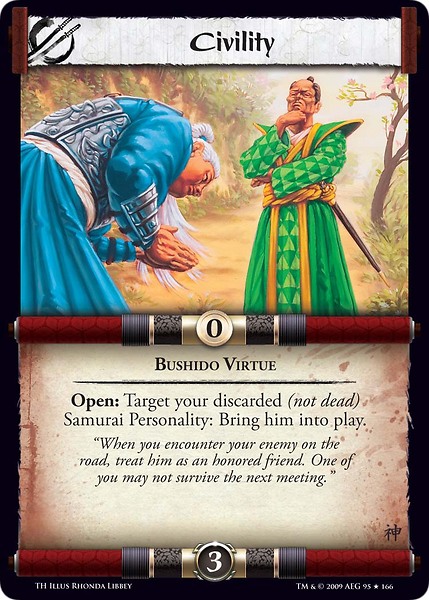
- Card Type
- Strategy
- Gold Cost
- 0
- Keywords
- Bushido Virtue
- Card Text
- Open,
 : Recruit your target performing discarded (not dead) Samurai Personality.
- Focus Value
- 3
- Legality
- Destroyer War (Celestial)
- Deck
- Fate
Printings
The Harbinger
- Rarity
- Rare
- Flavor Text
- "When you encounter your enemy on the road, treat him as an honored friend. One of you may not survive the next meeting."
- Artist
- Rhonda Libbey
- Card Number
- 95
- Publisher
- Alderac Entertainment Group
Rules Q&A
- Q: Does this constitute a reversal of past rulings that pretty much everything that retrieves cards from the discard constitutes a search? See Civility, for example.
A: Yes, after much discussion and consideration behind the scenes, we have decided to reverse any previous standings upon Otomo Sensei.
The ruling above is the most current and stands as-is. Brook Cunningham, "Otomo Sensei v. discard play", 3 Nov 2013 - Q: Followup question regarding this:
viewtopic.php?f=59&t=102625
With the new wording on Otomo Sensei
Not affecting Temple of Death
How will it Interact with Civility?
Civility:
Keywords
Bushido Virtue Text
Open: Choose your performing discarded (not dead) Samurai Personality: Bring him into play, paying all costs.
Otomo Sensei:
Keywords
All Clans Text
Before one of your cards enters either of your discard piles: Remove it from the game instead. Reaction: Any number of times per turn, before a player removes a searched-for card from his deck or discard pile, remove a card in your hand from the game: Remove the searched-for card from the game.
So will Otomo Sensei prevent me from playing a discarded personality? with the new wording i think not...
Thanks in advance!
A: Choosing one of your cards in your discard pile still fits the definition of "searching".
The change was that Temple of Death did not "get" the card (per the original vague wording of Otomo Sensei).
By attempting to put the Personality into play via Civility, you are most assuredly "get"ting it (or, as the Oracle wording now goes, "removing" it from your deck or discard pile).
Therefore, Otomo Sensei's Reaction CAN stop Civility. Brook Cunningham, "Otomo Sensei Vs. Civility", 19 Apr 2013 - Q: (I)f you use Civility to bring in Samurai X into play, can you use the reaction on Aramasu's vigilance to pay for the Samurai's gold cost(?)
A: No.
http://rules.l5r.com/CE_Costs_and_restr ... tory_costs: "The mandatory cost of an action is found in the constraints block."
If it's not there, it's a cost, but it's not a cost of the action. Zen Faulkes, "Civililty and Aramasu's Vigiliance", 26 Jan 2011 - Q: Daidoji Botan Limited: If a province has been destroyed since your last turn began: Gain 2 Honor.
I am curious as to when card memory begin. The only referenced rule I could find in the Comprehensive Rules was card memory ended once a card was both face-down and out of play. I would surmise that the opposite would hold true, that card memory begins once a card turns face-up. But does whether or not a card is in play impact its card memory status? In cases of cards in discard piles, cards retain memory as long as it stays face-up, actions taken previously in a turn can not be used again if a card is returned to play in the same turn. So does card memory begin even if a card is face-up and not in play or at some other point?
Specifically does Daidoji Botan track if a province has been destroyed since your last turn began even when he is not in play? In addition, would face-up or face-down status have an impact in this case.
First Example:
On your turn you discard a Daidoji Botan during your Dynasty Phase. On your Opponent's following turn, he destroys one of your provinces. On your subsequent turn you play Civility and bring the discarded Daidoji Botan into play. Is it legal to take his printed action? Daidoji Botan was "not" in play but was face-up in your discard pile when your province was destroyed on your opponent's turn after your last turn begun.
refenced card: Civility Open: Target your discarded (not dead) Samurai Personality: Bring him into play.
Second Example:
Your opponent destroys your province on his turn with a face-down card, the discarded card in your province is Daidoji Botan. On your subsequent turn your play Civility and bring that discarded Daidoji Botan into play. Is it legal to take his printed action? Daidoji Botan was "not" in play nor was he face-up in your discard pile at the time your province was destroyed, he was turned face-up as part of the resolution of the destruction of your province during your opponents turn after your last turn begun.
Third Example:
On your turn you reveal a Daidoji Botan in one of your provinces. You declare an attack on your opponent and destroy one of his provinces. During your Dynasty Phase you buy the revealed Daidoji Botan. Your opponent does not attack nor are any provinces destroyed on his turn. On your following turn, is it legal to take Daidoji Botan's printed action? Daidoji Botan was "not" in play but was face-up in a province at the time you destroyed a province since your last turn begun.
Similar question with a different card:
Asako Juro exp Battle: Destroy a target card opposing Juro controlled by a player who has taken a Maho action this game.
Would Asako Juro exp "remember" a player as having taken a Maho action this game prior to entering play?
Thank you for taking the time to answer.
A: In all Botan cases above, and in the case of Juro, they would be able to use their abilities.
"Card Memory", or a lack thereof, doesn't apply to the entire game state. It only applies to the card itself.
Tracking rule (emphasis mine): "“Memory” of the status of individual cards ends when the card enters a deck or a hand, or otherwise becomes both face-down and out of play (such as after a card in the deck or hand is shown). This includes dishonorable status, ongoing effects, and whether or not an ability has been used."
The Tracking rule exists to remove any obligation to track the status of a card, when it may potentially become mingled with two other identical copies of itself. It actually needn't apply to Unique cards, but we have it do so for consistency. Brook Cunningham, "Card Memory regarding Daidoji Botan", 19 Apr 2010