Counterattack
Legend of the Five Rings card from Gold Edition, Pre-Imperial Edition, Imperial Edition, Emerald Edition, Obsidian Edition, Jade Edition, Pearl Edition, Celestial Edition 15th Anniversary, Soul of the Empire, The War of Spirits, The Fall of Otosan Uchi, Broken Blades, Dark Allies, An Oni's Fury
Open in Oracle of the Void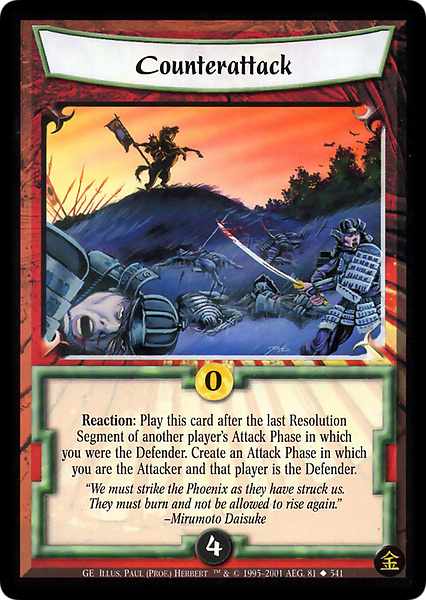
- Card Type
- Strategy
- Gold Cost
- 0
- Card Text
- Reaction: After the end of an Attack Phase in which you were the Defender: Declare an additional Attack Phase with that phase's Attacker as the Defender.
- Focus Value
- 4
- Legality
- Clan Wars (Imperial), Four Winds (Gold), Hidden Emperor (Jade)
- Deck
- Fate
Printings
Gold Edition
- Rarity
- Uncommon
- Flavor Text
- "We must strike the Phoenix as they have struck us. They must burn and not be allowed to rise again." - Mirumoto Daisuke
- Artist
- Paul (Prof.) Herbert
- Card Number
- 81
- Publisher
- Wizards of the Coast
Pre-Imperial Edition
- Rarity
- Fixed
- Artist
- Matt Busch
- Publisher
- Five Rings Publishing Group
Imperial Edition
- Rarity
- Uncommon
- Artist
- Matt Busch
- Publisher
- Five Rings Publishing Group
Emerald Edition
- Rarity
- Uncommon
- Flavor Text
- A strong man will try to be stronger than a blow. A wise man will learn to sidestep it. - Isawa Tomo
- Artist
- Matt Busch
- Publisher
- Five Rings Publishing Group
Obsidian Edition
- Rarity
- Uncommon
- Flavor Text
- A strong man will try to be stronger than a blow. A wise man will learn to sidestep it. - Isawa Tomo
- Artist
- Matt Busch
- Publisher
- Five Rings Publishing Group
Jade Edition
- Rarity
- Uncommon
- Artist
- Matt Busch
- Publisher
- Wizards of the Coast
Pearl Edition
- Rarity
- Uncommon
- Artist
- Matt Busch
- Publisher
- Wizards of the Coast
Celestial Edition 15th Anniversary
- Rarity
- Promo
- Flavor Text
- "Our losses are great. We must not falter. We are the last line of defense for the Empire now." - Shinjo Dun
- Artist
- Matt Busch
- Card Number
- 74
- Publisher
- Alderac Entertainment Group
Soul of the Empire
- Rarity
- Starter
- Artist
- Paul (Prof.) Herbert
- Publisher
- Wizards of the Coast
The War of Spirits
- Rarity
- Starter
- Flavor Text
- The Unicorn abandoned Shiro Iuchi so their forces could push Hantei's main force into Beiden Pass.
- Artist
- Paul (Prof.) Herbert
- Publisher
- Wizards of the Coast
The Fall of Otosan Uchi
- Rarity
- Starter
- Flavor Text
- "We must strike the Phoenix as they have struck us. They must burn and not be allowed to rise again." - Mirumoto Daisuke
- Artist
- Paul (Prof.) Herbert
- Publisher
- Alderac Entertainment Group
Broken Blades
- Rarity
- Starter
- Flavor Text
- "Let us tear the Tamori's wall aside like rice paper and show the Dragon who the true masters of magic are." - Isawa Ihara
- Artist
- Paul (Prof.) Herbert
- Publisher
- Alderac Entertainment Group
Dark Allies
- Rarity
- Starter
- Flavor Text
- "Let us tear the Tamori's wall aside like rice paper and show the Dragon who the true masters of magic are." - Isawa Ihara
- Artist
- Paul (Prof.) Herbert
- Publisher
- Alderac Entertainment Group
An Oni's Fury
- Rarity
- Starter
- Flavor Text
- The Phoenix armies retreated in the wake of the Masters' disappearance. The Dragon pursued, eager to put this war to an end.
- Artist
- Paul (Prof.) Herbert
- Publisher
- Alderac Entertainment Group
Rulings
- Erratum: Reads, "Counterattack 0G 4FV Reaction: Play this card after an Attack Phase in which another player was the Attacker and you were the Defender. Create an Attack Phase in which you are the Attacker and that player is the Defender." [MRP, The Fall of Otosan Uchi, 9 December 2002] Rules Archive, August 18, 2007, p. 11
- Cannot be played in response to Fu Leng's Horde, because there is no attacker. [JA, 14 September 2000] Rules Archive, August 18, 2007, p. 11
- Does not change who is the active player. [Card text, ZF, 11 July 2001] Rules Archive, August 18, 2007, p. 11
- Erratum: Counterattack is now played after the entire Attack Phase, not immediately after the last battle of one. It will always be played after Reactions to the end of one battle, such as Rallying Cry. [MRP] Legend of the Five Rings FAQ, May 21, 2003, p. 14
- Will nearly always be played after Rallying Cry. If it's not the very last battle to be resolved, RC clearly goes "first" because Counterattack can't be played at all. If it is, the general rule when two reactions to a game event have the same timing is to give the first reaction to the active player, which will typically be the Attacker (unless the Attack Phase that just happened was, itself, the result of an earlier Counterattack). [DW, netnews, 3/22/96] Accumulated Rulings, February 8, 2000, p. 21
- May be played after an Ambush. [RD, l5rinfo, 2/17/97] Accumulated Rulings, February 8, 2000, p. 21
- Multiples may be played as reactions to the same attack. [general rule on multiple reactions] Accumulated Rulings, February 8, 2000, p. 21
- Will always be played after Rallying Cry. The general rule is that whenever more than one player wants to act at the same time, start with the active player and go clockwise. So, the attacker will always have the first chance to play a reaction to the end of the last battle or of the Attack Phase. [DW, netnews, 3/22/96] (Note that this same logic means that the opposite is true if the original attacker Counterattacks after his opponent Counterattacks -- his Counterattack will go before the original defender's Rallying Cry.) May be played after an Ambush. [RD, l5rinfo, 2/17/97] Accumulated Rulings, April 22, 1998, p. 11
- Q: Hey. While we're talking about multiple Reactions... Can I Counterattack twice against the same attack? A: Yes. It's hard to visualize at first, since Counterattack takes so long to do what it does, but once the whole extra Counterattack-created Attack Phase is over, you're back to where you started: an attack against you has just finished, you took the opportunity to react, and now the player to your left gets one chance to react, and so on, in turn order, until all of you decline to react in succession. Until that happens, all Reactions taken "after an Attack Phase in which another player was the Attacker and you were the Defender" are still legal -- including another Counterattack. Legend of the Five Rings FAQ, May 21, 2003, p. 8
- Q: So if my opponent plays Deadly Ground and wins the battle, I can't use my Crane Poets to gain honor from my Personalities dying? What about Final Breath? Or Counterattack? A: Deadly Ground (and sometimes Night Battle) prohibits actions "for this battle", which means it lasts through the entire Resolution Segment since that's still part of the battle. And it prohibits a// actions, including Reactions, that do something besides destroy it. This means you can't react to the destruction of cards on the losing side. Reactions that get played "after resolution", such as Counterattack and, by the errata in past rulebooks, Final Breath, are still legal. Legend of the Five Rings FAQ, Version 3.6.2, May 1998, p. 9
- Q: You mean if, say, I'm defending, and I play Dispersive Terrain to give every Personality in my army +2F, and then I play Counterattack and attack my opponent back on that same turn, I still have +2F on everyone? A: Exactly. Legend of the Five Rings FAQ, Version 3.6.2, May 1998, p. 17
Rules Q&A
- Q: 2) Reactions to end of the end of Raid attack such as Retribution and Counterattack, do they trigger another set up Raid Attacks or are they treated as normal attacks where provinces and armies can be destroyed during resolution?
A: There are no text on Retribution making battles into Raid Battles. They are regular battles with their own distinct Attack Phase. Martin Lund, "Rules for 15 December 2004", 22 Dec 2004 - Q: I can see replacements for Rallying Cry (Spearhead) and Counterattack (Retribution), but there seems to be no substitute for Sup Tac. Any input?
A: There are no real replacements for any of those cards. Rallying Cry let you attack with any size of Army with no cost to your ability to defend due to bowing. Spearhead doesn't come close. Counterattack let you smash your entire army into the face of anyone foolish enough to attack you. Retribution doesn't come close. They were all removed because their effects were too powerful and environmentally deforming, near as I can tell.
Similar concepts, but it is kind of like comparing an apple to an apple tree. Martin Lund, "Rules for 29 August 2004", 2 Sep 2004 - Q: 2. How many times can you Retirbution/Counterattack when you've been attacked? Someone said if you had three copies of either in your hand at the time, you can do it three times.
A: You can keep playing Reactions to that trigger until each player consecutively passes. The means each time you finish resolving a Counter Attack or a Retribution, you're left with the original window for playing Reactions. You could conceivably play 3 Counter Attacks and 3 Retributions one at a time in response to the same Attack. Good luck having enough unbowed units to make those all useful, though. Martin Lund, "Rules for 20 April 2004", 22 Apr 2004 - Q: But the diference is that Counterattack isn't in play all the time. This card is.
A: Sorry, you're drawing a distinction that does not exist in the rules. Zen Faulkes, "Rules for 16 April 2003, Part 1", 16 Apr 2003 - Q: As it was my understanding that when a Reaction resolves, it resolves to the moment just before the Reaction was played. Thusly, the second Counterattack had been legal. However, according to my friend, one cannot play an identical Reaction after the resolution of one.
A: One cannot use the same INSTANCE of a Reaction more than once in response to the same trigger. However, two Reactions on two different cards -- even identical cards -- is allowed, because that's still two different instances. Jeff Alexander, "post for 21 February 2003", 22 Feb 2003 - Q: Can a defensive ally play a Counterattack?
A: The MRP says you have to be the Defender. Allies aren't the Defender. Jeff Alexander, "post for 18 December 2002", 19 Dec 2002 - Q: Okay, after this past weekend when I was rudely introduced to the Counterattack, Rally, Counterattack combo I started thinking. Is this possible with any other evil react combos? Could I Pick your battles twice with a Yu deck litterally knocking off an entire army while also To the Last Man-ing it?
A: Pick Your Battles has no effect on how many cards the Yu trait can destroy. Also, playing multiple Pick Your Battles in one battle is no different than playing only one, regardless of whether Yu is involved.
Playing multiple copies of To the Last Man is legal and will force two separate destructions. It's potentially very nasty, especially if your opponent has to destroy extra Force because he can't match the required amount exactly. Jeff Alexander, "post for 26 November 2002", 27 Nov 2002 - Q: Can counterattack be played as follows..
Player A attacks player B.
Player B allows the attack to come through and then Counterattacks. Player B plays Rally Cry. Player A does NOT play a Counterattack in response. Can player B play a SECOND counterattack using the same trigger as the 1st counterattack?
A: Yes. [GE p. 48] Note that Player B's Rallying Cry has absolutely no bearing on whether his second Counterattack is legal -- it only makes it more effective. Jeff Alexander, "post for 24 October 2002", 25 Oct 2002 - Q: I know that Ambush doesn't replace your Attack Phase of the turn, but does it count as an Attack Phase? In other words, if my opponent Ambushes one of my personalities, can I Counterattack?
A: Yes and yes. Jeff Alexander, "post for 23 October 2002", 24 Oct 2002 - Q: Assume The Path Not Taken's been used to copy Counterattack, by a Shiba player. Can the same physical CounterPath be played, recycled, and played again in reaction to the same attack?
A: No. Jeff Alexander, "post for 19 September 2002", 20 Sep 2002 - Q: The second Counterattack is not the same printed Reaction. It can't be -- it's on a different card. Multiple identically-worded Reactions ARE legal, provided they come from different cards.
Does that go for the following, if I cancel it can they do it again?
The Dark Path of Shadow Faction Ninja Text Your non-Personality Ninja cards enter play for 2 less Gold. You cannot lose Honor from opponents' card effects or your Ninja cards. Battle: If the total Chi of an army attacking one of your Provinces is less than 10, send all attackers home, bowed. You can do this while this Stronghold is bowed and in a battle in which you cannot perform actions. Honor 0 Gold 3 Provence Strength 0
A: The rule against using a printed action multiple times on the same trigger applies only to Reactions. The Dark Path of Shadow is worded so that you can use it every single time you get a chance to take an Open or Battle action (or pass).
Also, if since it's a Battle action, you get only one attempt at a time. If it's canceled, you don't get an immediate retry -- you have to wait until the turn order passes around to you again, giving everyone else a chance to take a Battle or Open action in the meantime. Jeff Alexander, "post for 19 September 2002", 20 Sep 2002 - Q: Counterattack has me confused. When is the right time to use it.
A: After the entire Attack Phase is over, by the Most Recent Printing. Jeff Alexander, "post for 6 August 2002", 6 Aug 2002 - Q: <snipedy snip> other player will have the opportunity to react, but when it'll be your turn to react again (remember the reactions sequence only end when ALL the players have passed in a row) you'll be able to play a second Counterattack.
Except you will not, as you are allowed to play each printed instance of a reaction once per trigger, and you already played Counterattack (as I think I mentioned in my first post). As can be seen in the rulebook (DA, page 48)
A: The second Counterattack is not the same printed Reaction. It can't be -- it's on a different card. Multiple identically-worded Reactions ARE legal, provided they come from different cards. Jeff Alexander, "post for 5 August 2002", 6 Aug 2002 - Q: Does this mean you can only play 1 Counterattack after an attack phase?
A: Two different Counterattacks is two different printed Reactions -- one printing on the first card, one printing on the second. You can still play two. Jeff Alexander, "post for 30 July 2002", 31 Jul 2002 - Q: 3) The Counterattack versus Rallying Cry question came up again. If the last battle is being resolved, can the Defender play Counterattack before the Attacker can play Rallying Cry? I thought it was ruled as a yes once before, but then in the last major tournament I was in the TO said it got reversed so I ruled the reversal last night. Was I wrong?
A: Counterattack was MRPed in An Oni's Fury so that it's played after the entire Attack Phase. Rallying Cry will always beat it now. The two no longer conflict. Jeff Alexander, "post for 10 June 2002", 11 Jun 2002 - Q: Unfortunately, this is not correct. Since there is only one end of a resolution segment to a battle in which you're being attacked, only one Counterattack can be played. By the time you'd play the second Counterattack, too many actions will have passed for you to react to the proper 'trigger'.
A: A trigger cannot become invalid because "too many actions have passed". If a Reaction does not negate, undo, or otherwise somehow invalidate the trigger as part of its costs or effects, taking it will not prevent subsequent reactions to that same trigger. It will still be there. Jeff Alexander, "post for 8 April 2002", 9 Apr 2002 - Q: I know this new way of working is probably more intuitive to most player, and this is probably why the change was made. Still, it would be nice if functional changes made by MRP were signaled in the corresponding rulebook
A: Take another look at page 80. Jeff Alexander, "post for 22 January 2002", 23 Jan 2002 - Q: Rules technicality. The whole mental problem with Ambush is kinda like the problem with Counterattack. Because there's an attack phase as one of the effects, people have a mental block about the immediacy of the effects. If there were an action that said 'Target one of your Samurai, draw a card, and lose 2 honor.' you'd have to commit Seppuku with your Samurai before you actually get to draw a card. It's the attack phase that makes this whole thing seem to not make sense. Replace it with another effect, and it doesn't seem so bad.
Actually, that's not the problem for me at all. The problem (of the few) I have is that when you use the effects on a card, you read it line by line and do the effects in the order.
A: That's irrelevant to the combo in question. The "read it line by line" rule applies when there is a timing issue that needs to be resolved. There's no timing issue here since seppuki is not done in response to the loss -- it's done in response to performing or getting targeted by a loss-causing action. And we know Ambush is a loss-causing action because one of its effects is "Lose 5 Honor." WHEN that loss happens doesn't matter. Jeff Alexander, "post for 29 October 2001", 30 Oct 2001 - Q: The way I understand how these cards work togehter / against eachother is as follows, can someone please correct any mistakes/confusions for me?
Player 1 (active) declares an attack vs. Player 2.
Player 1 sends enough force to take the province.
Player 2 does not defend.
Player 1 munches the province.
Player 2 gets to react to the end of the battle 1st and he plays Counterattack. (starting another attack phase)
A: Potential problem right there: Counterattack can only be played after the LAST battle in an Attack Phase. If the Province that just got crunched was not the last Province to have its battle resolved (and it usually isn't when there are no defenders anywhere), the Attacker can easily play Rallying Cry "first" because there is no Counterattack for it to conflict with. Jeff Alexander, "post for 5 October 2001", 6 Oct 2001 - Q: Player 1 can only play reacts to the Counterattack at this point, he has none so he passes.
Player 2 munches a province (ends his attack phase)
Player 2 passes (after battle reacts)
Player 1 passes (after battle reacts)
(we return to the end of Player 1's original attack phase)
Player 1 plays Rallying Cry.
Player 2 passes.
Player 1 passes.
Attack phase ends, go on to dynasty phase for Player 1.
I know this has been gone over and over, but my group is introducing the game to a few new people, and we 'old players' are in a disagreement as to how the carsd react with easchother.
A: Your example is a valid description of the way these cards interact under Gold Edition rules IF the Province with the rallying army gets resolved last. Jeff Alexander, "post for 5 October 2001", 6 Oct 2001 - Q: The Gold Edition rules (page 57) are a bit vague as to exactly when the battle ends, but implies that units return home AFTER the resolution segment. If this is so ruled, it clears up the retroactivity of Rallying Cry, but create serious problems with Counterattack. I would suggest adding an end of battle Segment, where (after reactions to the end of resolution if any) all cleanup occurs, and change Counterattack to take effect after the end of the Attack Phase.
A: I can see your interpretation, but that's a rather significant change, and I'll have to check upstairs to find out whether or not they want that to stick. As for adding a Cleanup segment...probably not. L5R is a complex enough game as it is, I really don't think we need to be making major changes to the foundation of the rules at this point. It might be something for the design team to keep in mind for the next major revision of the rules, but I wouldn't bet on it until then. Vaughn Derderian, "Rules for August 14th", 14 Aug 2001 - Q: What happens if Togashi Mitu with at least 1 Fire token is one of the attackers at the final battle of a battle phase, at which the defender plays Counterattack, and the attacker plays Rallying Cry?
A: The Archive entry for Mitsu is current, and correct. His bowing is prevented. Zen Faulkes, "Rules for 31 July 2001", 1 Aug 2001 - Q: (All the below scenarios will assume a player attacked his opponent with all of his unbowed personalities, against one province, and that province was the last battle to be resolved. The attacked player plays Counterattack following the last battle)
Is this correct? The player Counterattacking gets an opportunity to Rallying Cry off of his Counterattack before the player who made the initial attack does, since the Counterattacking players Rallying Cry is being played in response to the end of his Counterattack phase.
A: Correct! Zen Faulkes, "Rules for 30 July 2001, Part 2", 31 Jul 2001 - Q: Is this also correct? The player making the initial attack will not be able to Counterattack since his Rallying Cry will be played as a Reaction to his Attack phase, and if he is Reacting to his attack phase, he is no longer able to React to his opponents ounterattacking his provinces.
A: Just to be sure I cover all the bases here, let me rephrase that question in two ways.
1) Is it *legal* for the original Attacker to play the Counterattack? Yes. Counterattack has no requirement that you must have units you can send.
2) Will the Attacker's Counterattack accomplish anything? Probably not. As you note, the Attacker's Personalities will be bowed while the Counterattack is resolving. Zen Faulkes, "Rules for 30 July 2001, Part 2", 31 Jul 2001 - Q: So, basically, what this ruling has done is set up a Counterattack phase with in an attack phase, that can't be reacted to by a bowed out, initially attacking army. Is this all correct?
A: I don't want to put it in such strong terms. There are probably going to be exceptions because the original Attacker is going to have opportunities to respond to the original Defender's Counterattack.
By and large, however, yes -- it is going to be *extremely* difficult for an Attacker to deal with a Counterattack *if* all his or her attacking units were in the one Province. Zen Faulkes, "Rules for 30 July 2001, Part 2", 31 Jul 2001 - Q: Regarding the Counterattack/Rallying Cry ruling:
Last I saw, the reason that Counterattack was played before Rally on the last battle was because the active player got to react first. Doesn't that mean that if I'm attacking, I should get to play my reaction, Rallying Cry, before the defender can react, as I am the active player?
A: Wait just a second. It would be true that Rally beat Counterattack...if the active player got to React first. That's the old rules. Post-Gold, the player to the left of the active player gets first chance to React to a game state event. That's why Counterattack now beats Rally at the last battle *always*, whereas you used to need an attack/Rally/Counter situation to create the same sort of situation, where Counterattack got played before Rallying Cry. Vaughn Derderian, "Rules for July 30th", 30 Jul 2001 - Q: Checking the rules I've noticed that, after the last battle, Counterattack may be played before Rallying Cry. This means the attacker units are still unbowed!
A: You mean bowed, right? Yes, Counterattack is now played before Rallying Cry at the last battle. If the attacker chooses to resolve their battle last, they should be prepared for a really bad situation. Vaughn Derderian, "Rules for July 27th", 27 Jul 2001 - Q: Does this mean that the Attacking units in the last battle will always be unbowed against a Counterattack?
A: No, they'll be bowed. Resolve your battles first. Vaughn Derderian, "Rules for July 27th", 27 Jul 2001 - Q: Rallying Cry says that it prevents your personalities from bowing from the combat. They dont bow and then straighten. So I would say that if they play Counterattack before they bow from combat they are still straight and can defend against the CA.
A: Except that when Counterattack is played first, it must be resolved first. That's the way actions work in this game. So none of the units have been prevented from bowing yet. This is the way these two cards have always worked, by the way. It's just that now, CA may be played first more often. Jeff Alexander, "replies to 10-14 July 2001", 19 Jul 2001 - Q: The way I see it (which differs from the official rules) is that battles at provinces are contained within an overall attack phase. Since they are contained, the battle at the last province must end (with a chance to rally) BEFORE the overall attack phase ends (with a chance to Counterattack), even if nothing happens between the last battle and the end of the attack phase. See diagram:
|Battle 1| |Battle 2| |Battle 3| |Battle 4| | +--------+ +--------+ +--------+ +--------+ | +---------------------------------------------+ Attack Phase
I think this is easier to understand than making the end of the last battle and the end of the attack phase simultaneous. With this interpretation, timing issues on Rallying Cry / Counterattack would not come up.
A: Yes they would. The end of the last battle and the end of the Attack Phase are *not* simultaneous. Timing issues arise from the fact that Counterattack is a reaction to the end of the last battle and not to the end of the Phase. Since Rallying Cry is a reaction to the end of *a* battle, the two conflict when the battle in question is the last one. Jeff Alexander, "replies to 10-14 July 2001", 19 Jul 2001 - Q: I hate to put a stick in the hornets nest but the ruling with Counterattack and Rallying Cry is just awful. Everyone felt that intuitively it should not work that way except one.
A: Intuition doesn't exert a real strong pull in situations like this. Find a logical inconsitency and sing it out, and I'll be a very receptive audience. Zen Faulkes, "Rules for 12 July 2001", 13 Jul 2001 - Q: So I would say that if they play Counterattack before they bow from combat they are still straight and can defend against the CA.
A: Just one problem. That is not what the cards, rules, or rulings say. Here's the points to keep in mind.
1. The Gold Edition rulebook has bowing written in Resolution Segment. Rallying Cry is played *after* that segment. (Even if bowing was after the Resolution Segement, non-action effects still precede actions.) Therefore, units *always* bow before Rallying Cry can be played; you just normally don't "see" it.
2. By the timing rules, Counterattack *WILL* be played and resolve before Rallying Cry if there are no more battles to resolve. Zen Faulkes, "Rules for 12 July 2001", 13 Jul 2001 - Q: Counterattack: Will be played after Rallying Cry if there are more battles to resolve.
Zen there are never any more Battles to resolve when a Counterattack is played. As its trigger is the last resolution segment.
A: I know. I'm being redundant for purposes of clarity. Zen Faulkes, "Rules for 11 July 2001", 12 Jul 2001 - Q: Battle Actions: A resolves Province 4. Can play Rallying Cry. Resolution: B *can* play Counterattack here.
Since both parties want to play a reaction here, who gets to play first? By the quasi-official Gold rulebook, it seems that the opposing player -- i.e., the inactive player, B, gets to react first, then goes round the table (C, D, E, F, G...) and finally back to A again. If that's the case:
Battle Actions: A resolves Province 4. Can play Rallying Cry. Resolution: B *can* play Counterattack here. Reactions: B play Counterattack. Resolves Counterattack first. A plays Rallying Cry. Resolves Rallying Cry
That what you saying, Zen?
A: Just so. Zen Faulkes, "Rules for 11 July 2001", 12 Jul 2001 - Q: This means A's attacking army will take no part in the battles the Counterattack starts at all, correct?
A: Right. Zen Faulkes, "Rules for 11 July 2001", 12 Jul 2001 - Q: Let's take this a bit further. Assume B has a Rallying Cry here and for some reason wants to play it. And assume A has a Counterattack in hand too -- just to clarify something.
A: [snip] Zen Faulkes, "Rules for 11 July 2001", 12 Jul 2001 - Q: Battle Actions: B resolves Province 4. Can play Rallying Cry. Resolution: A *can* play Counterattack here. B plays Rallying Cry. Resolves Rallying Cry. A play Counterattack. Resolves Counterattack. [Resolves A's Counterattack; see below] A plays Rallying Cry. Resolves Rallying Cry
Is that correct? Because A is the active player here, so his reactions go *last* -- Counterattack doesn't change who's the active player, just who's attacking.
A: Exactly right. Zen Faulkes, "Rules for 11 July 2001", 12 Jul 2001 - Q: I tend to see this situation in a nested sense, as in:
A's attacks { [whatever happens here] B's 1st Counterattack { [whatever happens here] A's 1st Counterattack { [whatever happens here] B's 2nd Counterattack { [whatever happens here] } } } A's Rallying Cry }
From this point of view, A's Rally won't kick in until waaaay after the Counterattacks finishes. I would just like to ask if this is what is supposed to happen.
A: Yes, as far as I can tell. Zen Faulkes, "Rules for 11 July 2001", 12 Jul 2001 - Q: Anyway, another question is that if B throws down a Rallying Cry in reaction to his 1st Counterattack, when would it resolves? Before A's 1st Counterattack, as A is actually the "active" player?
A: Exactly this. Zen Faulkes, "Rules for 11 July 2001", 12 Jul 2001 - Q: Sorry, but this is a long response to question 2.
Counterattack can only happen once all battles have resolved, not after just one battle. Therefore, all battles with B attacking A would resolve, then a chance to rally, then a counterattack by B. This Counterattack is not complete until all battles have resolved at Player A's provinces, so if player A had another counterattack, he'd have to wait until player B was done killing him. Therefore, the question is answered by the fact that Counterattack demands you wait until all battles have resolved; end of story.
However, you COULD have this situation with Shiryo no Tsuko. Let's say Player A attacks B, then B wins a battle with Shiryo no Tsuko's personality. An attack phase begins for player B at player A. In this case you could use forced march before letting player A get on with the rest of his attack. But, what would happen if player A then counterattacked the Shiryo no Tsuko attack of player B? There are already battles going on! Would this attack phase take place, disregarding currently in-place battles in player A's original attack phase? Or would this allow the player to assign additional units to current battles?
A: It looks as though all players are free to reassign their units any way they like. Once the Counterattack battles are over, resume the original attack where you left off, with any surviving units back in the battles they were in when the whole series of reactions started. Don't straighten any bowed cards, either. Units can find themselves fighting battles at Provinces which no longer exist. Jeff Alexander, "Rulings for 8 February 2001", 14 Feb 2001 - Q: My opponent Attack resolves.. I Counterattack. After the Counterattack resolves, is it possible to use Tsuko Sensei?
A: Sure. Vaughn Derderian, "Rules for", 12 Jan 2001 - Q: 2.) Can a person play Counterattack, Rallying Cry, then another Counterattack against an attacker in the same turn? Yes.<< I assume you mean, yes, if the other player counterattacks back? I don't think it'd be legal for Player A to attack me, have me Counterattack him, Rally, and Counterattack him again. Counterattack requires that I be the one being attacked. I'm beginning to think this needs to be in the FAQ...
It's *in* the FAQ. Been there for at least three months, probably longer. I thought it had been there for years (I knew about it in 1997, when I started playing), but I checked and it wasn't there in a Sept 1998 copy of the FAQ that's still gathering dust on my hard drive.
A: It's in the Archive, not the FAQ. And, in the form that you copied from the Archive, it is explained, but not in the detail that many people require it to be. It is a very difficult concept for a lot of people to grasp, and even then lots of people disagree with some of the basic concepts. The Archive explains it in one sentence, and yet to fully explain the interaction of Rallying Cry and Counterattack, I'd have to use a page or two. The Archive can't (and shouldn't) do that, but the FAQ should.
Essentialy, I've only been working on this for a few months, and I've already had to answer that question two or three times. The answer needs to be written down somewhere, and explained fully. That's the FAQ's job. Vaughn Derderian, "Rules for December 11th", 11 Dec 2000 - Q: Under Pearl Edition rules; can a player Counterattack after being Counterattacked?
A: Yes. Brook Cunningham, "Sun and Moon #rules-questions", 21 Jan 2024