Coward!
Legend of the Five Rings card from Khan's Defiance, Ivory Edition
Open in Oracle of the Void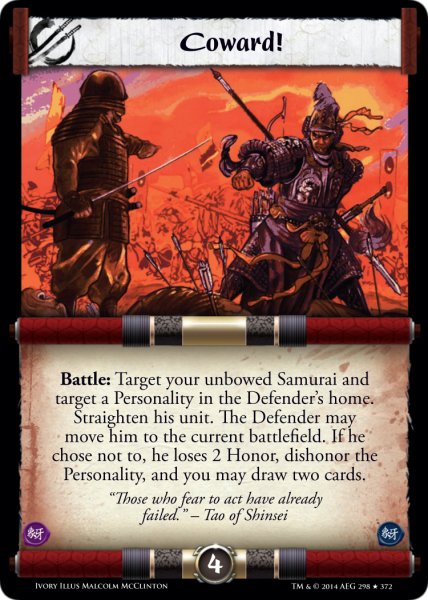
- Card Type
- Strategy
- Gold Cost
- 0
- Card Text
- Battle: Target your unbowed Samurai and target a Personality in the Defender's home. Straighten his unit. The Defender may move him to the current battlefield. If he chose not to, he loses 2 Honor, dishonor the Personality, and you may draw two cards.
- Focus Value
- 4
- Legality
- A Brother's Destiny (Ivory Edition), A Brother's Destiny (Twenty Festivals), Age of Enlightenment (Lotus), Race for the Throne (Samurai)
- Deck
- Fate
Printings
Khan's Defiance
- Rarity
- Rare
- Flavor Text
- "Not while I live, dog!"
- Artist
- Malcolm McClinton
- Card Number
- 121
- Publisher
- Alderac Entertainment Group
Ivory Edition
- Rarity
- Rare
- Flavor Text
- "Those who fear to act have already failed." - Tao of Shinsei
- Artist
- Malcolm McClinton
- Card Number
- 298
- Publisher
- Alderac Entertainment Group
Rules Q&A
- Q: e.g.
I think this means that Final Sacrifice can only target a unit at the current battle. So if Isawa X and Shiba Y are at home, and Shiba Z is defending, and the attacker plays Determined Challenge on Isawa X, Final Sacrifice can only target Shiba Z (a legal, if useless target for Determined Challenge) but could not target Shiba Y to cause him to be moved into the battle. Correct?
And therefore,
While nothing stops you playing Final Sacrifice in response to Coward, it will never do anything, since Coward can only target units at home and Final Sacrifice can only target units at the current battlefield. Correct?
A: The Yojimbo is targeted by Final Sacrifice, so - if played during a battle - he must be at the current battlefield. This means he is not a legal target for actions which only target cards in your home, so the redirection will fail.
However, if the action being Interrupted targets a card "at any location", then the Yojimbo is a valid target, and the redirection will work. Alex Jones, "Final Sacrifice vs targets 'at any location'", 19 May 2015 - Q: Assume P'an Ku takes control of a personality using his ability. The personality's owner, during the course of a battle opposing the personality taken by P'an Ku, plays Coward! and targets P'an Ku, which straightens P'an Ku. The personality P'an Ku took control of goes back under the owner's control.
Does that personality return to the owner's control in the owner's home or at that battlefield?
A: Per the CR, if a Personality changes control while at a battlefield, it goes into its new controller's army at that battlefield. Jon Palmer, "P'an Ku losing control of personality", 25 Jun 2014 - Q: What effect does Coward! have if you target Doji Katata with it?
A: Katata's trait prevents him from moving or assigning to attack.
Should you target him with Coward!, his controller could choose to move him to the current battlefield, have the movement effect prevented and fail due to Katata's trait, and then when Coward! checks to see what his controller CHOSE (it doesn't check what actually happened), then no further effects would occur. Brook Cunningham, "Coward! + Doji Katata", 12 Jan 2014 - Q: The new text on Coward! is worded slightly different than the original printing. It says the defender MAY move them, but the penalty effect hinges on the Defender CHOOSING not to move them, whereas the original made it explicit (The Defender may choose to move it to the current battlefield; if he did not...). Is there any functional difference between the two wordings with regards to a personality who will not move into a defending army? In the original printing it was very clear that the defender could choose to move them, have it fail, and not trigger the penalty. I'm not as sure with the new wording.
Thank you
A: Coward! works the same way now as it did then.
The new wording of "may" implies a choice needs to be made, and the penalties (or lack there of) are dependent upon that choice and not the successful/unsuccessful movement of the targeted Personality. Ben Higgins, "Coward!", 8 Jan 2014 - Q: Seppuku reaction says: Reaction: Any number of times per turn, before you lose Honor from an action that targeted or was performed by one of your Courtier or Samurai Personalities: He commits seppuku. If the seppuku destroyed him, reduce the Honor loss to one.
Assuming the action in question was performed by two samurai or courtiers, or was performed by one and targeted another (eg Coward! being played on defense and choosing not to move), would it be legal to commit seppuku with both personalities (That is, two seppukus)?
A: Yes, you may.
After the first seppuku, you're still at the timepoint where you can react to "Before you lose Honor" and the trigger of you losing Honor still exists.
This is assuming your opponent does nothing to invalidate the trigger at his opportunity to react to "Before" you "lose Honor" that occurs between your first Seppuku reaction and your second.
EDIT: [This ruling is incorrect. See here.] Brook Cunningham, "Several seppukus for a single action", 1 Dec 2008 - Q: Hi, I'm a (relatively) new player, trying to get to grips with presence, location and how things work/when they can be played. Specifically this is in relation to Coward.
For reference: Rule of location: The Rule of Location: If a Battle action is on a card in a unit (a Personality or attachment in play), the unit must be at the current battlefield; and any cards in units must be at the current battlefield to be legally targeted by a Battle action.
EXCEPTION: A Battle Action can target or be taken by a card in a unit at another location if its costs or effects say they move the unit to the current battlefield. Choices within the action must then be taken, if possible, such that they do move the unit there.
Coward: Battle: Target one of your unbowed Samurai at the current battlefield: Target one of the Defender's units in his home. Straighten it. The Defender may move it to the current battlefield. If he chooses not to, he loses 2 Honor, the unit's Personality is dishonored, and you may draw two cards.
By the rule of location exception, can Coward satisfy the rule of location through it's own effects text?
IE, can I play Coward with no unbowed samurai personality at the battlefield, use the effects text to target and bring into the battle a samurai personality from my home and satisfy the rule of location this way?
Thanks.
Edit: Thanks Chris for the quick reply and clarification. That makes sense
A: The targeting requirement ("one of your unbowed Samurai at the current battlefield:") will prevent you from doing that. If it had just said "one of your unbowed Samurai" without the "at the current battlefield" phrase, then you would be able to (assuming the rest of the conditions were satisfied). Chris Fuchs, "Coward and location, trying to understand", 4 Oct 2007 - Q: If I play Ambush, then during the ambush battle play Coward! on a personality that wasn't chosen as the target of the Ambush, what happens?
A: The target is straightened. If the Defender tries to move the unit in, the movement is negated. But Coward! then looks for the decision, not whether movement actually happened. Zen Faulkes, "Coward and Ambush", 5 Aug 2007 - Q: If I use Bayushi Saya's ability on a person, then go into battle, then use Coward on the same person, would they be dishonored if they moved in(?)
A: Mod reminder: Please note Experience levels when a card has more than one. Thanks!
Assuming you mean the non-Experienced Bayushi Saya...
And assuming that you are the attacker....
This question is, "Who performs Coward! ?"
Rules, Glossary, Perform: "A Personality or Follower is performing an action if its controller is the player taking the action..."
And you don't have to read any further. Another player's Personality can never perform one of your actions, so it is never a trigger for the non-Experienced Bayushi Saya. Zen Faulkes, "Saya and Coward", 15 Jul 2007 - Q: Can the card Coward! move a personality into the battlefield even if the person is bowed?
A: All effects are independent. Yes. Zen Faulkes, "Coward!", 3 Jul 2007 - Q: referencing viewtopic.php?t=58587
Yes, you are right, it doesn't say "any location". Allow me to reword the question...
I'm defending with an unbowed samurai and have a personality at my home. I play coward targetting my personality at home. Under samurai rules, since Coward! specifically says "in his home" therefore allowing me to ignore the part of the rule of location that requires the target be at the current battlefield, can I choose to dishonor him, lose two honor, and draw two cards?
A: Yes. Chris Fuchs, "Battle actions outside of battle, Part 3 - Coward!", 2 Jul 2007 - Q: I'm defending with an unbowed samurai and have a personality at my home. I play coward targetting my personality at home. Under samurai rules, since Coward! specifically says "in any location"...
A: Not at the card text I'm looking at. I see "at the current battlefield," "in his home," and "the current battlefield." Zen Faulkes, "Battle actions outside of battle, Part 2 - Coward!", 25 Jun 2007 - Q: If I am playing Spider clan and use Coward! while defending on one of my own units, if I choose not to move him to the battle do I lose the 2 honor? I believe not.
A: Spider Clan has no special rules. Specific stronghold text may prevent/negate your honor loss, however. Chris Fuchs, "Coward! and Spider Clan", 4 Jun 2007 - Q: Two questions from last night's games
If you are the defender can you use Coward! to move your own personality into the battle?
Can you use Final Sacrifice to change target of opponent's beneficial Action to your Yojimbo? Let's say redirect Breaking the Rhythm from opponent's character to your own Yojimbo?
A: Yes.
Whether your Yojimbo is a legal target for the action is key here, and would/should be assessed case by case. Brook Cunningham, "Oracle of the Void #rules", 16 Mar 2025