Failure of Duty
Legend of the Five Rings card from Samurai Edition, Hidden City
Open in Oracle of the Void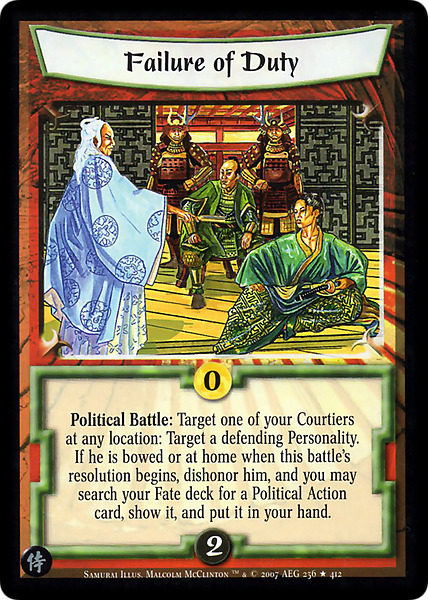
- Card Type
- Strategy
- Gold Cost
- 0
- Keywords
- Political
- Card Text
- Political Battle: Target your performing Courtier at any location to target a defending Personality. After this battle's resolution begins, if the second target is bowed or at home, dishonor him, and you may search your Fate deck for a Political Strategy, show it, and put it in your hand.
- Focus Value
- 2
- Legality
- Race for the Throne (Samurai), Rain of Blood (Diamond)
- Deck
- Fate
Printings
Samurai Edition
- Rarity
- Rare
- Artist
- Malcolm McClinton
- Card Number
- 236
- Publisher
- Alderac Entertainment Group
Hidden City
- Rarity
- Rare
- Artist
- Malcolm McClinton
- Card Number
- 89
- Publisher
- Alderac Entertainment Group
Rulings
- Erratum: Reads, "Failure of Duty 0G 2FV Political Battle: Target one of your Courtiers at any location: Target a defending Personality. If he is bowed or at home when this battle’s resolution begins, dishonor him, and you may search your Fate deck for a Political Action card, show it, and put it in your hand." [MRP, Samurai Edition, 25 July 2007] Comprehensive Rules, Samurai Edition, with specific card rulings, final version, May 2009, p. 135
Rules Q&A
- Q: If the defending Personality is bowed and in the losing Army, does she become dishonored before or after dying during Resolution?
A: The personality is dishonored at the beginning of the Resolution Segment, well before armies are destroyed. Martin Lund, "Rules for 6 May 2004", 9 May 2004 - Q: Here is what I do. I use Maru, they bow... Asako Henry. I ambush Asako Henry with Bayushi Tom. I target an unbowed Taneji and Asako Henry with Failure of Duty. He passes. I pass. My question is does the dishonoring happen at the point where both of us pass and we start with the resolution or does it happen when everything has been computed and the battle is over?
A: Do the dishonoring and drawing at the beginning of the Resolution Segment. Martin Lund, "Rules for 5 May 2004", 8 May 2004 - Q: If I Ambush someone, hit them with a Failure of Duty, bow them out, but end up bowing out as well, will their personality still die a horrible dishonorable death, or will the honor gain from tieing the battle rehonor the guy before he dies?
A: The honor gains come AFTER the destruction of the Personalities. He'll still die a dishonorable death, but then the honor gain afterwards for his controller will be negated and he'll be restored to Honorable Status and be Honorable Dead. Martin Lund, "Rules for 5 May 2004", 8 May 2004 - Q: Failure of Duty Political Battle: Target one of your Courtiers at any location: Target a defending Personality. If he is bowed or at home when this battle’s resolution begins, dishonor him, and you may search your Fate deck for a Political Action card, show it, and put it in your hand.
Doomed intention Reaction: After another player's action resolves that dishonored any of his own Personalities: Destroy one of those target Personalities.
I play failure of duty whith one of my defending personality. When the battle resolves he is at home (Seikitsu mountain) so I dishonor him. Can my opponent react with doomed intention ? I woud say no because when failure resolves (when I play the card) my personnality is not dishonored. It happens only when the delay effect applies (when battle's resolution begins) and it's no more a valid trigger for doomed.
A: Doomed Intentions cannot react to Failure of Duty. Doomed Intentions triggers after step D, "Action resolves"; during that step of Failure of Duty the delayed effect is step up but (obviously!) its effects are delayed until much later.
See also: Resolve and Delayed_effects. Alex Jones, "Failure of Duty + doomed intention", 1 May 2008 - Q: I am confused about the interaction between Kitsune Tsutaro and Failure of Duty.
When may I trigger Tsutaro's ability? Immediately after I play Failure of Duty, or must I wait until after battle resolution begins and I search my deck for a political action?
A: Failure of Duty is "resolved" after it is played. The clause about doing something "when this battle's resolution begins" is a Delayed Effect, and thus you don't wait until it is applied to consider the Action resolved. Martin Lund, "Kitsune Tsutaro and Failure of Duty", 27 Feb 2008 - Q: 1. An action or trait begins to resolve when its sequence of effect activation begins, assuming costs, targeting and conditions have been met. It stops resolving when its sequence of effect activation has ended, even if the application of some effects has been delayed.
A: Comprehensive Rules: Glossary - R - "Resolve"
So you read through the Action and activate all the effects in order. The ones that are not delayed are applied immediately when activated. The ones that are delayed are applied later. When you reach the end of the ability's text and have activated the last effect (regardless of whether you applied it, delayed it, or had it fail / get Negated) the Action is Resolved. Martin Lund, "Kitsune Tsutaro and Failure of Duty", 27 Feb 2008