Family Keep
Legend of the Five Rings card from Celestial Edition
Open in Oracle of the Void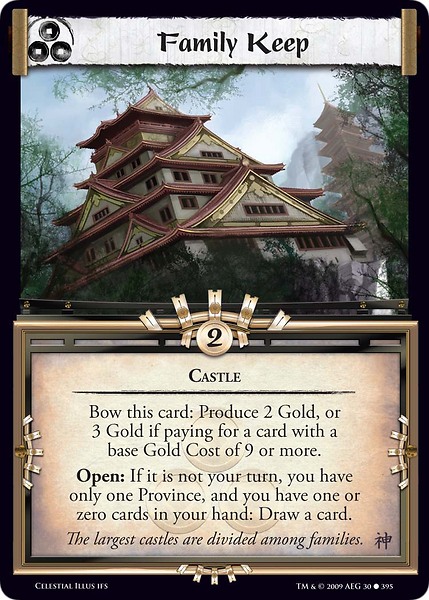
- Card Type
- Holding
- Gold Cost
- 2
- Keywords
- Castle
- Card Text
- w: Produce 2 Gold, or 3 Gold if paying for a card with a printed Gold Cost of 9 or more which may only pay for that card.
Open: If it is not your turn, you have only one Province, and you have one or zero cards in your hand, draw a card. - Legality
- Destroyer War (Celestial)
- Deck
- Dynasty
Printings
Celestial Edition
- Rarity
- Common
- Flavor Text
- The largest castles are divided among families.
- Artist
- IFS
- Card Number
- 30
- Publisher
- Alderac Entertainment Group
Rulings
- Erratum: Reads, "Family Keep 2G Castle Bow this card: Produce 2 Gold, or 3 Gold if paying for a card with a base Gold Cost of 9 or more. Open: If it is not your turn, you have only one Province, and you have one or zero cards in your hand: Draw a card." [MRP, Celestial Edition, 29 June 2009] Comprehensive Rules, Celestial Edition, with specific card rulings, final version, February 2012, p. 132
Rules Q&A
- Q: These 2 rulings contradict each other.
A: Not that I can see. Zen Faulkes, "Family Keep/Asako Mokichi Clarification", 20 Apr 2010 - Q: In Asako Mokichi's ruling, you say it has to explicitly state "exactly" or "only"(.)
A: Yes, but that's not all that was said.
The quoted ruling goes on to say, "or by mentioning two or more specific numbers such as 'zero or one.'"
Family Keep mentions two or more specific numbers: "one or zero cards." Zen Faulkes, "Family Keep/Asako Mokichi Clarification", 20 Apr 2010 - Q: (I)n Family Keep you say it doesn't, because it's implied.
A: No, the post doesn't say anything about "implied." It just used an example rather than citing a rule. Zen Faulkes, "Family Keep/Asako Mokichi Clarification", 20 Apr 2010 - Q: Surely in the absence (yet another!) technical errata, only one of these rulings can be correct?
A: I'm not seeing a problem. Zen Faulkes, "Family Keep/Asako Mokichi Clarification", 20 Apr 2010 - Q: In relation to: viewtopic.php?f=59&t=83023 and viewtopic.php?f=59&t=83047
These 2 rulings contradict each other. In Asako Mokichi's ruling, you say it has to explicitly state "exactly" or "only", but thenin Family Keep you say it doesn't, because it's implied. Surely in the absence (yet another!) technical errata, only one of these rulings can be correct?
A: I admit, I didn't answer the question on Family Keep with the citation that Zen did for Mokichi.
But if you'll notice, his rules citation completely backs up what I ruled to be the correct interpretation. Brook Cunningham, "Family Keep/Asako Mokichi Clarification", 20 Apr 2010 - Q: relevant text
Open: if it is not your turn, you have only one province, and you have one or zero cards in your hand: draw a card
if i have one province and it is my opponents turn, i have a full hand (8 cards) does this allow me to draw additional cards?
i would imagine it doesn't (card intent) but the lack of the word only before one or zero means if i have say 8 cards i fulfil the criteria as i do technically have 1 card.
just wanted this confirmed
A: You're correct. Having more than one card would make you ineligible to fulfill the requirements of Family Keep's action.
One has to consider that if a portion of card text is meaningless from a purely technical read (because you'd always have one or zero cards in your hand), then what's called for is another interpretation.
EDIT: Also, the Rules actually shore up this problem, above and beyond common sense:
http://rules.l5r.com/CE_Special_wording_rules#Numbers_of_things (emphasis mine): "If the presence of an exact number of things is being checked for, this will be noted by language such as 'exactly two' or 'only one,' or by mentioning two or more specific numbers such as 'zero or one.'" Brook Cunningham, "Family Keep wording vs intent", 19 Apr 2010 - Q: I'm guessing it's not what's intended...
A: Sadly, most players telepathy does not work that well, so we have to work with what is in the Comprehensive Rules. Zen Faulkes, "Family Keep", 2 Sep 2009 - Q: In regards to this: viewtopic.php?f=59&t=78820&view=unread#unread
While the gold cost HAS a value while the card is being played, the gold cost is not the BASE gold cost. From the definition of Base, as already quoted:
"Base" refers to a stat, keyword, ability, or trait that exists on a card or other entity as printed (following the most recent printing) or initially created, without modifications from effects. A stat’s base value can not be changed.
For Family Keep to produce 3 gold, the base gold cost must be a value of 9 or more. This means that there are several things it should check, to determine if the cost is a base gold cost. They are (per the rulebook definition of base):
A) the printed/initial value B) Without modifications from effects C) Cannot be changed.
The printed/initial value of Ruthless Advance is an asterisk, which by rulebook definition, means it has NO BASE VALUE. Ruthless does not meet this condition.
The gold cost is modified depending on target, but that isn't really from an effect, so Ruthless is probably ok here.
The gold cost of Ruthless changes, so that's out to.
Based on the rulebook definition of Base, there are three things that determine a base value. Ruthless fails to meet two of those three. How can Family Keep produce three gold instead of two for Ruthless Advance?
A: It's been pointed out that the previous posts are all operating on an incorrect assumption.
The asterisk gold cost on Ruthless Advance is a cost for its action, not the strategy card.
http://rules.l5r.com/CE_Card_types#Strategy_cards: "Gold Cost: a Strategy card's Gold Cost is part of the base costs of each of its abilities. The number in the coin is not a separate cost of playing the Strategy card." (Emphasis added.)
Family Keep can't be used in any case. It pays card costs, not action costs.
The base cost issue will be tidied up, but at least the initial question is put to bed. Zen Faulkes, "Family Keep", 2 Sep 2009 - Q: In reguards to this: viewtopic.php?f=59&t=78820
Asterisks: An asterisk (*) appearing instead of a stat on a card means that the stat has no base value, but is determined according to other circumstances. This also means that the stat is variable. If such a value cannot be determined at any given time, its base value is zero.
How can Family Keep check a base gold cost of 0, according to the highlighted area of the rules, and find a non-zero number? Ruthless advanced only has a gold cost for a temporary amount of time, thus after the action is resolved, its gold cost is back to an Asterisk which cannot be determined as a gold cost of any particular amount. Therefore, its base gold cost has to be 0 according to the rule highlighted.
A: And while the action is being taken, it has a well-defined non-zero cost. Alex Jones, "Family Keep", 2 Sep 2009 - Q: Regarding this ruling:
viewtopic.php?f=59&t=78820
Family Keep will pay 3 gold for a card with a BASE gold cost of 9 or more per its wording.
Asterisks: An asterisk (*) appearing instead of a stat on a card means that the stat has no base value, but is determined according to other circumstances. This also means that the stat is variable. If such a value cannot be determined at any given time, its base value is zero.
Ruthless Advance has an asterisk for its gold cost. This means the BASE gold cost is null, and is not determined when played. Regardless of what Ruthless is targeting, Family Keep should only produce two gold.
http://rules.l5r.com/Glossary_B#Base
Base "Base" refers to a stat, keyword, ability, or trait that exists on a card or other entity as printed (following the most recent printing) or initially created, without modifications from effects. A stat’s base value can not be changed.
A: Arguably, the quoted paragraph is contradictory: the first sentence says that an asterisk means that the stat has no base value, which could reasonably imply that the base value is zero; the last sentence implies that if the value can be determined, its base value is non-zero, since if the base value were always zero then the rule should state that.
I decided that the second interpretation is more consistent with the concept of showing the base value with an asterisk rather than as 0. Alex Jones, "Family Keep", 2 Sep 2009 - Q: Q: When playing Ruthless Advance, Can Family Keep produce 3Gold? (I think its a yes, but I want to be sure. Ruthless is a variable Gold cost while Family Keep says Base Gold cost.( Ex. 8GPersonality with Fubatsu Blade, making it a 12GC[10 to ruthless])
References:
Ruthless Advance: Battle: Pay Gold equal to the targeted unit's total Gold Cost minus 2: Destroy a target defending unit. Gold *
Family Keep: Castle Bow this card: Produce 2 Gold, or 3 Gold if paying for a card with a base Gold Cost of 9 or more. Open: If it is not your turn, you have only one Province, and you have one or zero cards in your hand: Draw a card.
Thank you for your answers!
A: Yes.
Strategy cards: Gold Cost: a Strategy card's Gold Cost is part of the base costs of each of its abilities. The number in the coin is not a separate cost of playing the Strategy card.
Asterisks: An asterisk (*) appearing instead of a stat on a card means that the stat has no base value, but is determined according to other circumstances. This also means that the stat is variable. If such a value cannot be determined at any given time, its base value is zero.
When playing a Strategy, you must pay the Gold Cost of the Strategy (which is one of the costs of the action). The base cost of Ruthless Advance is variable, but when you are paying its cost this value is known, and if it's 9 or more, a Family Keep will produce 3g towards it. Alex Jones, "Family Keep", 1 Sep 2009