Final Sacrifice
Legend of the Five Rings card from Celestial Edition, Words and Deeds, Ivory Edition, Onyx Edition, Shattered Empire, Glory of the Empire, Promotional–Ivory
Open in Oracle of the Void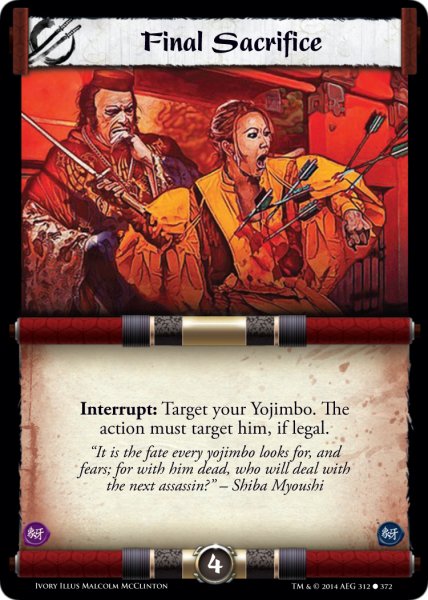
- Card Type
- Strategy
- Gold Cost
- 0
- Card Text
- Interrupt: Target your Yojimbo. The action targets him instead of another card, if legal.
- Focus Value
- 4
- Legality
- A Brother's Destiny (Ivory Edition), A Brother's Destiny (Twenty Festivals), Destroyer War (Celestial), Race for the Throne (Samurai), Shattered Empire, War of the Seals (Onyx Edition)
- Erratum
- Errata effective 19th May 2015
- Deck
- Fate
Printings
Celestial Edition
- Rarity
- Uncommon
- Flavor Text
- "When the assassins came, she gave her life to save that of her charge. She honored the Phoenix and the Shiba with her life, and we will remember her forever in our records of honor." - Shiba Tsukimi
- Artist
- Malcolm McClinton
- Card Number
- 231
- Publisher
- Alderac Entertainment Group
Words and Deeds
- Rarity
- Uncommon
- Flavor Text
- "She threw herself in front of me and saved my life. How dreary to have to find a replacement."
- Artist
- Malcolm McClinton
- Card Number
- 103
- Publisher
- Alderac Entertainment Group
Ivory Edition
- Rarity
- Common
- Flavor Text
- "It is the fate every yojimbo looks for, and fears; for with him dead, who will deal with the next assassin?" - Shiba Myoushi
- Artist
- Malcolm McClinton
- Card Number
- 312
- Publisher
- Alderac Entertainment Group
Onyx Edition
- Rarity
- Fixed
- Flavor Text
- "To give your life for another, to sacrifice yourself without thought to allow another to live, this is the essence of the samurai." - Akodo's Leadership
- Artist
- Malcolm McClinton
- Card Number
- 314
- Publisher
- Onyx Lives
- Publisherurl
- https://sites.google.com/view/the-onyx-lives-project/home
Shattered Empire
- Rarity
- Fixed
- Flavor Text
- "To give your life for another, to sacrifice yourself without thought to allow another to live, this is the essence of the samurai." - Akodo's Leadership
- Artist
- Malcolm McClinton
- Card Number
- 309
- Publisher
- Onyx Lives
- Publisherurl
- https://sites.google.com/view/the-onyx-lives-project/home
Glory of the Empire
- Rarity
- Starter
- Flavor Text
- "She threw herself in front of me and saved my life. How dreary to have to find a replacement."
- Artist
- Malcolm McClinton
- Publisher
- Alderac Entertainment Group
Promotional–Ivory
- Rarity
- Promo
- Flavor Text
- "It is the fate every yojimbo looks for, and fears; for with him dead, who will deal with the next assassin?" - Shiba Myoushi
- Artist
- Malcolm McClinton
- Publisher
- Alderac Entertainment Group
Rulings
- Erratum: Reads, "Final Sacrifice 0G 4FV Reaction: When an action would target a Personality you control, target your Yojimbo: The action targets him instead, if legal." [MRP, Celestial Edition, 29 June 2009] Comprehensive Rules, Celestial Edition, with specific card rulings, final version, February 2012, p. 132
Rules Q&A
- Q: Scenario A: Enemy Personality A: 7G Enemy Personality B: 6G unit Enemy Personality Yojimbo C: 8G unit
My Samurai Personality: 14G Unit
I target both A and B with Standing Fast. Enemy interupts with Final Sacrifice to target C. Since C+A and C+B targeting combinations are illegal, am I forced to target C alone or does the original targeting remain?
A: Errata has been issued to Final Sacrifice.
The player of Final Sacrifice must choose one of the targeting choices of Standing Fast to be changed to the Yojimbo. In the situation described, changing the targeting of either A or B to instead target C will result in illegal targets, so Final Sacrifice's redirection effect will fail. Alex Jones, "Final Sacrifice and Standing Fast", 19 May 2015 - Q: Player A plays Standing Fast, targeting two units of player B, Isawa X and Isawa Y.
Player B interrupts with Final Sacrifice, targeting a third unit, Shiba Z.
Final Sacrifice requires that one of the two targets of Standing Fast be Shiba Z. But which player chooses which of Isawa X and Isawa Y is no longer targeted?
A: Errata has been issued to Final Sacrifice.
The player of Final Sacrifice chooses which targeting choice is changed. Alex Jones, "Final Sacrifice vs Standing Fast", 19 May 2015 - Q: e.g.
I think this means that Final Sacrifice can only target a unit at the current battle. So if Isawa X and Shiba Y are at home, and Shiba Z is defending, and the attacker plays Determined Challenge on Isawa X, Final Sacrifice can only target Shiba Z (a legal, if useless target for Determined Challenge) but could not target Shiba Y to cause him to be moved into the battle. Correct?
And therefore,
While nothing stops you playing Final Sacrifice in response to Coward, it will never do anything, since Coward can only target units at home and Final Sacrifice can only target units at the current battlefield. Correct?
A: The Yojimbo is targeted by Final Sacrifice, so - if played during a battle - he must be at the current battlefield. This means he is not a legal target for actions which only target cards in your home, so the redirection will fail.
However, if the action being Interrupted targets a card "at any location", then the Yojimbo is a valid target, and the redirection will work. Alex Jones, "Final Sacrifice vs targets 'at any location'", 19 May 2015 - Q: Regarding: viewtopic.php?f=59&t=113673
Under the new "plain english" wording, what exactly differentiates the phrases "The action may not target" and "the action must target" on traditionalist and final sacrifice. Why does one of these phrases force a new targeting later on in the resolution segment, while the other straight negates an action? What part of this is even remotely intuitive?
A: Errata has been issued to Final Sacrifice and Traditionalist. Alex Jones, "Final Sacrifice", 19 May 2015 - Q: Nothing in the 20F rules appears to allow the targeting to change after Step C without explicitly stating it. Unlike Final Sacrifice, which explicitly chooses a new target, Traditionalist just makes a target illegal.
A: The new targeting rules make Traditionalist change function because under the old rules, all targets were chosen after Interrupts, so an Interrupt could get ahead of this choice and force a new one.
However, in Action Sequence it explicitly says in step E, "Targeting as chosen in step C is now actually carried out when called for by the card text, possibly altered by Interrupts or other effects."
So, Final Sacrifice still works as intended.
Hope that helps, Roger Roger Giner-Sorolla, "Final Sacrifice", 14 May 2015 - Q: Nothing in the 20F rules appears to allow the targeting to change after Step C without explicitly stating it. Unlike Final Sacrifice, which explcitly chooses a new target, Traditionalist just makes a target illegal.
If a Personality is targeted by a Favour action in Step C and then by Traditionalist in Step D, there is nothing that allows the Favor action to retarget and its original target is illegal- would this constitute "the player cannot find a legal target, the effects stop immediately, and no further effects or targeting happen."
A: You are correct. As long as there is another legal target, Traditionalist makes the current targeting illegal, but does not allow retargeting. This may be amended in the future but at present it will negate the favor's effects. Jon Palmer, "Traditionalist and 20F Rules", 1 May 2015 - Q: Now that targeting occurs before interupts, when someone targets one of my courtier at Dakatsu's location, even if I Final Sacrifice it to a Yohimbo, do they still lose the two honor for the original targeting?
A: No. Effects based off targeting trigger at step E of the action sequence, and at that point, the change in targets to the Yojimbo has occurred. Jon Palmer, "Bayushi Dakatsu and Final Sacrifice", 27 Mar 2015 - Q: An interaction that was quite clear to me before Twenty Festivals' rules change was: my A New Alliance vs. my opponent's Final Sacrifice. My opponent had to play it before I chose my two targets, then I had to select his Yojimbo as one of them. In the end, I could hit my most desired target, but not the second most.
However, I'm not sure to have understood how it works under Twenty Festivals' rules: 1) as above (I hope) 2) Final Sacrifice doesn't work at all because targets have already been chosen (unlikely) 3) I have to announce my two choices of targets, then my opponent plays Final Sacrifice and can redirect any one of my choices (weird but hard to exclude from the texts)
---
A New Alliance Political Open: The abilities on two target Dynasty or Fate cards (in play) cannot be used.
Final Sacrifice Interrupt: Target your Yojimbo. The action must target him, if legal.
New rules for Interrupts 3. In the action sequence, required targeting is now chosen after costs are paid but before Interrupts are taken, meaning that players of Interrupts know what an action will target beforehand. Interrupts that say things like “If the action targets a Samurai” refer to this pre-choice of targets. Effects that trigger from targeting, such as “before” or “after” targeting, still trigger when the targeting actually happens in the action’s resolution. Optional targeting (“may target”) is still chosen and carried out in the action’s resolution entirely.
A: Option 3 is now the correct outcome. Alex Jones, "A New Alliance vs. Final Sacrifice", 23 Mar 2015 - Q: Hi all,
So to ask for clarification regarding the new "Targeting Paradoxes" section of Comprehensive Rules as it is not very clear to me when some things should happen from this thread
viewtopic.php?f=59&t=112030
If i have The Abbot and a Yojimbo at the Battlefield and a copy of Final Sacrifice in hand. My opponent declares an action (say Block Supply Lines) when does he pay the extra 2g to allow him to target the Abbot? Does he hay to pay it in initial costs step (i.e. before interrupts or targeting in effects block) or when he targets (after interrupts. If he does Pay before can I then final sacrifice to redirect or is it no longer a legal target?
thanks
Az
A: If your opponent wishes to target The Abbot with his Block Supply Lines, he must pay 2g during the Pay Costs step of the action.
As per the Targeting Paradoxes section, this ties the action to targeting The Abbot: no other card is a legal target (unless that card also has a similar effect that makes the action targeting it cost 2g extra). Alex Jones, "Re: The Abbot", 19 Feb 2015 - Q: At the current battle, I have a non-Yojimbo Personality. My opponent wants to Sudden Movement a Shugenja at home who has been casting a lot of Home Battle spells. At home, I also have a number of Yojimbo Personalities. If, as I believe, Interrupts also follow the rules of presence and location, is it legal for me to Interrupt my opponent's Sudden Movement with Final Sacrifice despite not having a Yojimbo target for it at the current battlefield?
Sudden Movement Battle: Target two Personalities controlled by the same player at different locations. Switch their locations. Straighten both their units as they move.
Final Sacrifice Interrupt: Target your Yojimbo. The action must target him, if legal.
A: The Yojimbo you target with Final Sacrifice must be at the current battlefield, because, as you correctly point out, Interrupts are subject to the Rule of Location (and Presence) - regardless of the targeting specification of the original action. Alex Jones, "Sudden Movement + Final Sacrifice", 2 Dec 2014 - Q: If my Crane opponent announces Daidoji Gensai's Home Battle action, and I interrupt with Final Sacrifice onto my Yojimbo (with no followers) at the current battlefield, is he then forced to discard a card (if able) in order to make a ranged attack targeting that yojimbo? (assuming Gensai's movement is successful)
And would this be different if the Crane player had Sacred Temples in play?
Relavent card text: Daidoji Gensai Home Battle: If Gensai would be opposed, move him to the current battlefield. After he moves, you may discard a card to make a Ranged Attack with strength equal to the card's Focus Value.
Final Sacrifice Interrupt: Target your Yojimbo. The action must target him, if legal.
Sacred Temples Other players' actions will not discard cards from your hand.
A: If the Crane player has Sacred Temples in play, no use of Gensai will trigger it - it's Gensai's controller's ability forcing the discard.
Final Sacrifice will not force Gensai's controller to activate his ranged attack ability. It is still an optional ability, and they can choose not to use it, in which case his ability produces no targeting and the Yojimbo will not be targeted. Jon Palmer, "Daidoji Gensai vs Final Sacrifice", 24 Sep 2014 - Q: My oponent targets one of my spells with Unsettling Gathering.
I Interrupt with Final sacrifice, targetting one of my Yojimbos.
Can I do this, does my Final just fail? Or does the Gathering fail? Or both?
Thanks for your time.
Edit. My apologies. Just saw that he could target any attachment on the table (because interrupts come before targeting. :S) but the target of Unsettling must be my yojimbo.
If this is true, must he target an attachment that can legally attach to my yojimbo even if it is one of his attachments?
Edit. Ok, I understand this is a bit of a mess, do you want me to reword it? I am quite happy to do so if needed.
A: It depends on if your Yojimbo is a Personality or an attachment.
If you target your Yojimbo Personality, he must attach the moved attachment to your Yojimbo Personality. If he cannot attach the attachment, the effect fails.
If you target your Yojimbo follower, it must be the attachment selected to move. It can be moved to any Personality, but again, the attachment must be legal or the effect will fail.
Please remember that Final Sacrifice is played before ANY targets are chosen. So your opponent will be able to choose his targets based on the restrictions of Final Sacrifice. Jon Palmer, "Final Sacrifice and a spell.", 19 Jul 2014 - Q: I have a shugenja with Suitengu's Embrace attached:
Water Battle, w: Bow a target enemy card without attachments, or bow this Shugenja to bow a target enemy card with attachments.
My opponent has two Personalities. A non-Yojimbo without attachments, and a Yojimbo with an attachment. I announce Suitengu's Embrace, bowing the Spell. During Interrups, my opponent plays Final Sacrifice:
Interrupt: Target your Yojimbo. The action must target him, if legal.
Which scenario happens?
A) I can choose to not bow my Shugenja, and thus cannot legally target the Yojimbo. B) I must bow my Shugenja and target the Yojimbo to bow.
A: What can happen depends on if your Shugenja is bowed or unbowed.
If the Shugenja is unbowed, then you are forced to target the Yojimbo, as you can bow your Shugenja to target the Yojimbo, which is a potential legal target.
If your Shugenja is bowed, then you have two legal targets, the non-Yojimbo or the Yojimbo's attachment, as you cannot bow your Shugenja to target a card with attachments. In this case, targeting the Yojimbo is not a legal target to the action, so Final Sacrifice will have no effect. Ben Higgins, "Suitengu's Embrace and Final Sacrifice", 30 Jun 2014 - Q: RE: http://www.alderac.com/forum/viewtopic. ... d#p1427087
My opponent plays an action and I react with Final Sacrifice http://imperialassembly.com/oracle/#cardid=2550,#hashid=e96ed35f5a96d8b2eeb6eac5f435a324,#cardcount=2
Interrupt: Target your Yojimbo.
I target all of my Yojimbo, yes? Yojimbo is plural, afterall. Since all of my Yojimbo is generally not a legal target the action does nothing? Or does the following completely seperate sentence on the card act as a qualifier to ensure it's singular? Will there be a definition on every single card that says "Target your Yojimbo" or some varient of such to confirm whether it means one Yojimbo or all your Yojimbo? I just want the team to be very aware of the precedence this ruling sets for any future wording that mentions Yojimbo.
EDIT: Followup:
With the following cards (as examples), do I target all of my Samurai, or just one? Explain why in either case.
http://imperialassembly.com/oracle/#cardid=8,#hashid=80bfc2b1ca900f1cfbfb21005d677cdb,#cardcount=0
http://imperialassembly.com/oracle/#cardid=9156,#hashid=80bfc2b1ca900f1cfbfb21005d677cdb,#cardcount=8
A: Targeting is by default, a singular thing.
When a single effect would have you target two or more objects, we explicitly state the number, or the range of number, of targets you must choose.
Examples of cards with multiple targets are A Growing Rift, Band of Brothers, and Bountiful Fields. Ben Higgins, "Yojimbo", 26 Jun 2014 - Q: With Interrupts being subject to the rule of presence, am I correct in my understanding that if Determined Challenge is used at a battlefield where the opponent has no presence, that he cannot interrupt with final sacrifice to cause me to pull in a Yojimbo instead of the pesky Shugenja I intended to target?
A: Indeed. Alex Jones, "Determined Challenge + Final Sacrifice", 9 May 2014 - Q: So, this question arose in a recent game of mine against a friend.
Situation: I have an unbowed personality A and a bowed yojimbo personality B. My opponent announces M'rika's open action, with the intent of bowing personality A. I want to Final Sacrifice to force the action to target personality B.
Is personality B a legal target for said action?
Relevant card text:
My friend insisted that, since you can't bow someone who is already bowed, that he would not be a legal target for the action.
My understanding of the rules, however, is that the legality of targeting is separate from the success/failure of an effect. In other words, since M'rika's action only specifies "target personality", any personality is a legal target for the action. The effect of bowing will obviously fail if it targets an already bowed card, but that is not a problem of legal targeting.
1. Who is right?
2. By extension, is a bowed personality a "legal target" for fear effects?
3. And just to make 100% sure (pretty sure I saw a ruling on this before, but search couldn't find it) is a 4F personality a "legal target" for a RA/MA/Fear 3?
A: You can't bow someone who is already bowed, but you can certainly target a bowed Personality with an effect that will bow them (if the effect cannot target a bowed Personality, it will say "target an unbowed Personality").
You're perfectly okay to play Final Sacrifice in this manner. Jon Palmer, "Final Sacrifice & "legal target" vs failed effect", 2 Apr 2014 - Q: One of the players in my playgroup doesn't like to take anyone's word on anything, so I feel compelled to ask here so he can see answers from the rules team.
First, must Ranged Attacks target someone of their strength or less, or can a Ranged attack target someone it can't kill? For example, if someone uses a Ranged 3, can I Final Sacrifice to force it to target a 4 Force Yojimbo and not kill someone or is he an illegal target?
Second, and I apologize for even posting this because English pretty clearly defines the key word here, but when someone is challenged with Demonstrating Technique how many times are they allowed to focus? English seems to say once and only once because it's, well, exact, but my belligerent friend insists that "exactly" means "at least."
A: A ranged attack may target a card it cannot destroy; in this case it has no effect. This is one of the best uses of Final Sacrifice (unless they play Unholy Strike!)
Each Personality in the Demonstrating Technique duel must focus once and may only focus once. They may not continue focusing once they have focused once. Jon Palmer, "Ranged Attack targeting; Demonstrating Technique", 5 Mar 2014 - Q: Steel on Steel fizzles?
A: No, since the original target, (Personality B, the one Final Sacrifice was trying to move the effect away from) is still there. Personality B is going to a duel. Zen Faulkes, "Targeting: Final Sacrifice, Elite Guard", 11 Mar 2010 - Q: This cannot retroactively invalidate Final Sacrifice, because Final Sacrifice had to have already resolved successfully for the Elite Guard reaction to be able to be used to begin with.
A: The "if legal" clause isn't a condition for whether it's legal to announce and use Final Sacrifice. It's a condition on the effect of changing the target to the Yojimbo Personality. And that the change of targeting doesn't happen immediately, it happens when targeting occurs, which makes it a (very slightly) delayed effect. Zen Faulkes, "Targeting: Final Sacrifice, Elite Guard", 11 Mar 2010 - Q: Hi all,
1) Another player play a Touch of Death on one of my bowed personality. To redirect with a Final Sacrifice, the Yojimbo must be bowed and have an equal or fewer Chi than the Shugenja's Chi?
A: This is correct. Equal to or lower than the performing Shugenja's Chi. Dan Jacobson, "Final Sacrifice and legal target", 31 Aug 2009 - Q: 2) Regarding the steps of an action (targeting first then paying costs) and the "if legal" on the Final Sacrifice, can I redirect the Dramatic Assassination on a Yojimbo with a total unit gold cost greater than: a] the original target? b] the amount of Gold can be paid by the Dramatic Assassination's player?
A: You may redirect to any legal target, including b], but the player playing Dramatic Assassination has the option to not pay costs, and discard the Dramatic Assassination without effect. Dan Jacobson, "Final Sacrifice and legal target", 31 Aug 2009 - Q: Thanks in advance.
A: You are welcome! Dan Jacobson, "Final Sacrifice and legal target", 31 Aug 2009 - Q: Regarding this:
If my personality is targeted with an action, can I play Final Sacrifice twice and change the target of the same action twice to the same Yojimbo for purposes of playing Ring of the Void?
I cannot find a reason why not. If any of the other rules guys can find the rule that prevents it (as I have a niggling feeling there might be), I'm sure they'll speak up.
--------------------
I think that, if you target the same yojimbo twice with both Final Sacrifices, the second time it wouldn't be considered successful as no target was changed, the game state remained the same as before playing the second Final Sacrifice... You'd have to target two different yojimbo with each Final Sacrifice so each copy of the card actually did something.
A: Just confirming that Mamoru's assessment is right. Zen Faulkes, "Changing Targets", 30 Aug 2009 - Q: If my personality is targeted with an action, can I play Final Sacrifice twice and change the target of the same action twice to the same Yojimbo for purposes of playing Ring of the Void?
A: I cannot find a reason why not. If any of the other rules guys can find the rule that prevents it (as I have a niggling feeling there might be), I'm sure they'll speak up. Zen Faulkes, "Changing Targets", 29 Aug 2009 - Q: Chasing Osano-Wo vs Final Sacrifice. If I play the first card and my opponent plays the second as an interrupt. The interesting thing is that Chasing doesn't seem to have a cost block, because all the text is after the colon. Therefore it appears to me that both the bowing the monk/shugenja and the force bonus to the second target are both effects. In a game, my opponent played Sacrifice and claimed to redirect only the second effect to target his Yojimbo. But the action has two targets. Why is my opponent allowed to redirect the second targeting effect in preference to the first? It seems to me that it may not be legal to play Sacrifice in response to Chasing because his Yojimbo isn't a monk/shugenja and chasing states it doesn't work if his person isn't a legal target?
A: The constraints block was removed in Ivory, just FYI, but as to your question.... ...."the action targets [the yojimbo] instead of another card, if legal." It's the opponent's Interrupt, so they get to choose which "another card" of the two Chasing is targeting its substitution effect applies to. Brook Cunningham, "Onyx Lives #rules-questions", 18 Aug 2025 - Q: Two questions from last night's games
If you are the defender can you use Coward! to move your own personality into the battle?
Can you use Final Sacrifice to change target of opponent's beneficial Action to your Yojimbo? Let's say redirect Breaking the Rhythm from opponent's character to your own Yojimbo?
A: Yes.
Whether your Yojimbo is a legal target for the action is key here, and would/should be assessed case by case. Brook Cunningham, "Oracle of the Void #rules", 16 Mar 2025