Game of Sincerity
Legend of the Five Rings card from War of Honor, The Imperial Gift 1, Three Dynasties
Open in Oracle of the Void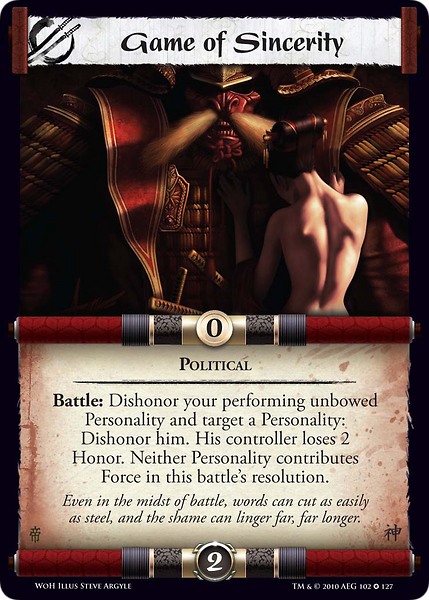
- Card Type
- Strategy
- Gold Cost
- 0
- Keywords
- Political
- Card Text
- Battle: Dishonor your performing unbowed Personality and target a Personality: Dishonor him. His controller loses 2 Honor. Neither Personality contributes Force in this battle's resolution.
- Focus Value
- 2
- Legality
- Age of Conquest (Emperor), Destroyer War (Celestial), Race for the Throne (Samurai), Three Dynasties
- Deck
- Fate
Printings
War of Honor
- Rarity
- Fixed
- Flavor Text
- Even in the midst of battle, words can cut as easily as steel, and the shame can linger far, far longer.
- Artist
- Steve Argyle
- Card Number
- 102
- Publisher
- Alderac Entertainment Group
The Imperial Gift 1
- Rarity
- Fixed
- Flavor Text
- Even in the midst of battle, words can cut as easily as steel, and the shame can linger far, far longer.
- Artist
- Gonzalo "Genzoman" Ordoñez Arias
- Card Number
- 21
- Publisher
- Alderac Entertainment Group
Three Dynasties
- Rarity
- Fixed
- Flavor Text
- "Is that not what all life is?" - Bayushi Nitoko
- Artist
- Steve Argyle
- Card Number
- 406
- Publisher
- Onyx Lives
- Publisherurl
- https://sites.google.com/view/the-onyx-lives-project/home
Rules Q&A
- Q: Relevant text:
Here's the question:
Let's say I can play Sincerity of the Dragon during battle, and I name the value 4. For my next action I play Game of Sincerity (2 focus value). My opponent passes. I then play Brave New World (4 focus value). Does the sincerity of the Dragon then resolve?
I assume this to be the case (and the answer is yes), since the Sincerity of the Dragon is a delayed effect waiting for the next action with a specific focus value (and not only the immediate next action).
A: Yes, that sequence is correct. Brook Cunningham, "Clarification on The Sincerity of the Dragon", 9 Apr 2012 - Q: Can I chose the performer as the target of Game Of Sincerity?
A: Because they are not targeted simultaneously, no rule prevents it (http://rules.l5r.com/CE_Abilities_and_a ... _targeting and http://rules.l5r.com/CE_Glossary_T#Targeting). Zen Faulkes, "Self Game of Sincerity", 1 Apr 2011 - Q: A situation occurred in a game last night where a Matsu Haruya was destroyed by a battle resolution. Which raised the following questions.
Firstly What happens with regard to Haruya's trait? Does Haruya's player gain 3 honour or does it rehonour the now destroyed Haruya or something else?
This led to a secong duestion that also came up, if the said Haruya had been targeted by for example a Game of Sincerity and chose to commit seppuku what would happen?
I have looked through the rules forum answers on this and cannot, as yet regrettably, find clarity
Relevant Text on haruya
Lion Clan • Samurai • Deathseeker • Hero After Haruya is destroyed during an Attack Phase: Gain 3 Honor. Battle: Bow a target enemy card with lower Force.
Thanks in advance Az
A: As with Senichi, when Haruya dies dishonourably, he is not rehonoured (because the rehonour effect doesn't apply because he's out of play) and the honour gain is negated.
If he is targeted by Game of Sincerity, he is dishonoured, but before you lose the 2 honour Haruya can commit seppuku: he is rehonoured then destroyed, so you can gain 3 honour from his trait. You then lose 1 honour from Game of Sincerity. Alex Jones, "Matsu Haruya and Being destroyed dishonored", 11 Jul 2010 - Q: How are these two situations different from each other? Why I'm unable to play Final Duty when I got bowed personality targeted with Plains? Because rulebook says clearly that army total force is force of your unbowed personalities not force you count during resolution. Plains doesn't say that personality contribute force to army total force. Maybe he cotributes in resolution?
A: No, he doesn't JUST contribute in resolution. Because Plains doesn't say "during/in resolution" like Game of Sincerety, it means the Personality contributes his Force while bowed during the Combat Segment TOO. Brook Cunningham, "Plains of Resolution; Game of Sincerity; Final Duty", 7 May 2010 - Q: Could you make some kind of final rule for this and write down grounds of that decision?
A: We already had done:
Contribute: "To add a card's or unit's Force to an army total. Effects allowing or denying contribution apply at any time an army exists, unless restricted to battle resolution." Brook Cunningham, "Plains of Resolution; Game of Sincerity; Final Duty", 7 May 2010 - Q: Example: I am opposed at battefield A and have Game of Sincerity played on my Personality Bob. I move Bob home for my action. The battle then resolves.
Question: If I move Bob to battlefield B, does he contribute his force towards resolution or does Game of Sincerity's effects still apply?
Game of Sincerity: Political Battle: Dishonor your target unbowed Personality: Dishonor a target Personality. His controller loses 2 Honor. Neither Personality contributes Force in this battle's resolution.
The card specifically refers to "this battle's resolution" but I wasn't sure about its duration. Sorry if this question has been asked before- didn't see it specifically asked on search function. Thanks for your time.
A: He contributes force in the resolution of the battle at province B.
Game of Sincerity's ongoing effects (which come the text "Neither Personality contributes Force in this battle's resolution") last until the end of the turn. However, "this battle" only refers to the battle currently being fought, not to any subsequent battle this turn. Alex Jones, "Game of Sincerity and Resolution at another battle", 23 Apr 2010 - Q: (I)f subsequent to being targeted by a Game of Sincerity I play Laughter of the Flames on my personality, will that counteract the effects of the Game of Sincerity (?)
A: No. Laughter of the Flames only overrides one reason a card may not contribute force: because it is bowed. It does not override any other reason a card might not contribute force. Zen Faulkes, "Game of Sincerity - Laughter of the Flames", 6 Feb 2010 - Q: (I)f the word contribute is going to continue to be used is it possible to have it added to the comprehensive rules glossary please?
A: Many -- indeed, most -- words in L5R cards have only their normal English usage. We are not going to duplicate the dictionary in the rules glossary. That way lies madness. Zen Faulkes, "Game of Sincerity - Laughter of the Flames", 6 Feb 2010 - Q: If I have a personality that is targeted by Game of Sincerity, am I then able to play justly earned victory to negate the "Neither Personality contributes Force in this battle's resolution" portion of game of sincerity, or is that not seen as being a force bonus or penalty?
A: The latter. Nothing happens to the card's force -- they're just not added to the total for the army. Zen Faulkes, "Justly earned victory and game of sincerity", 31 Jan 2010 - Q: Hi all,
I have only one personality in a battle. He's targeted by Game of Sincerity. In resolution, I have an army even if my personality doesn't contribute Force. I'm right?
And if the opponent have one personality too (or have others but bowed by exemple). His personality and mine always targeted by Game of Sincerity. The two armies are destroyed in resolution due to a tie? Even if the forces are equal to 0?
A: Yes, to all the questions quoted above. Dan Jacobson, "Game of Sincerity clarification", 10 Sep 2009 - Q: If I use Game of Sincerity on a personality, then bow my personality for some action, then subsequently target him with Essence of the East Wind does he contribute force to his unit?
A: No.
Essence of the East Wind says the Personality contributes Force even if bowed. Bowing is the only state the card text overrules. It is not a "this Personality contributes force not matter what" card.
Similar question here: viewtopic.php?f=59&t=78369 Zen Faulkes, "Game of Sincerity + Essence of the East Wind", 18 Aug 2009 - Q: If my opponent plays Game of Sincerity on my personality, then I play Shameful Injury on my personality, will I have force at resolution?
A: No. There is no rule that "contributing no force" is equivalent to "force penalty." Zen Faulkes, "Game of Sincerity vs Shameful Injury", 11 Aug 2009 - Q: I'm pretty sure I know the answer, but I wanted to make sure.
Game of Sincerity - Battle: Dishonor your target unbowed Personality: Dishonor a target Personality. His controller loses 2 Honor. Neither Personality contributes Force in this battle's resolution.
Final Duty - Battle: If your current army has lower total Force than the current enemy army: Ranged 6 Attack.
Do personalities targeted by Game of Sincerity (as long as they are unbowed) count when determining "army force" for Final Duty?
Thanks John
A: Army Force consists of the total Force of all unbowed Personalities and Followers at a battlefield.
The fact that some may not contribute Force at Battle Resolution is irrelevant for Final Duty. Dan Jacobson, "Game of Sincerity and FInal Duty", 6 Jul 2009 - Q: Ties happen so infrequently that their rules questions hardly come up, and ties featuring Dishonored Personalities on both sides are even more rare, so I am not surprised that my search-fu has not turned up the answer I was looking for.
This came up a couple of weeks ago. After a flurry of battle actions my opponent and I ended up tied with a dishonored personality on each side (Game of Sincerity is going to make that part of the equation more common).
How exactly is this resolved? Do we each simultaneously rehonor our whole armies and then kill them all, gaining zero honor in the process?
A: Do we each simultaneously rehonor our whole armies and then kill them all, gaining zero honor in the process?
Pretty much. It's described under Honorable and dishonorable: There are a number of ways to rehonor a dishonorable Personality. * Before a player with one or more dishonorable Personalities in his or her army gains Honor ... from destroying opposing cards in battle resolution, all such dishonorable Personalities are rehonored and the Honor is not gained. In a tied battle, all dishonorable Personalities in an army are rehonored before being destroyed, and their army’s leader gains no Honor.
More detail here. Alex Jones, "Battle Resolution - Dishonored and Tied", 1 Apr 2009 - Q: Game of Sincerity: Can it target an already dishonored personality for its effect?
A: Yes. This is a variation of "Is an action legal if an effect can't happen?"
http://rules.l5r.com/FAQ#Is_an_action_l ... _happen.3F Zen Faulkes, "Effects that can't occur (Game of Sincerity)", 25 Mar 2009 - Q: (C)an I Misdirection, and have the personality he dishonors as a cost target HIMSELF with the effect?
A: Yes. Zen Faulkes, "Effects that can't occur (Game of Sincerity)", 25 Mar 2009 - Q: Can I play Game of Sincerity on my personality, and target the same personality with the effect?
Text:
Political Battle: Dishonor your target unbowed Personality: Dishonor a target Personality. His controller loses 2 Honor. Neither Personality contributes Force in this battle's resolution.
Thanks, Mark
A: Yes.
Although the following found in the Glossary entry for Target:
When multiple targets are chosen simultaneously, the same target cannot be chosen twice.
it doesn't apply since the targets are not chosen simultaneously, because of the following under Required targeting:
All targets are designated in the order described, including simultaneously if a number of targets are indicated by a number (such as, “target two Holdings.”) Targeting in the constraints block happens before targeting described in the effects block. Alex Jones, "Game of Sincerity targetting", 26 Feb 2009 - Q: Color me surprised about the reversal, because this ruling about committing seppuku several times with different personalities has been stated for two months and a half.
Does this mean this ruling has been changed too?
My argument: Seppuku says: Reaction: Any number of times per turn, before you lose Honor from an action that targeted or was performed by one of your Courtier or Samurai Personalities: He commits seppuku. If the seppuku destroyed him, reduce the Honor loss to one.
I still think that any honor loss that is performed or targeted by more than one personality, has a different triggering for seppuku for each personality that performs or is targeted by the action.
E.g. I have a Doji Bob (courtier) and Kakita Jennifer (samurai) at the current battlefield. I announce Game of Sincerity. Doji Bob performs it and Kakita Jennifer is targeted by it. Therefore, I have two distinctive triggers for the seppuku: Trigger #1: before you lose Honor from an action that targeted Kakita Jennifer: She commits seppuku. If the seppuku destroyed her, reduce the Honor loss to one Trigger #2: before you lose Honor from an action that was performed by Doji Bob: He commits seppuku. If the seppuku destroyed him, reduce the Honor loss to one.
Please explain what's wrong with this example.
A: You know, I thought I had answered a question like this before. But I didn't bother digging it up, to spare myself the shame and embarrassment. So much for that, eh?
<-- There it is. There's the shame.
Anyway... the ruling that you linked is the same error as one that Bayushi Loïc made a month ago. There's nothing different about them, apart from the name of the single-honor-loss causing card (Coward! vs. Game of Sincerity), so there's no reason to think his reversal doesn't also apply to mine.
I see the logic in your example, but you can't break it down like that. Just because there are two different conditions under which the trigger applies doesn't mean there are two seperate triggers if BOTH conditions apply at the same time. The trigger is the Honor loss, which only occurs once. Brook Cunningham, "Game of sincerity, Seppuku, Ring of the Phoenix", 19 Feb 2009 - Q: I'm now thoroughly confused by the whole Ring of the Phoenix, Game of Sincerity, seppuku nonsense.
If I can only seppuku once in response to a single honor loss, how is it different when someone plays 3 Assigning Blames in response to the destruction of a single personality?
A: The difference is multiple copies. Again, with underlined emphasis and addendum in brackets,
http://rules.l5r.com/Timing#Resolving_timing_conflicts: "A player can not use the same Reaction or triggered trait twice to a single triggering occurrence from the same copy of a card, or from the rules [where there is also only effectively only one copy of said Reaction, no matter how many rulebooks you own -- BC]." Brook Cunningham, "Game of sincerity, Seppuku, Ring of the Phoenix", 18 Feb 2009