Houhou
Legend of the Five Rings card from Celestial Edition, Khan's Defiance, Samurai Edition Banzai
Open in Oracle of the Void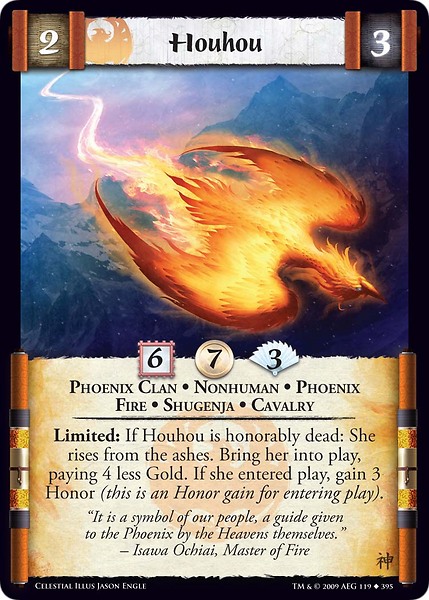
- Card Type
- Personality
- Force
- 2
- Chi
- 3
- Honor Requirement
- 6
- Gold Cost
- 7
- Personal Honor
- 3
- Clan
- Phoenix
- Keywords
- Cavalry, Fire, Nonhuman, Phoenix, Phoenix Clan, Shugenja
- Card Text
- Limited,
 : If Houhou is honorably dead, she rises from the ashes. Recruit for 4 less Gold. If she entered play, gain 3 Honor.
- Legality
- Age of Enlightenment (Lotus), Destroyer War (Celestial), Race for the Throne (Samurai)
- Deck
- Dynasty
Printings
Celestial Edition
- Rarity
- Uncommon
- Flavor Text
- "It is a symbol of our people, a guide given to the Phoenix by the Heavens themselves." - Isawa Ochiai, Master of Fire
- Artist
- Jason Engle
- Card Number
- 119
- Publisher
- Alderac Entertainment Group
Khan's Defiance
- Rarity
- Uncommon
- Flavor Text
- The Phoenix are at peace with themselves, and many of their ancient allies have returned.
- Artist
- Jason Engle
- Card Number
- 45
- Publisher
- Alderac Entertainment Group
Samurai Edition Banzai
- Rarity
- Starter
- Flavor Text
- The Phoenix are at peace with themselves, and many of their ancient allies have returned.
- Artist
- Jason Engle
- Publisher
- Alderac Entertainment Group
Rulings
- Erratum: Reads, "Houhou 2F/3C 6HR 7G 3PH Phoenix Clan • Nonhuman • Phoenix • Fire • Shugenja • Cavalry. Limited: If Houhou is honorably dead: She rises from the ashes. Bring her into play, paying 4 less Gold. If she entered play, gain 3 Honor (this is an Honor gain for entering play)." [MRP, Celestial Edition, 29 June 2009] Comprehensive Rules, Celestial Edition, with specific card rulings, final version, February 2012, p. 138
Rules Q&A
- Q: A player with negative honor has a Houhou honorably dead. So Houhou can't enter play by his own text because the honor requirement is not met.
...can the action be played in order to react with other cards to "An action being announced"?
A: No.
Good Faith Rule: "If the action involves putting one or more cards into play as a non-optional effect, the player must be able to bring those cards into play legally to meet the Good Faith rule." Brook Cunningham, "Houhou + Good Faith rule", 15 Jan 2011 - Q: Can someone exlpain why a force penalty overkill is counted for a 'set' interaction but not a 'bonus' interaction?
ex. 'Set'
Houhou is 2F. A -4F penalty is applied, dropping Houhou to 0F.
Houhou then has Force set @ 5 (which means 'apply bonus or penalty' to reach 5)... we have rulings that say you count the full -4, apply a 7F bonus and Houhou would then have 9F after the penalty expires.
However... if all set means is 'apply bonus or penalty'... why does this (to my knowledge) work completely differently than giving Houhou a flat force bonus?
Ex. 'Flat Bonus'
Houhou is 2F. A -4F penalty is applied, dropping Houhou to 0F.
Houhou then has a +5F bonus applied. The 'Set' ruling implies that when a bonus is applied you count prior overkill penalties, which would make Houhou 3F after the +5F bonus. But this is not how it works. Houhou is 5F after the flat bonus.
So... why are we counting the overkill for one interaction that effectively works a permanent flat bonus but not counting the overkill when we are applying a flat bonus? Why does 'Set' require +7F to reach 5 when a flat bonus only requires +5F?
Unless we do count overkill in all cases... but... I don't think I have ever seen anyone do that.
Edit: I can logically understand why an overkill caused by tokens would be counted as they constantly assert their effect. What is giving me hangups is the disparity between how non-token effects are handled.
A: To "Set" a stat to a certain value implies not only a bonus/penalty, but it also accounts for bonuses and penalties already active on the personality.
A mere stat bonus or stat penalty does not do this.
That is the distinction made between setting a stat to a value and giving a stat bonus/penalty. Dan Jacobson, "Force penalty overkill interactions - 'set' vs 'bonus'", 12 Apr 2010 - Q: Does Houhou's "if she entered play, Gain 3 Honor" apply only to entering play with her Limited ability? Or does it happen if she enters play outside the Dynasty Phase with the use of a card like Shiba's Guidance? For example, if I am in combat and an opponent attacks me and I use Shiba's Guidance to bring Houhou back into play in the current battle, do I gain her 3 honor for enter play as printed on the card? Thank you.
A: Houhou's ability is Limited: If Houhou is honorably dead: She rises from the ashes. Bring her into play, paying 4 less Gold. If she entered play, gain 3 Honor (this is an Honor gain for entering play).
The honour gain is not a separate trait, it's an effect of the action. If you bring her into play using a different action, you won't gain 3 Honour from her ability.
Note that within the text box of a card, the order of the four parts is fixed: Keywords, Traits, Abilities, Flavour. Once you get to an ability, all the rest is abilities or flavour. Alex Jones, "Shiba's Guidance + Houhou", 19 Mar 2010 - Q: Just to clarify this answer.
According to the OP, houhou dies without being in an army (My highlights): Player B's turn 5: Use Seiden Sanzo's ability to give Houhou +3F. Player B skips combat segment. Houhou is destroyed (honorably)
Genji said: "Stop. At the time Houhou is destroyed from Seiden Sanzo's effects, Player A and B lose 5 honor per Conspiracy's text. Honorably Dead/Dishonorably dead has no relevance here."
Is Houhou considered to be in an army even when the combat segment has not happened? or did you miss the statement about there being no combat segment?
A: Yeah, I missed it. Sorry about that.
Conspiracy's effects do not end when Houhou hits the discard pile. They end after Houhou is destroyed while in an army. At that time, the resolver of Conspiracy and the player who last controlled Houhou will lose 5 honor. Dan Jacobson, "Conspiracy, death and returning", 4 Mar 2010 - Q: I control Tsuruchi Onaka, and target the opponent's HouHou with Onaka's Open action. I use a duelist to play Imperial Adjudication, targeting the dishonorable HouHou. I win the duel. Before the turn ends, does HouHou get rehonored even though he's out-of-play?
A: No.
http://rules.l5r.com/CE_Effects#Effects ... ut_of_play: "When an effect is activated, it will only apply to cards that at the time of activation are either in play, or in a temporary focusing, entering-play, or resolution area, unless the effect:
"specifies an out of play area," Does not apply.
"is triggered by a card entering an out of play area (such as, being destroyed or discarded from the hand)," Does not apply.
"uses wording such as “all Samurai in and out of play”," Does not apply.
"is a continuous effect from a card out of play, in which case it affects only that card." Does not apply. Zen Faulkes, "Tsuruchi Onaka + Rehonored Dead Personality", 25 Aug 2009 - Q: Thanks so much, that's what I get for searching under an Oni for info. Glad to hear I was misinformed.
Ryukuro Jason Brown
A: Moved to CCG Rules Questions and merged with existing thread. Zen Faulkes, "Houhou and Dynasty Phase Honor Clarification", 5 Aug 2009 - Q: In regards to viewtopic.php?f=59&t=77744
Why does "Setting a stat to a value" look for anything other than the current value of the stat? This, at least to me, goes against the blind cards philosophy completely.
In the following example:
1. Houhou is given a -4 force penalty with Asako Serizawa. 2. Houhou casts Ritual of Summoning. 3. Turn ends, and -4 force penalty from Asako Serizawa expires.
Why does Ritual of Summoning see Houhou's force as anything but 0? Should't it be as follows:
1. Houhou is given a -4 force penalty with Asako Serizawa.
---Houhou now has a -4F penalty until end of turn, and 0 force.
2. Houhou casts Ritual of Summoning.
---Ritual of Summoning checks Houhou's force. It's zero. It gives Houhou a permanent +5F bonus. Houhou now has a -4F penalty and a +5F bonus, therefore has 1 force.
3. Turn ends, -4F penalty goes away, Houhou has a +5F bonus, for a total 7F.
Back to my question - Why does Ritual of Summoning care for anything other than Houhou's current force?
~Andrew
A: But Ritual of Summoning doesn't say, "Give the Shugenja +5f," it says, "Set the Shugenja's force to 5." The Rules say this means, give the Personality a force bonus or penalty sufficient to make his force 5.
In the case of a Houhou with a -4f penalty, a bonus of +7f is required to make Houhou's force 5.
See Setting stats to a value: "To set a stat to a value, give an appropriate bonus or penalty." Alex Jones, "Ritual of summoning and negative force bonus", 24 Jul 2009 - Q: In this topic - http://alderac.com/forum/viewtopic.php?f=59&t=77744
Ritual of Summoning does not give a permanent 5 force bonus, Ritual of Summoning permanently SETS the force to 5. Can you explain why Houhou is getting a permanent 7 force bonus from it?
Thanks in advance,
HN
Edited Title for Clarity -Genji
A: Permanently Setting a stat to a value implies that a permanent force bonus or force penalty is given to get to that value.
In the case of a Houhou that has been affected by Asako Serizawa's ability, the permanent force bonus given by Ritual of Summoning is 7. (2-4+7=5).
When Serizawa's force penalty ends, the permanent force bonus remains, putting Houhou at 9 Force. Dan Jacobson, "Ritual of summoning and negative force bonus", 24 Jul 2009 - Q: There is some question over at viewtopic.php?f=244&t=77181 about what happens when you give a personality a negative force bonus then raise their for with ritual of summoning. Some people seem to think that you can give a personality more negative bonus then their force, effectively giving someone -12 force. According to the rule book force can not be lowered past 0 so any force penalty beyond was is required to set the personalities force to 0 would be negated.
Example:
Houhou is given a -4 force penalty with Asako Serizawa and his force now becomes 0 with a -2 force penalty. Asako Serizawa tries to give Houhou another -4 but because his force is currently 0 it has not effect. Houhou casts Ritual of Summoning and permanently gets a +5 force bonus. At the end of turn the -2 force penalty goes away setting his permanent force to 7.
A: http://rules.l5r.com/Card_features#Maxi ... _penalties: "To get a stat's current value at any given time, do steps A through C, below:
"A: Apply all current bonuses and penalties." Also note section below -- setting a stat to a value is just a bonus or penalty.
"B: If the total is below 0, treat it as 0. (Does not apply to Family Honor, Honor Requirements, and stats with a + or – sign such as an Item’s Force and Chi stats.)
"C: If the total is less than a minimum or more than a maximum, treat it as the minimum or maximum." Zen Faulkes, "Ritual of summoning and negative force bonus", 23 Jul 2009 - Q: If i have 2 dead Houhous in the game, can i bring them both in the action phase and gain 6 honor?
A: Yes. Brook Cunningham, "Houhou and Dynasty Phase Honor Clarification", 12 Jul 2009 - Q: After doing that, can i still gain honor for purchasing a personality for the printed amount of gold in the dynasty phase?
A: Yes. Brook Cunningham, "Houhou and Dynasty Phase Honor Clarification", 12 Jul 2009 - Q: Does the new sentence on the end of HouHous limited ability mean that you can not gain honour for bringing in further Houhous in the same phase. And does it effect honor gaining during that dynasty phase that turn.
A: No and no. Brook Cunningham, "Houhou and Dynasty Phase Honor Clarification", 2 Jul 2009 - Q: You said that Shosuro Adeiko can react while dead, this mean if she is dead and he trigger goes off she can use her ability.
Because of this ruling you are saying that if I have dead Shosuro Adeiko who has not used her ability yet this turn and her trigger gets activated. (a personality i control dies for any reason[pre errata]) She can hand out her effect. (-3f/-1c + -1c if dishonored)?
Can personality use their abilities from the gravyard if all other restrictions are met? for example most reactions and any person with the text "even if [this card] is not at the current battle"
So do personalities need to be dead or can they just be discarded?
Houhou says "If Houhou is honorably dead: " that is a additional restriction that doesnt say you can do a action if you are dead does it?
Is there a rule that prevents a personality from taking a action from the gravyard? (i had previously been going on common sense to say no but this areas to directly contradict that)
A: The standard rule is that you can only use the abilities of a card if you control that card.
Use of abilities on cards that are out of play need explicit exceptions to let you use them while out of play. Phrases like "Even if [cardname] is dead / in your discard pile," are the most common example. The other common example is when a card has a Reaction with a timing trigger that comes after the card has left play, such as "After [cardname] is destroyed."
Adeiko is an example of a card with the latter type of exception. She has a Reaction that states you can use it after she is destroyed. You can use it after she is destroyed even though she is now in the Discard Pile. You can not use it in Reaction to any other Personality being destroyed if you do not control her. Martin Lund, "even if is dead? questions", 18 Mar 2008 - Q: Regarding Wardens + Houhou from a while back:
The reason given previously was that "enters play without gaining honor" doesn't apply only to the Dynasty phase. In fact, I couldn't even ask the question without supposing that to be true in advance, so it didn't really help to answer the question. (i.e. if that phrase did apply only to Dynasty, Wardens would never be able to attach in the first place) Also, you point out that Wardens makes no mention of source for the honor, a point which I grant, but still doesn't seem pertinent. In particular, why am I waiting until the end of the action to prevent myself from taking it when a perfectly good trigger already exists midway through it?
1) Houhou entering play and the 3 honor are two entirely separate effects, with a period interposed between them. To quote the CR:
"If mandatory costs and required targeting have been met, activate the action’s effects in order (see Effects, Order of Effects). If not, the action does not resolve.
Effects of an action are independent. If any effect is negated, does not happen, or fails to occur (for example, bowing an already bowed Personality, or moving him to a location he was already in), the other effects still happen, and the action is still legal. [ADDED Oct 17 2007]"
Given the nature of action parsing, you should be able to see why I'm looking for a more thorough explanation, no? I wouldn't have bothered asking the question if Houhou was worded "Bring her into play, paying 4 less Gold and gaining 3 Honor." At least in that case, the honor gain is arguably bound to the entering play effect. As it stands, they're two entirely different effects that aren't conjoined. If any sort of blind-card ruling exists, I don't see why I'm looking ahead in an action to prevent myself from taking a Reaction with an immediately valid trigger. The personality enters play -without netting honor- in much the same way as a person re-entering play because of the card Will. We aren't arguing that Wardens can't react to Will, are we?
2) Even if we were inclined to liken this to a Dynasty phase entering-play honor gain, that happens in advance of the personality entering play, so there's no question of Wardens' function at that point. When the personality enters play during Dynasty, an honor gain has clearly already happened.
3) Further proof, according to the CR:
"Effects occur in the order they are written. All effects are separate, even if joined by the word "and." ... EXCEPTION: Phrases modifying effects may come after the effect’s text, but are applied at the same time as the effect. Such phrases will directly refer to the effect, increasing or reducing its restrictions or scope. Modifying phrases refer to the immediately previous effect text, unless they explicitly refer to another effect or to multiple effects. Modifying phrases that refer to multiple effects refer to all relevant effects in that trait or ability."
I'm not seeing any references to the entering play effect in the honor gain effect. It seems fairly unmodified. Am I misunderstanding this? Can it be explained with just a smidge greater detail?
A: The arguments are understood, as they were before. The ruling has not changed. We will let you know if they do, which is possible. Zen Faulkes, "Re: Houhou + Wardens", 5 Feb 2008 - Q: Since we can't gain honor for bringing a personality into play outside of dynasty, isn't it unavoidable that we have a trigger for Warden's reaction? After all, it's Houhou's action that's giving the honor (in a later stage of the action, at that), and not Houhou entering play.
A: Wardens says nothing about the source of the honor gain, and there is no rule saying "bringing a Personality into play without Honor" only refers to the Dynasty phase. Ruling stands for the moment. Zen Faulkes, "Houhou + Wardens", 6 Jan 2008 - Q: Am I correct in assuming I cannot use the Wardens' Reaction to attach to Houhou if I bring into play using her Limited ability?
A: That looks right. Zen Faulkes, "Houhou + Wardens", 2 Jan 2008 - Q: If you use the Ring of the Phoenix as a limited action to kill Houhou to bring Asako Keiki into play (for example...) do you pay 7g for Keiki or 0 gold?
A: http://rules.l5r.com/Costs_and_restrictions: "The mandatory costs of a card entering play are its Gold Cost (if any) and any other costs for entering play listed in its traits. Costs are mandatory by default."
"The Gold cost of any non-Action card type, found in the gold coin symbol, is a cost for it to enter play under any circumstance." Zen Faulkes, "Paying gold cost with Ring of the Phoenix", 7 Sep 2007 - Q: In reference to viewtopic.php?t=54559 (17/03/2007) which unfortunately seems to have disappeared : Houhou Limited: If Houhou is honorably dead: She rises from the ashes. Bring her into play, paying 4 less Gold. Gain 3 Honor. The question was: Bringing into play and honor gaining are both separate effects, so if I cannot or do not pay Houhou's cost, then bringing her into play fails, but I still gain honor, right? Zen Faulkes answered: Yes, but note that you cannot choose not to pay a cost. If you can pay, you must.
Unless I misunderstood something, the answer meant that assuming I owned an honorably dead Houhou, even if I had less than 3 Gold left, I could still use Houhou's ability in order to gain 3 Honor, although this didn't bring her into play.
This question was asked in March therefore under Lotus rules. Is it still true under Samurai rules please ?
Indeed, I read an odd sentence in the comprehensive rules that made me doubtful. It is written in the 'Optional costs' section of the 'Costs' part of the 'COSTS AND RESTRICTIONS' chapter : "If an action brings a card into play, being able to pay the card's cost is required under the good faith rule. However, the card’s Gold is not a cost of the action." (emphasis mine).
If this is irrelevant about Houhou, may an example be given where this rule can be applied, please ?
Thanks for reading.
A: By the very passage of the Costs and Restrictions section that you have quoted, in Samurai Edition you can not activate Houhou's ability without the capacity to pay the modified cost of Houhou.
You can't play an ability that puts a card into play unless you can pay all necessary costs of that card. This is meant to be implied under the part of the Good Faith Rule that says: "Additionally, if the action puts any cards into play, the player must be able to bring them into play legally to meet the good faith rule."
I'll talk to Roger about making this implication something more explicit in the Comprehensive Rules entry for the Good Faith Rule. Martin Lund, "Houhou's ashes become expensive", 20 Jul 2007 - Q: Shiba Aikune - exp 3: If i use the special ability and destroy Houhou i can bring him back?
A: Yes. Zen Faulkes, "I doubt about Shiba Aikune versus Houhou", 27 May 2007 - Q: If he still Honored, Houhou has a honorably dead?
A: Yes. Zen Faulkes, "I doubt about Shiba Aikune versus Houhou", 27 May 2007 - Q: I appologise if there was something in the rules forum I could have searched to find the answer to this. As it is, I really don't know what I would be searching for.
Now, I know with Houhou you will still get you the honour gain if you do not bring her back to life due to not having enough gold to pay the cost of bringing her back (or atleast I believe this to be true). Because the gaining of honour is the last action and is a sentence on it's own, it's completely independant of the rest of the action. So even if Houhou doesn't come back to life, honour is gained.
Now, what about Asahina Hideki? He reads:
The honour gain is seperate, so even if you fail to straighten or bow a temple it will happen. But can you actually take the action if you do not control a temple? Houhou's action can be used if you do not have the gold to pay, so I'm thinking probably yes. However, I'm looking for a real answer here. Thanks.
A: You must meet all targeting requirements for the action to be legal. If you have no temples to target, you may not announce his action. Chris Fuchs, "Asahina Hideki", 24 May 2007 - Q: Hello Guys, one question under Lotus Rules for Houhou. I want to confirm if, when I use her ability. Does she check for the honor requeriment? I have attached something from the rulebook, but I am not sure if those applies only during dynastiy phase or also for actions like Houhou
A: Yes, Honor Requirement is always checked unless explicitly exempted. Compare to the Spell "A Life for a Life". Brook Cunningham, "Sun and Moon #rules-questions", 26 May 2025