Inexorable
Legend of the Five Rings card from Embers of War
Open in Oracle of the Void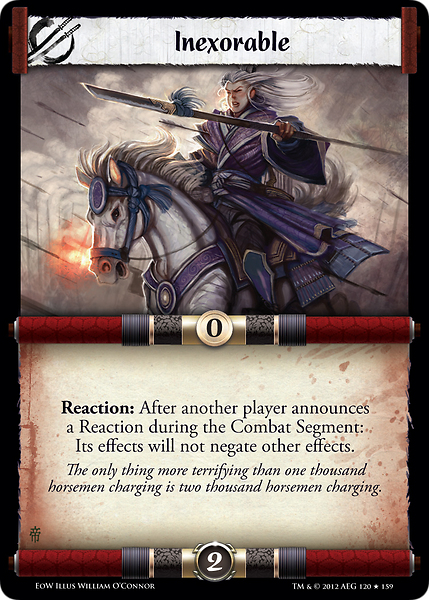
- Card Type
- Strategy
- Gold Cost
- 0
- Card Text
- Reaction: After another player announces a Reaction during the Combat Segment: Its effects will not negate other effects.
- Focus Value
- 2
- Legality
- Age of Conquest (Emperor)
- Deck
- Fate
Printings
Embers of War
- Rarity
- Rare
- Flavor Text
- The only thing more terrifying than one thousand horsemen charging is two thousand horsemen charging.
- Artist
- William O'Connor
- Card Number
- 120
- Publisher
- Alderac Entertainment Group
Rules Q&A
- Q: Hello Rules Team,
I searched for "Gift Armor", "Gift Armor negate", and "Gift Armor Inexorable" regarding this, but while I found topics close to this I didn't find any exactly on this, so I'd appreciate your counsel.
Let's say I have Gift Armor attached to my Personality and my opponent plays a "destroy" card, like Cast Aside the Weak. Gift Armor's trait activates in response. Can my opponent respond to the Trait by playing Inexorable? This would depend entirely on if the Trait is considered an announced reaction or if it was...well, something else. I can't put my finger on the terminology (nor am I sure what to search for in the EE Rules), but you know what I'm getting at.
I'm thinking the answer is "No, they can't", but I would like your confirmation, one way or another.
Thanks!
Relevant Card Text:
A: No.
Traits are not Reactions. Alex Jones, "Gift Armor vs. Inexorable", 2 Mar 2013 - Q: My opponent and I are in battle. On his side, he has Hida Bakishi, on my side I have several personalities. Hida Bakishi performs Bishamon's Tower's battle action, "Battle: Choose your performing Berserker or unbowed Personality and target an enemy card with lower Force and no attachments: Destroy it," destroying one of my personalities. He then announces Bakishi's reaction, "Reaction: After an action resolves that Bakishi performed and that destroyed a card at the current battlefield: The next time (this turn) another player's action targets Bakishi, negate its effects on him." If I react to Bakishi's reaction with Inexorable, which says "After another player announces a Reaction during the Combat Segment: Its effects will not negate other effects," would that effectively cancel out Bakishi's reaction? Meaning, would his reaction still be able to negate the next effect I try to use on him?
A: If Inexorable is played in Reaction to Hida Bakishi's action, his action will not negate anything. Alex Jones, "Hida Bakishi Vs. Inexorable", 3 Jan 2013 - Q: As somewhat of a follow-up to this thread, while Takeshi's ability will not allow you to negate a send home effect that states it will not be negated with a performed negation effect, it would prevent your opponent from stopping your use of that card with Inexorable, correct?
A: No. Inexorable does not negate anything; it says another action will not negate actions. This is not in and of itself negation, and therefore Takeshi has no effect on Inexorable. Jon Palmer, "Tamori Takeshi", 23 Dec 2012 - Q: Am I right in thinking that "before engaging" effects are before the combat segment and "after engaging" effects are during, hence I can Inexorable any applicable "after engaging" ones?
A: That is correct, even says so right here! Jon Palmer, "Easy question about when combat segment begins", 15 Oct 2012 - Q: Suitengu's Torch says: Reaction: After you announce a Thunder Battle action: Its effects will not be negated or delayed.
Inexorable says: Reaction: After another player announces a Reaction during the Combat Segment: Its effects will not negate other effects.
If I attack a Mantis player and he, as the defender, plays the first action as a Thunder action send home with the Reaction off the stronghold, can I use Inexorable to counter the effects of the stronghold reaction and then play a movement negation card?
A: No.
A negation effect can itself be negated or otherwise prevented, but "will not" is not preventable.
See Effects, "Does not/Will not" versus Negation: These phrasings are equivalent in the way their form of prevention works, and the rules on prevention below refer to both of them. The main difference between the two is that in the card set, negation effects are sometimes specifically prevented with wording such as "will not be negated," whereas there is no such wording to prevent "does not" effects as a specific category. Alex Jones, "Suitengu's Torch vs Inexorable", 10 Jul 2012 - Q: This is a seemingly improbable set of events, but given the prevalence of all the cards, I can see it coming up a lot. The example I list is specific, but the consequences apply to dozens, if not hundreds of card combinations.
The breakdown is this. Personality_A targets Personality_B with a simple bow action. Player_B reacts with Ancestral Protection, negating the effects. Player_A reacts with Inexorable, making the effects non-negatable. Player_B NOW reacts with Ryoshun's Guidance, wanting to change the target of the now-non-negatable action.
The question: Does the timing of "When another player's action would," take place before the "after an action targets?"
or
Do both of those steps trigger at the same time, allowing the negation chain followed by redirection?
I apologize if there is already a ruling on this, but there are so many combinations of cards that share these wordings that I couldn't find any in my search.
Ancestral Protection: Reaction: After an action targets your Personality, destroy your performing Ancestor: Negate the action's effects.
Inexorable: Reaction: After another player announces a Reaction during the Combat Segment: Its effects will not negate other effects.
Ryoshun's Guidance Reaction: When another player's action would target one of your cards, discard this card: Choose another of your non-Stronghold cards at the same location. The action targets it instead, if legal.
A: "Would target" does in fact take place prior to "after an action targets". Therefore, the redirection window has passed after Inexorable is played. Jon Palmer, "Inexorable followed by Redirection", 26 Jun 2012 - Q: Hi,
I need some claryfikation
If my enemy play The Snow Has Teeth: Reaction: After engaging: The current battlefield's province has a maximum strength equal to its base strength until the end of the battle. Negate the next effect that would move one of your Personalities from its battlefield. After the next time this battle a Terrain enters play, destroy it.
Is there any posibility to negate the efect of base maximum strength? Can I add some from ex. Indomitable Home? Or play any reaction like Inexorable? What if I had earlier an efekt of welling spirits? Does it target my base strength or Base strength + willing spirits? And if base strength when I play in this situation Inexorable will the willing spirits efekt will be safe?
Thx for reply
A: The Snow Has Teeth sets a maximum on the province's strength equal to its base strength. This will override all other province strength-increasing effects, such as Willing Spirits and Indomitable Home. If your base province strength is 6 (say, Temple of Purity), nothing is getting it above that 6 number.
Province strength-increasing effects will still allow you to raise the province back to its base if it has been lowered - for instance, the attacker players The Snow Has Teeth, then uses Qalyar's reaction to lower the province strength by 2. You may increase it back to its base strength; however, if you use an Ring of Earth to give it +3, only 2 of that will be counted. Jon Palmer, "The Snow Has Teeth and the province strength", 9 Jun 2012 - Q: So my opponent attacks with Hotako and I defend with 2 Yurishi. He plays power of strength targeting both the Yurishi. I react with both the Yurishi and move them both home. If he plays Inexorable can he still target the second Yurishi with the ranged attack?
We figured that if both reacted and moved home the power of the strength would be able to bow one of the Yurishi but because it targets both personalities in the constraints block when it gets to the effects and you have to declare the optional target of the ranged attack the personality isn't a legal target so you wouldn't be able to declare the ranged attack.
A: Your assertion is correct. You cannot target the Ranged Attack in the above scenario, as the Yurishi, being at home, is not a legal target at the time of targeting. Jon Palmer, "Goju Yurishi vs Power of Strength and Inexorable", 1 Jun 2012 - Q: If my opponent targets my scorpion personality with an action that would destroy him, I announce Loyalty of the Scorpion and my opponent reacts with Inexorable, am I able to choose to not pay the costs due to interference? Or, since the target nor the costs were interfered with am I forced to pay the mandatory costs of selecting a scorpion personality to destroy? Thank you for your help!
A: The latter.
Since the neither target nor the costs were interfered with you must choose a Performer and pay the mandatory cost of destroying him. Alex Jones, "Loyalty of the Scorpion vs Inexorable", 30 May 2012 - Q: Hi there!
My opponent announces the Snow has Teeth after engaging, and I react with Inexorable. I can now send people home again without the Snow Has Teeth negating it. But, can I now also raise my province strength (beyond the maximum)? I think not, but in the past stuff that disallowed other stuff was functionally regarded the same as 'negated', so I need to make sure...
Thank you!
A: Giving a stat a maximum value is new effect, not a negation effect. Alex Jones, "The Snow Has Teeth and Inexorable", 24 May 2012 - Q: ...can you confirm if the same things happens with regards to Inexorable and Snake Tattoo? For example - a Monk personality is targeted with a battle action and reacts with Snake Tattoo. If the Monk personality's opponent reacts with Inexorable, presumably the battle action's effects still occur even though the Monk presonality is in a different province? Presumably Inexorable will also hose Goju Yurishi's reaction also?
A: And yes, the case in the above link describing the interaction between Snake Tattoo and Yoritomo Hiromi also applies to Snake Tattoo/Goju Yurushi and Inexorable. The Tattooed Personality or Yurushi will still move, but Inexorable will prevent the negation, and the action's effects will occur as normal, since the Tattooed guy or Yurushi were legally targeted in the first place. Brook Cunningham, "Inexorable", 22 May 2012 - Q: So this came up in a game the other and I just wanted to double check that we played it correctly. Player A (Spider, go spider!) announces an action, in this instance it was A Brave New World. Player B (dirty dishonor player) reacts to announcing with Bad Kharma. Player A then reacts to the Bad Kharma with my copy of Inexorable. Do I now get to resolve my Brave New World without paying the cost of discarding a card? Bad Kharma tells me only to ignore the costs but doesn't negate anything anymore due to my Inexorable. We played on without me having to discard, which seems pretty great but wanted to check we played it correctly.
Relavent Text:
Bad Kharma- Reaction: After another player with Family Honor of -1 or lower announces an action on a Strategy: He ignores the action's costs. Negate its effects.
Inexorable- Reaction: After another player announces a Reaction during the Combat Segment: Its effects will not negate other effects.
A Brave New World- Battle: Choose your performing Personality and discard a card: Move your Personality to the current battlefield. Straighten his unit if he moved.
A: You played it correctly.
Inexorable would cause the negation from Bad Kharma to fail, but its effect letting you ignore the action's cost still happens. Brook Cunningham, "Bad Kharma vs Inexorable", 10 May 2012