Iron Tetsubo
Legend of the Five Rings card from The Truest Test, Samurai Edition Banzai
Open in Oracle of the Void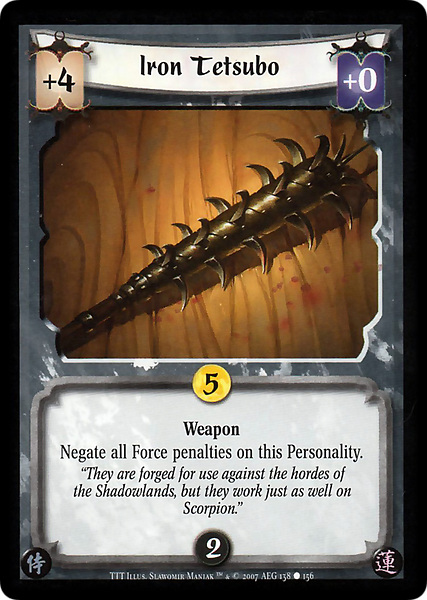
- Card Type
- Item
- Force
- +4
- Chi
- +0
- Gold Cost
- 5
- Keywords
- Weapon
- Card Text
- Negate all Force penalties on this Personality.
- Focus Value
- 2
- Legality
- Age of Enlightenment (Lotus), Race for the Throne (Samurai)
- Deck
- Fate
Printings
The Truest Test
- Rarity
- Common
- Flavor Text
- "They are forged for use against the hordes of the Shadowlands, but they work just as well on Scorpion."
- Artist
- Slawomir Maniak
- Card Number
- 138
- Publisher
- Alderac Entertainment Group
Samurai Edition Banzai
- Rarity
- Starter
- Flavor Text
- "They are forged for use against the hordes of the Shadowlands, but they work just as well on Scorpion."
- Artist
- Slawomir Maniak
- Publisher
- Alderac Entertainment Group
Rules Q&A
- Q: Considering, for example, the scenario involving 2F Moshi Taya and 5F base Hida Bob with an Iron Tetsubo exchanging force with Determination taken as a reaction before Taya's Battle action was announced: Definitely, Taya will end up with 9F. Will Hida Bob end up with 2F or 9F?
Moshi Taya Battle: Exchange the Force of one of your target Naval Personalities with the Force of a target Personality opposing him.
Iron Tetsubo Negate all Force penalties on this Personality.
Determination Dark Virtue Reaction: Before you announce an action, target one of your Samurai: The action can not have its effects negated or have its targeting changed. After the action destroys any Personality, remove him from the game.
1. Moshi Taya is currently at 2F. Hida Bob is at 9F.
2. Iron Tetsubo grants Hida Bob a continous trait negating all force penalties on him. Continuous traits do not have a duration. They are "always on."
3. When two stats are exchanged, their current values are noted. Then, each stat is set to the other's current value, simultaneously. Any changes to stat values from an exchange do count as bonuses or penalties.
Various effects will set a stat to some particular value, such as effects that switch or copy stats. To set a stat to a value, give an appropriate bonus or penalty.
Moshi Taya's force is set to 9F and that involves a +7F bonus. Hida Bob's force is set to 2F and that involves a -7F penalty.
4. Taya's Battle action's effect is an ongoing effect.
5. The effects of Determination are neither continous nor instantaneous. It is an ongoing effect affecting in this case Taya's Battle action. Ongoing effects last until the end of the turn in which they occur unless otherwise indicated. Ongoing effects do not end if the card they came from leaves play.
The effect of Taya's Battle action cannot be negated and this is a non-continuous negation effect.
6. The effect of Iron Tetsubo on Hida Bob is continous, specifically a continuous negation effect, since it is a non-triggered continuous trait.
A: Duration of negation effects: "If a non-continuous negation effect uses “can not” wording, (such as, “Battle: A target Personality cannot be bowed,”) this is an ongoing effect that follows the normal rules of duration, prevents instantaneous effects from happening, prevents new ongoing effects from taking place, and negates ongoing or continuous effects."
Determination creates an ongoing effect that negates the Iron Tetsubo's continuous negation effect. Alex Jones, "Moshi Taya, Iron Tetsubo, and Determination", 20 Jun 2008 - Q: Terrain Battle: Before this battle’s resolution, reduce the Force of each Personality at this battlefield to the Force of his highest Force Follower, or to 1 if he has no Followers.
A: So, it says "Before this battle's resolution." That means the effect happens after the Combat Segment. You aren't going to be playing any copies of Shout of Defiance (a Battle Action) after the Force reduction effect is applied.
As to the Iron Tetsubo, it says, "Negate all Force penalties on this Personality," and the Rules say, Martin Lund, "Three stone river and Iron Tetsubo", 19 Mar 2008 - Q: Bonuses and penalties are commonly referred to by a mathematical expression such as +1F or -1 Personal Honor. The terms “gain,” “increase” and “give” for bonuses, and “lose,” “reduce” or “suffer” for penalties, are also used.
...
Any change in a stat’s value is considered a bonus (if increased) or penalty (if decreased), with the following exceptions:
A: Ref: Comprehensive Rules - Stats
So reducing your Personality from say, 6F to 1F involves a -5F Penalty, which would be Negated by the Iron Tetsubo. Martin Lund, "Three stone river and Iron Tetsubo", 19 Mar 2008 - Q: Hida Fumetsu has the trait that he gains +3F during the Combat Segment
Iron Tetsubo has a trait that negates all Force Penalties on the personality.
If Hida Fumetsu equips an Iron Tetsubo, and then attacks, what will his total force be after the Combat Segment ends and why?
(10? 13?)
A: http://rules.l5r.com/Card_features#Gene ... bout_stats: "Any change in a stat’s value is considered a bonus (if increased) or penalty (if decreased), with the following exceptions:
"When a bonus, penalty, maximum, or minimum ends or is negated, the resulting stat change is not considered a penalty or bonus." (Emphasis added.) Zen Faulkes, "Hida Fumetsu and Iron Tetsubo (Loss of Force Bonus=Penalty?)", 27 Feb 2008 - Q: Justly Earned Victory vs Iron Tetsubo: Which overrides which?
A: Mod reminder: When a card has mutiple actions, please specify which one you're talking about. Thanks!
Assuming we're talking about the second ability, "Negate all current Force bonuses and penalties to cards at this battlefield from actions" (emphasis added), I note that Iron Tetsubo is not an action. Zen Faulkes, "Justly Earned Victory vs Iron Tetsubo", 2 Feb 2008 - Q: Hi !
In a situation where Shosuro Adeiko has put a -3/-1 token on one of my personnalities, I'd like to know what happens in those cases:
- I attach Iron Testubo (the force penalty is negated) to the personnality. I then transfer the Iron Tetsubo to another of my personnalities. What happens to the force penalty ? Has it been negated for ever or only while the Iron Tetsubo is attached ?
A: Only while the Iron Tetsubo is attached. That Token creates a Continuous Effect. Once one Continuous Effect negating another Continuous Effect ends, the previously suppressed Continuous Effect reasserts itself. Martin Lund, "Force penalty tokens", 2 Nov 2007 - Q: If I use the Daidoji Gunso Battle ability targeting the Iron Tetsubo, does its trait negate the force penalty?
So by extension is it possible to use two Daidoji Gunsos to destroy a single Iron Tetsubo by reducing its force to 0?
Daidoji Gunso: Battle: Give a target card opposing this one -2F. If the taret now has 0F, destroy it.
Iron Tetsubo: Negate all force penalties on this Personality.
The reason I ask is that the Tetsubo adds its force to that of its Personality, so I'm not sure if lowering its force is considered a force penalty to the Personality or not.
A: Giving a force penalty to a +x attachment will lower the personalities force, and is not considered a force penalty to the personality. Chris Fuchs, "Daidoji Gunso and Iron Tetsubo", 11 Sep 2007 - Q: Hi
I am a bit confused about the Iron Tetsubo rulings that have been made recently. Which of the following is correct:
A personality has an Iron Tetsubo attached and receives a force penality later that turn does:
a) The penalty gets negated.
b) The penalty affects the personality normally?
Thanks in advance.
A: Penalty is negated. Chris Fuchs, "Confused about Iron Tetsubo", 9 Jul 2007 - Q: If a negation effect is continuous (such as, “This card can not gain Force bonuses” on a card in play), it negates all relevant instantaneous, ongoing and continuous effects while the negation effect applies. If such an effect ceases to apply, ongoing effects do not reassert themselves, but continuous effects do.
Non-continuous negation effects (that is, from actions and triggered traits) vary in scope and duration, depending on how they are written.
A: This is a continuous negation effect, and thus negates all relevant instantaneous, ongoing and continuous effects while the trait remains on a card in play.
If it were the result of a triggered trait or an action, then you'd go down the bulleted list and arrive at the bottom entry (Otherwise, (such as a Battle action just saying “Negate all Force penalties on your Samurai”) such a negation should be interpreted as an instantaneous negation that only ends existing ongoing effects, with no effect on continuous effects or new ongoing effects.) - but in this case that does not apply.
Several people read through the Comp. Rules and had the same confusion (myself included) before Chris highlighted the key point. Like I said, we'll look into better formating to make the answer to this sort of question a little more accessible. Martin Lund, "Iron Tetsubo pt. 3", 5 Jul 2007 - Q: RE: This.
Pardon me, but I don't believe the response in the link above sufficiently or correctly answers the question that preceeds it.
The quote in the answer from the comprehensive rules states: "...a Battle action just saying “Negate all Force penalties on your Samurai”... should be interpreted as an instantaneous negation that only ends existing ongoing effects, with no effect on continuous effects or new ongoing effects."
But the Tetsubo's negation isn't an action, it's a trait that sits in play, saying what it says, for as long as the Tetsubo does. This seems to me to be ongoing negation rather than instantneous. Whether I'm correct or not, the answer's quoted reference to an "action" (above bolded emphasis mine) is either wrong in the former case or makes the point unclear in the latter.
Please clarify or correct. Thank you.
A: Doesn't matter that one example is an action and one is an item; the wording is exactly parallel. Zen Faulkes, "RE: Iron Tetsubo", 5 Jul 2007 - Q: Iron Tetsubo: Does it work for subsequent penalties only? Or does it remove all the existing ones when it's brought into play?
A: Comprehensive Rules, Effect, Negating Effects: "...a Battle action just saying “Negate all Force penalties on your Samurai”... should be interpreted as an instantaneous negation that only ends existing ongoing effects, with no effect on continuous effects or new ongoing effects." Zen Faulkes, "Iron Tetsubo", 4 Jul 2007