Moto Latomu
Legend of the Five Rings card from Lotus Edition, Winds of Change
Open in Oracle of the Void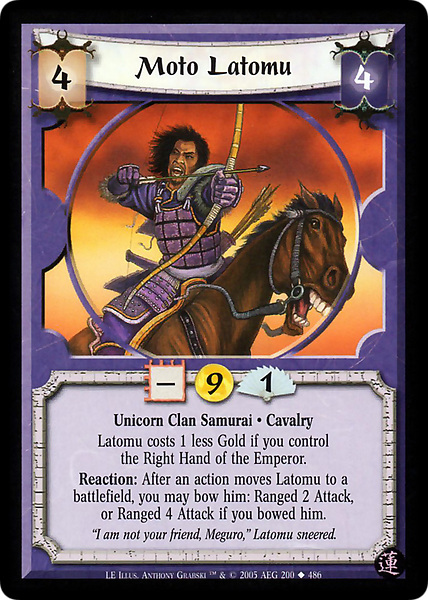
- Card Type
- Personality
- Force
- 4
- Chi
- 4
- Honor Requirement
- -
- Gold Cost
- 9
- Personal Honor
- 1
- Clan
- Unicorn
- Keywords
- Cavalry, Samurai, Unicorn Clan
- Card Text
- Latomu has -1 Gold Cost if you control the Right Hand of the Emperor.
Reaction: After an action moves Latomu to a battlefield, you may bow him. Ranged 2 Attack, or Ranged 4 Attack if you bowed him. - Legality
- Age of Enlightenment (Lotus), Four Winds (Gold), Rain of Blood (Diamond)
- Deck
- Dynasty
Printings
Lotus Edition
- Rarity
- Uncommon
- Flavor Text
- "I am not your friend, Meguro," Latomu sneered.
- Artist
- Anthony Grabski
- Card Number
- 200
- Publisher
- Alderac Entertainment Group
Winds of Change
- Rarity
- Uncommon
- Flavor Text
- "Sezaru had only four jade tears. Kaneka was forced to enter the Shadowlands without us. I pray for him."
- Artist
- Anthony Grabski
- Card Number
- 73
- Publisher
- Alderac Entertainment Group
Rulings
- Erratum: Reads, "Moto Latomu 4F/4C -HR 9G 1PH Unicorn Clan Samurai. Cavalry. Latomu costs 1 less Gold if you control the Right Hand of the Emperor. Reaction: After an action moves Latomu to a battlefield, you may bow him: Ranged 2 Attack, or Ranged 4 Attack if you bowed him." [MRP, Lotus Edition, 31 October 2005] Rules Archive, August 18, 2007, p. 115
Rules Q&A
- Q: I need a ruling concerning Action Card "Taut Bowstrings" and some personalities.
Taut Bowstrings (WoC) "Reaction: Play before one of your target Followers or Items bows to produce a ranged attack or as part of a combined ranged attack. That card need not bow. Reaction: Play after a unit moves into a Province or before a unit leaves a Province to make a ranged attack targeting it from your opposing cards in that Province. Your cards need not bow to produce this attack."
Now, usually RAs are Battle actions, but sometimes they are Reactions. Moto Latomu has such ability, Moto Latomu exp gives it to others, and Shosuro Tsuyoshi has one compared against Chi. My question is, can I use second ability of TB with such RAs? I would say yes, basing on RAs description on page 90 in rulebook, but I'm not sure.
A: The only snag I see in that under page 90 of the Rulebook, it says that for Combined Ranged Attacks: "must all be the same type, and the cards must all be able to make a ranged attack at that time and at the intended target."
Taut bowstrings gets around the "at the same time" part by letting everyone shoot out of turn, but not the "same type" part. You'd need all "Reaction" RAs or all "Battle" RAs, but you could not make a combined RA of "Reaction" ability Ranged Attacks and "Battle" ability Ranged Attacks. Also, keep an eye out on your targets, since many Reaction Ranged Attacks target something that has to do with their Trigger, and their Trigger may not be met when Taut Bowstrings lets them shoot out-of-turn.
Comparing against Chi isn't a problem. The Combined Ranged Attack picks up all such special properties from its individual parts. If you combine a Chi comparison RA with a regular RA, the Combined Ranged Attack is compared against Chi. Martin Lund, "Rules for 4 January 2005", 8 Jan 2005 - Q: Here's the scenario :
We are in a battle, he has hayaku on defense, I am attacking with two personalities (Moto Latomu and Iuchi Yue, for example) It's his action, and he plays Overwhelmed.
Does his reaction to being destroyed as the cost for overwhelmed allow him to effectively shoot my Moto Latomu for 4, thus leaving only one personality at the province, which I must choose to destroy because I do not have two or more personalities in my army?
A: Yes. Hyaku must be destroyed to pay the cost of Overwhelmed during the Pay Costs step of taking the Action. You don't get to choose to send anyone home or destroy anyone until the Resolve Effects step, which comes later. Further, Hyaku's reaction comes before his destruction, so the sequence will be:
- Announce Overwhelmed
- Target Hyaku
- React before paying by destroying Hyaku with Hyaku's Reaction to shoot Latomu
- Destroy Hyaku to pay the cost of Overwhelmed
- Resolve Overwhelmed's effects - forcing you to deal with sending home 2 units or destroying your biggest Personality. Martin Lund, "Rules for 3 November 2004", 5 Nov 2004 - Q: I suspect that the third question is subject to the Moto Latomu precedent (i.e. the ruling where Latomu moves from the current battle to a different battle in an attempt to make a ranged attack), but I would just like to confirm if this is a similar instance.
A: It is pretty much the same kettle of fish, with the added spice of being able to count as being someplace else while taking an Action. Martin Lund, "Rules for 26 October 2004", 1 Nov 2004 - Q: With talk about Moto Latomu, I was wondering if Rekai's Battle action is affected by the ruling for Latomu since its range attacks involves movement?
A: No impact that I can see. The cards are very distinct in function. Rekai has a single ability with both movement and Ranged Attack effects in it. Latomu only has a Ranged Attack. His ability does not generate any movement, but rather Reacts to it. Martin Lund, "Rules for 21 July 2004", 23 Jul 2004 - Q: For example, can I (presuming Moto Latomu has a Shinjo Horsebow)...
A: None of the examples will work. You can't use Shinjo Horsebow at the same time as Latomu. Latomu's Ranged Attack is part of a Reaction, while Shinjo Horsebow only produces Ranged Attacks as a Battle Action.
"The combined actions' types must all be the same, and the cards must all be able to make a ranged attack at that time and at the intended target." (Diamond Edition Rulebook, pg 90, "Making Ranged Attacks") Martin Lund, "Rules for 5 July 2004", 7 Jul 2004 - Q: Cut and Pasted from http://l5r.alderac.com/rulings/
If an action gives you an option of which effect to use (e.g., Moto Latomu, Scrutiny's Sweet Sting), you must announce which you intend to use when you announce the action. [ML, 22 June 2004]
Scrutiny's Sweet Sting If redirected, you can attempt to remove any trait allowed (even if the new target Personality has none of them). [ML, 27 May 2004]
A: [MARTY] The newer ruling overrides the old one. The newer ruling came after some Rules Team discussions. Martin Lund, "Rules for 29 June 2004", 2 Jul 2004 - Q: Hi! We have here a strange problem. Some unicorns players claim that if you have two personalities in the same battle (one or both of the Moto Latomu (Reaction: After an action moves Latomu into a battle, bow Latomu for a Ranged 4 attack, or make a Ranged 2 Attack without bowing.))
and switch them using the Northern Provinces of the Moto.
(Battle:Switch the locations of two of your unbowed Cavalry Personalities that this action has not targeted this turn. You may do this when your Stronghold is bowed.)
then Moto Latomu can use his ranged attack.
If they are in the same battle, there is no movement, and the "moves in" on latome doesn´t kick, I think.
A: You are correct. There is no movement if the unit does not change locations. No movement means no reactions to movement. Jeff Alexander, "rules for 2-3 March 2004", 4 Mar 2004 - Q: I declare an attack, assign no attacking personality. Before resolution at a province where there is a defending personnality, I use Honor Lesson Dojo to take an action. I move Moto Latomu into the battle with tireless assault. Can I then use the reaction to make a ranged attack ?
A: Yes (card text). Zen Faulkes, "Rules for 29 November 2003", 29 Nov 2003 - Q: when Moto Latomu moves into a battle and uses his Reaction to make a Ranged 2 Attack without bowing, if it is then cancelled by Fall On Your Knees, he can use the Reaction again to make a Ranged Attack again.
A: Correct. Zen Faulkes, "Rules for 14 November 2003, Part 2", 15 Nov 2003 - Q: Player A attacks one of Player B's provinces with Ide Sadanobu, and attacks another province with Moto Latomu. Latomu has a Dai-kyu attached. Player A uses Northern Provinces of the Moto to switch Latomu and Sadanobu, reacting to the movement with Latomu's ranged attack. Can Latomu then combine his ranged attack with that of his Dai-kyu?
A: No; combining is only an option when Ranged Attacks are made as a Battle action (Gold Edition rulebook, pg. 63). Zen Faulkes, "Rules for 24 September 2003", 24 Sep 2003 - Q: I am very confused over the recent rulings that Rain of Death can be used for the second Battle action in battles other than that which is being resolved (please see Marty's many explanations). I understand how it meets relevance, action coming from the card in the current battle etc. I can't see how it can be used based on these previous rulings from Jeff:
Moto Kumari
Cannot use his Reaction upon moving to a battle other than the current one, because it targets an opposing Personality, and actions targeting "opposing" cards require the card making the action be in the current battle. [Extension from Moto Latomu, 12 May 2004]
Moto Latomu
Cannot use his Reaction upon moving to a battle other than the current one, because Ranged Attacks target opposing cards, and actions targeting "opposing" cards require the card making the action be in the current battle. [JA, email, 12 May 2004]
Seems to me that the use of the "opposing" in Rain of Death would have the same limitation. My reasoning:-
1) Although RoD can meet relevance by being at a battle, it can never be opposed as it is not in an army. Therefore the word "opposing" needs to be applied to the tactician personality you use.
2) RoD clearly states that it is the personality that is performing the action, in the cost portion of the second action.
3) Previous rulings would show that you can only take actions targeting "opposing" cards, if the card performing the action is in the current battle.
Marty, Jeff, Zen please explain this to me.
[Edit] Is this just a difference between "performing" (as described on RoD) and "making" (as described in the rulings)?
Cheers
UK Ronin
Thanks for the speedy response, I just wish there was a better way to continue this discussion.
OK Zen wrote:
Quote:
UK Ronin wrote:
Previous rulings would show that you can only take actions targeting "opposing" cards, if the card performing the action is in the current battle.
Diamond rules, pg. 81: "A player can take an action that refers to an 'opposing' card or 'this battle,' or that includes an implicating phrase such as 'another attacking card' or 'the Province this card is defending,' only if the card on which the action is printed is in the current battle."
The action is printed on Rain of Death. Rain of Death is in the current battle.
In the case of the Moto Personalities, the actions are printed on them, so they must be in the current battle.
Great, so you have shown that Rain of Death is in a battle (not disputed), that the action can meet relevance (coming from a card in the battle) and that, assuming you still have presence in the battle with RoD, you can take the action with a Tactician. So now answer how this interacts with Jeff's ruling, I have bolded the portion of Jeff's ruling causing my misunderstanding.
Moto Latomu
Cannot use his Reaction upon moving to a battle other than the current one, because Ranged Attacks target opposing cards, and actions targeting "opposing" cards require the card making the action be in the current battle. [JA, email, 12 May 2004]
I state again a couple of points:
1) Although RoD can meet relevance by being at a battle, it can never be opposed as it is not in an army. Therefore the word "opposing" needs to be applied to the tactician personality you use.
2) RoD clearly states that it is the personality that is performing the action, in the cost portion of the second action.
Is it your contention that the card Rain of Death is "the card making the action" even though the wording of Rain of Death clearly says that the performing card is the Tactician destroyed to pay the costs? DE rulebook pg 71 describes the process to determine what is performing the action. It seems to me that point 3. is the one that applies and that this confirms the Tactician you destroy as the cost is performing the action as described on RoD.
I think basically it comes down to this question.
Are "making the action" and "performing an action" the same or different?
I cannot find a definition in the rulebook of what "making an action" means. Is Jeff's previous ruling just badly worded? Did he mean "performing" instead of "making"?
Cheers
UK Ronin
A: Diamond rules, pg. 81: "A player can take an action that refers to an 'opposing' card or 'this battle,' or that includes an implicating phrase such as 'another attacking card' or 'the Province this card is defending,' only if the card on which the action is printed is in the current battle."
The action is printed on Rain of Death. Rain of Death is in the current battle.
In the case of the Moto Personalities, the actions are printed on them, so they must be in the current battle. Zen Faulkes, "Rain of Death and "Opposing" - Updated, take a loo", 31 Mar 2005 - Q: Hello.
Opposing retrictions for cards in play but not in an army
Sorry to bring back this one.
"Opposing" restriction vs Rain of death's second action.
From March 2005 Ruling Archive
konn wrote:
I have 2 tacticians on battlefield A, one tactician on Battlefield B, and one tactician on my home. I'm resolving battle A first. I play RoD. ¿Can I use the ability of destroy 2 opossing cards on battlefield B (destroying my tactician on B)?
Yes.
From March 2005 Ruling Archive
A reference to "an opposing card" means "a card opposing this card"
when it is used on a card that can be in [an army]. It instead means
"a card opposing a card you control" when used on something else.
From DE rulebook.
An action which refers to this battle always refers to the battle currently being resolved. In addition, if the card it appears on is of a type which can be in battles (such as a Personality), the card must be in the current battle for the action to be legal.
The Diamond Edition Rulebook, page 81 wrote:
A player can take an action that refers to an opposing card or this battle, or that includes an implicating phrase such as another attacking card or the Province this card is defending, only if the card on which the action is printed is in the current battle.
From Acc. Rulings.
actions targeting "opposing" cards require the card making the action be in the current battle. [Extension from Moto Latomu, 12 May 2004]
card text
Tactical Battle: Bow and destroy the performing Tactician: Target two cards opposing him that have no unbowed cards attached. Destroy them.
So when you try to destroy your tactician in battle B,while resolving battle A.
-you have presence (the 2 tacticians.)
-you have relevance (the action comes from the formation that is in the current battle)
-the card that has the action with "opposing" is in the current battle, but
-Since the formation cant be opposing (it cant be in an army only in battlefields) it must transmit the opposing to other card that is in the army.
Opposing means cards in an army that has an enemy army at the same battlefield.
[It instead means "a card opposing a card you control" when used on something else.]
So now is the tactician in battlefield B who must meet the "opposing"
Q)Has the tactician to meet the "opposing"?
Q)when [It instead means "a card opposing a card you control" when used on something else.] is applied you only check if the card with the action on it is in the current battle?
Q)Rain of death is "special". Could this be applied to other formations/terrains?(cards that can be in battlefields but not in an army)
Thanks.
Greetings.
A: Re-read page 81.
In the case of Kumari and Rain of Death the card with the Action is in the Current Battle.
So page 81 is satisfied by Rain of Death simply being in the Current Battle - regardless of where the targets and Tactician are.
As for "opposing" in relation to Rain of Death - Rain of Death can't oppose anything. It can't be in an Army. When using a Reference to "opposing" from something that can't be in an Army, you have to find out what it is refering to actually establishing opposition. It might mention another card to be opposed like the Tactician who paid the cost of the second ability, or it might mention no one like the first ability on Rain of Death - in which case it means opposing you the player.
We have definitions that fit both those situations, and precedents for them as well. For the first ability of Rain of Death, see how Tsuruchi Technique and Arrows from the Woods work. For the second ability, check out To Do What We Must. Martin Lund, "Opposing retrictions for cards in play but not in an army", 31 Mar 2005