Asako Juro
Legend of the Five Rings card from The Heaven's Will
Open in Oracle of the Void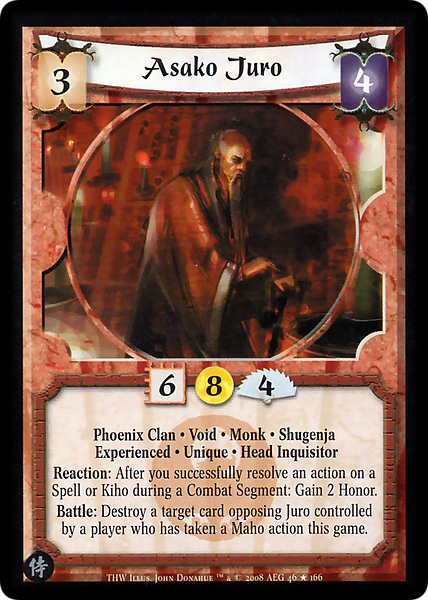
- Card Type
- Personality
- Force
- 3
- Chi
- 4
- Honor Requirement
- 6
- Gold Cost
- 8
- Personal Honor
- 4
- Clan
- Brotherhood of Shinsei, Phoenix
- Keywords
- Unique, Experienced, Head Inquisitor, Inquisitor, Monk, Phoenix Clan, Shugenja, Void
- Card Text
- Reaction: After your Spell or Kiho action resolves during a Combat Segment: Gain 2 Honor.
Battle: Target a card opposing Juro controlled by a player who has taken a Maho action this game: Destroy it. - Legality
- Race for the Throne (Samurai)
- Deck
- Dynasty
Printings
The Heaven's Will
- Rarity
- Rare
- Artist
- John Donahue
- Card Number
- 46
- Publisher
- Alderac Entertainment Group
Rules Q&A
- Q: Daidoji Botan Limited: If a province has been destroyed since your last turn began: Gain 2 Honor.
I am curious as to when card memory begin. The only referenced rule I could find in the Comprehensive Rules was card memory ended once a card was both face-down and out of play. I would surmise that the opposite would hold true, that card memory begins once a card turns face-up. But does whether or not a card is in play impact its card memory status? In cases of cards in discard piles, cards retain memory as long as it stays face-up, actions taken previously in a turn can not be used again if a card is returned to play in the same turn. So does card memory begin even if a card is face-up and not in play or at some other point?
Specifically does Daidoji Botan track if a province has been destroyed since your last turn began even when he is not in play? In addition, would face-up or face-down status have an impact in this case.
First Example:
On your turn you discard a Daidoji Botan during your Dynasty Phase. On your Opponent's following turn, he destroys one of your provinces. On your subsequent turn you play Civility and bring the discarded Daidoji Botan into play. Is it legal to take his printed action? Daidoji Botan was "not" in play but was face-up in your discard pile when your province was destroyed on your opponent's turn after your last turn begun.
refenced card: Civility Open: Target your discarded (not dead) Samurai Personality: Bring him into play.
Second Example:
Your opponent destroys your province on his turn with a face-down card, the discarded card in your province is Daidoji Botan. On your subsequent turn your play Civility and bring that discarded Daidoji Botan into play. Is it legal to take his printed action? Daidoji Botan was "not" in play nor was he face-up in your discard pile at the time your province was destroyed, he was turned face-up as part of the resolution of the destruction of your province during your opponents turn after your last turn begun.
Third Example:
On your turn you reveal a Daidoji Botan in one of your provinces. You declare an attack on your opponent and destroy one of his provinces. During your Dynasty Phase you buy the revealed Daidoji Botan. Your opponent does not attack nor are any provinces destroyed on his turn. On your following turn, is it legal to take Daidoji Botan's printed action? Daidoji Botan was "not" in play but was face-up in a province at the time you destroyed a province since your last turn begun.
Similar question with a different card:
Asako Juro exp Battle: Destroy a target card opposing Juro controlled by a player who has taken a Maho action this game.
Would Asako Juro exp "remember" a player as having taken a Maho action this game prior to entering play?
Thank you for taking the time to answer.
A: In all Botan cases above, and in the case of Juro, they would be able to use their abilities.
"Card Memory", or a lack thereof, doesn't apply to the entire game state. It only applies to the card itself.
Tracking rule (emphasis mine): "“Memory” of the status of individual cards ends when the card enters a deck or a hand, or otherwise becomes both face-down and out of play (such as after a card in the deck or hand is shown). This includes dishonorable status, ongoing effects, and whether or not an ability has been used."
The Tracking rule exists to remove any obligation to track the status of a card, when it may potentially become mingled with two other identical copies of itself. It actually needn't apply to Unique cards, but we have it do so for consistency. Brook Cunningham, "Card Memory regarding Daidoji Botan", 19 Apr 2010 - Q: Question: The wording for Asako Juro makes me think that if a player does at least one maho action during the entire game, Juro can kill any of his personalities. Is this correct?
Player 1: Performs Hated Curse (text below) using personality a. Player 1: Declares an attack and assigns personalities b at battlefield 1. Personality a does not assign. Player 2: Assigns Juro at battlefield 1, opposed personality b. Player 2: Uses Juro's ability to destroy personality b.
And this can continue each turn non stop. Juro will be able to destroy a personality every turn as long as the "player" has taken the Maho action.
Thank you for your assistance with this, if this is in fact the way this works Juro's action is stupid good in draft.
Asako Juro Experienced Phoenix Clan • Void • Monk • Shugenja • Experienced • Unique • Head Inquisitor Reaction: After you successfully resolve an action on a Spell or Kiho during a Combat Segment: Gain 2 Honor. Battle: Destroy a target card opposing Juro controlled by a player who has taken a Maho action this game.
Hated Curse Kiho Maho Limited: Dishonor your target unbowed Shugenja: Bow a target Personality. Lose 2 Honor.
A: This is correct.
If Player A ever takes a Maho action (Hated Curse, Touch of Death, etc.), Player B controlling Asako Juro Experienced can destroy an opposing card with his Battle action, once per turn, for the rest of the game. Dan Jacobson, "Asako Juro Exp + Maho Actions", 14 Nov 2008