Retribution
Legend of the Five Rings card from Emperor Edition, Celestial Edition, Diamond Edition, Lotus Edition, Samurai Edition, Winds of Change, Training Grounds, Promotional–Celestial, Reign of Blood, Hidden City, Promotional–Samurai
Open in Oracle of the Void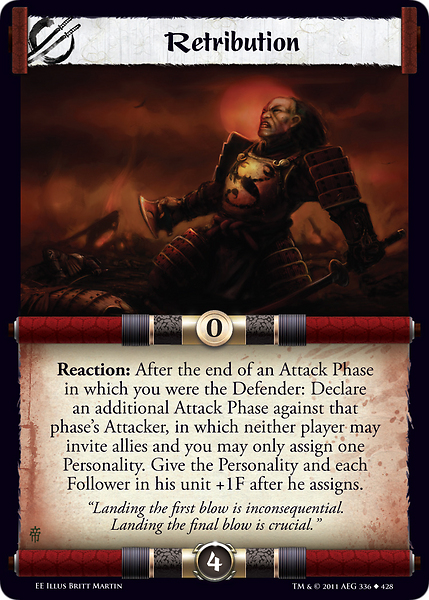
- Card Type
- Strategy
- Gold Cost
- 0
- Card Text
- Reaction: After the end of an Attack Phase in which you were the Defender: Declare an additional Attack Phase against that phase's Attacker, in which neither player may invite allies and you may only assign one Personality. Give the Personality and each Follower in his unit +1F after he assigns.
- Focus Value
- 4
- Legality
- Age of Conquest (Emperor), Age of Enlightenment (Lotus), Destroyer War (Celestial), Four Winds (Gold), Race for the Throne (Samurai), Rain of Blood (Diamond)
- Deck
- Fate
- Notes
- The Promotional version of this card is legal upon release, The Promotional version of this card was released to the 2011 Winner's Choice, Name a Card, Level 10, Level 15, Level 20, and Jewel Event participants
Printings
Emperor Edition
- Rarity
- Uncommon
- Flavor Text
- "Landing the first blow is inconsequential. Landing the final blow is crucial."
- Artist
- Britt Martin
- Card Number
- 336
- Publisher
- Alderac Entertainment Group
Celestial Edition
- Rarity
- Uncommon
- Artist
- Britt Martin
- Card Number
- 270
- Publisher
- Alderac Entertainment Group
Diamond Edition
- Rarity
- Common
- Flavor Text
- "The Four Winds risked everything for the Empire. Can the Great Clans do any less?" - Miya Hatori
- Artist
- Ed Cox
- Card Number
- 242
- Publisher
- Alderac Entertainment Group
Lotus Edition
- Rarity
- Common
- Artist
- Ed Cox
- Card Number
- 287
- Publisher
- Alderac Entertainment Group
Samurai Edition
- Rarity
- Uncommon
- Flavor Text
- "You will pay for what you have done. I swear it!"
- Artist
- Britt Martin
- Card Number
- 275
- Publisher
- Alderac Entertainment Group
Winds of Change
- Rarity
- Common
- Artist
- Ed Cox
- Card Number
- 84
- Publisher
- Alderac Entertainment Group
Training Grounds
- Rarity
- Fixed
- Flavor Text
- Jin sensed a change. More samurai had arrived.
- Artist
- Ed Cox
- Card Number
- Lion 13, Lion 38, Shadowlands 04, Shadowlands 15
- Publisher
- Alderac Entertainment Group
Promotional–Celestial
- Rarity
- Promo
- Flavor Text
- "Attack me and escape? Never!"
- Artist
- Héctor Herrera
- Publisher
- Alderac Entertainment Group
Reign of Blood
- Rarity
- Starter
- Flavor Text
- "The Four Winds risked everything for the Empire. Can the Great Clans do any less?" - Miya Hatori
- Artist
- Ed Cox
- Publisher
- Alderac Entertainment Group
Hidden City
- Rarity
- Starter
- Flavor Text
- "The Four Winds risked everything for the Empire. Can the Great Clans do any less?" - Miya Hatori
- Artist
- Ed Cox
- Publisher
- Alderac Entertainment Group
Promotional–Samurai
- Rarity
- Promo
- Flavor Text
- "You will pay for what you have done. I swear it!"
- Artist
- Britt Martin
- Publisher
- Alderac Entertainment Group
Rulings
- Causes an Attack to be declared. [JA, email, 11 June 2004] Rules Archive, August 18, 2007, p. 31
- Q: Can I play Retribution twice against the same attack? A: Yes. It's hard to visualize at first, since Retribution takes so long to do what it does, but once the whole extra Retribution-created Attack Phase is over, you're back to where you started: an attack against you has just finished, you took the opportunity to react, and now the player to your left gets one chance to react, and so on, in turn order, until all of you decline to react in succession. Until that happens, all Reactions taken "after an Attack Phase in which you were the Defender" are still legal -- including another Retribution. Legend of the Five Rings FAQ, April 26, 2004, p. 12
- Erratum: Reads, "Retribution 0G 4FV Reaction: After the end of an Attack Phase in which you were the Defender: Create an additional Attack Phase of your own in which you must choose the previous phase’s Attacker as the Defender. Neither player may invite allies and you may only assign one unit. Give the Personality and each Follower in that unit +1F after it assigns." [MRP, Celestial Edition, 29 June 2009] Comprehensive Rules, Celestial Edition, with specific card rulings, final version, February 2012, p. 150
- Erratum: Reads, "Retribution 0G 4FV Reaction: After the end of an Attack Phase in which you were the Defender: Declare an additional Attack Phase against that phase’s Attacker, in which neither player can invite allies and you can only assign one unit. Give the Personality and each Follower in that unit +1F after it assigns." [MRP, Samurai Edition, 25 July 2007] Comprehensive Rules, Samurai Edition, with specific card rulings, final version, May 2009, p. 151
Rules Q&A
- Q: 2) Reactions to end of the end of Raid attack such as Retribution and Counterattack, do they trigger another set up Raid Attacks or are they treated as normal attacks where provinces and armies can be destroyed during resolution?
A: There are no text on Retribution making battles into Raid Battles. They are regular battles with their own distinct Attack Phase. Martin Lund, "Rules for 15 December 2004", 22 Dec 2004 - Q: Following the questions on Ambush / Retribution,
I would like to ask if someone can play "Call to Arms" as a reaction to an "Ambush" thus straightening all his personalities before the Ambush takes place.
A: If his Personality is the target to be the Defending Personality, then he will be the Defending Player, and thusly be able to play Call to Arms during the Assignment Segment, as per card text of Call to Arms. Martin Lund, "Rules for 17 and 18 September 2004", 23 Sep 2004 - Q: Question 1: Do battles occur at all of my opponent's provinces during the attack phase created by Retribution? (I assume the answer is yes)
A: Yes. An Attack Phase creates a battle at each of the Defender's provinces. Retribution says nothing to contradict this. Martin Lund, "Rules for 16 September 2004", 23 Sep 2004 - Q: Question 2: May I use Tireless Assault to move units other than the unit I played Retribution on into battles during the attack phase created by Retribution? ( If not why not?)
A: Again, Retribution says nothing to the effect of preventing this. Martin Lund, "Rules for 16 September 2004", 23 Sep 2004 - Q: Question 3: May I play Retribution after an Ambush? ( I assume yes)
A: Ambush creates an Attack Phase. The controller of the Personality who is targeted to defend is the Defender for that Attack Phase. If your Personality is Ambushed, you can play Retribution afterwards. Martin Lund, "Rules for 16 September 2004", 23 Sep 2004 - Q: Question 4: I attack my Opponent. He reacts and plays Retribution. I then react to his Retribution, and play my own. May I target the unit I used in my initial attack?
A: Again, Retribution says nothing that prevents this choice. Keep in mind that your original attacking unit is likely bowed by this point, though. Martin Lund, "Rules for 16 September 2004", 23 Sep 2004 - Q: Scenario 2: I have 5 Personalities in Play. My Opponent has four Provinces. My opponent Ambushes one of my Personalities. After the Ambush I play Retribution. I assign my Retribution unit to his fourth Province, and proceed to resolve the other three battles first. I use Tireless Assault to move into and destroy each of these Provinces in succession with my other three Personalities. Legal?
A: Yes. Martin Lund, "Rules for 16 September 2004", 23 Sep 2004 - Q: Would it make a difference if I resolved the unit assigned by Retribution first?
A: No. Martin Lund, "Rules for 16 September 2004", 23 Sep 2004 - Q: Can Call to Arms be used when a player uses Retribution?
Given any attack phase has a declaration segment, a maneuvers segment, an action segment, and finally a resolution segment, then the attack phase created by Retribution should be enough to trigger Retribution, right?
A: You are correct, sir. Martin Lund, "Rules for 26 April 2004", 29 Apr 2004 - Q: 3) Can you use Unrequited Love when you are targeted by Retribution?
A: No. Jeff Alexander, "rules for 27 Feb. 2004", 28 Feb 2004 - Q: As new 'attacker' after playing Retribution, during the new attack phase, can I Tireless Assault an additional unit in, since that's not an assignment (thus avoiding the 1 unit limitation)?
A: Yes (Rules Archive, General Rules, Battle, Maneuvers Segment). Zen Faulkes, "Rules for 17 October 2003, Part 3", 17 Oct 2003 - Q: Does Retribution target?
A: Currently, yes (Winds of Change rulesheet). Zen Faulkes, "Rules for 11 September 2003", 12 Sep 2003 - Q: Of particular interest is playing Outmaneuvered In Court (OIC) vs Retribution, do they need to select an attacker at the targetting step and thus that person can be stopped from assigning and moving into the battle with OIC
A: No, it does not target a unit. Retribution creates an attack phase (card text), which includes the Maneuvers segments. Zen Faulkes, "Rules for 11 September 2003", 12 Sep 2003 - Q: Howdy!
I had a quick question about the following interaction:
Both my opponent and I have 4 provinces. My opponent attacks and takes my province (now 3 to 4.) I have a defender elsewhere who I play Reprisal on to counterattack and take his province (3 to 3.)
After my Reprisal phase attack, does the trigger still exist to play Retribution in reaction to my opponent's original attack.
If not, and I have to play Retribution before the Reprisal, does the order in which they get played matter. If not, how is it decided?
Cheers!
Reprisal Battle: Give your target defending or your target opposed Personality +1F for each card in his unit (including himself). After this Attack Phase ends, if he was defending and you have fewer Provinces than the Attacker, declare an additional Attack Phase against him, during which your other Personalities cannot attack.
Retribution Reaction: After the end of an Attack Phase in which you were the Defender: Declare an additional Attack Phase against that phase's Attacker, in which neither player may invite allies and you may only assign one Personality. Give the Personality and each Follower in his unit +1F after he assigns.
A: Reprisal will automatically trigger the attack phase after the other player's attack phase ends. However, this does not close the window for reactions played "after the end of an Attack Phase", such as Retribution. That window is only technically closed when both players pass on it. Therefore, you will still be able to Retribution after the attack phase created by Reprisal (but both your and your opponent will have a chance to react to the end of your Reprisal's attack phase first, so he might Retribution you!) Jon Palmer, "Reprisal + Retribution", 13 Mar 2015 - Q: Hi Rules Team,
I searched things like "Retribution trigger" and found the following results. However, that's an old ruling and since then I know there's been a change in ruling re: reacting to the same trigger multiple times. I can't find that second change (reacting to the same trigger) despite some effort so I'd like to ask here:
My opponent attacks me and takes a province. Can I react by playing Retribution, taking one of his provinces, and then playing another Retribution? I want to make sure this doesn't violate that recent ruling on reacting to the same trigger (the end of the original Attack Phase).
Thanks!
A: Yes, you may do that. The restriction on reaction triggers means that you can't use the same copy of an ability to react multiple times to the same trigger. If it's a different Retribution, it's a different ability. Jon Palmer, "Multiple Retributions vs. Triggers restrictions", 4 Nov 2013 - Q: Hi, I have a question: Could you play Perfect Moment/ Retribution and go to attack after opponent played Ambush on my personality?
A: No. Both of those cards are triggered by the end of an Attack Phase, and Ambush does not create an Attack Phase (it did, at one point, but no longer). Jon Palmer, "Perfect Moment after Ambush", 10 Oct 2013 - Q: Here is the scenario that happened to me in a game with a player running Shadow Dragon against me. Said player attacked with Shadow Dragon and 2 other personalities. He then used Shadow Dragon's trait to straighten. I reacted with The perfect moment and he chose not to assign Shadow Dragon to defend. I took the province and then he reacted with Retribution with Shadow Dragon to essentially take 2 provinces. However, my question is can a personality with the Conqueror trait be involved in two different attack phases if the opponent rets or TPMS the original attack and said Conqueror was in the army that destroyed a province at resolution?
So basically to summarize: A) Player A attacks with a Conqueror Personality, takes province and uses his trait to straighten B) Player B reacts with Retribution or TPM and Player A decides to not assign Conqueror Personality to defend C) Player A then reacts to Player B's battle with Retribution and assigns the Conqueror Personality to attack
Is the scenario above considered a legal play? Also could Player B actually then use move-in cards like Sound of Thunder to send their troops in to defend the second attack if Part C is a legal play?
A: The Second Battle Rule only restricts Personalities from being in an attacking army if they've already been in one that Attack Phase. Both Retribution and The Perfect Moment create a new Attack Phase, and therefore Personalities are not restricted by prior Attack Phase resolutions. What you describe is legal (and since the Second Battle Rule only applies to attackers, it'd be legal for your defenders to move in regardless). Jon Palmer, "Retribution and Conqueror question", 2 Jul 2013 - Q: I think I got jipped here so please help me understand this:
I'm playing Steel Soul Dojo
My opponent attacks, I defend.
In the first battle I play a Dark Virtue and draw a card. Battle resolves, Attack Phase ends. I play Retribution. My opponent manages to get a defender into the battle. I play a Dark Virtue and go to draw my card........only to be told that I can't since I already used the trait this phase. I think this is incorrect.
Additionally, that scenario continued as follows:
I win the battle but the province is saved. I play a second Retribution to send my other unbowed personality at my opponent now that my opponent has no defenders. I play A Brave New World to move in my bowed personality who attacked in the previous Retribution. My opponent says I can't do this since the personality was already at a battle as an attacker. I think this is wrong. I checked the rules I saw that it is only specific to the current phase.
Am I misunderstanding how Retribution works? Retribution (and A Perfect Moment) state "Create an additional Attack Phase....." Is this additional attack phase somehow part of the original attack phase, or was I just being told wrong?
A: You were told incorrectly in both cases.
Each Retribution/Perfect Moment creates a new, separate Attack Phase after the one you're reacting to has ended.
As such, you WOULD be able to draw again during your Retribution thanks to Steel Soul Dojo. Also, you are correct that the Second Battle Rule also only restricts moving into another battle per phase. So again, it WOULD be legal for you to move during your second Retribution the Personality who bowed from resolution in your first. Brook Cunningham, "additional attack phase", 14 Apr 2012 - Q: Rebuilding the Empire states:
Ambush
Retribution
The Perfect Moment
Question: By "he may not declare an attack", which of the following are not possible until that players next turn begins (please choose all that apply), A. Declare an attack (for the attack phase) B. Ambush C. Retribution D. The Perfect Moment
Thank you!
A: Creating an Attack Phase and declaring an attack are essentially the same thing, as seen here. That is, if you Create an Attack Phase, declaring it comes part and parcel with it. And if you can't do the latter, you can't create the former.
Fighting a battle and creating battlefields, however, without an accompanying Attack Phase, are separate effects.
So, in answer to your question, only "B" is legal in your scenario. A, C, and D are not. Brook Cunningham, "Clarification on Rebuilding the Empire", 9 Apr 2012 - Q: If I use Leaked information targeting one of my own personalities, and get attacked the same turn: Can I use Retribution to get both the performer and the target of Leaked Information to attack a province?
A: No, because "you may only assign one unit". Zen Faulkes, "Leaked Information + Retribution", 28 Jan 2011 - Q: Does a Retribution mean you declare an attack, thus triggering Celestial Disfavor?
A: Retribution says, "Create an additional Attack Phase". Attack phases always have a Declaration Segment (http://rules.l5r.com/CE_Sequence_of_pla ... ptional.29).
Yes. Zen Faulkes, "Retribution & Celestial Disfavor", 26 Nov 2010 - Q: So quick question:
Player A attacks Player B. Player B plays retribution to create his own battle phase. He assigns one personality to Provence 1.
Are battles created at all provinces or just the original one that has been assigned to?
Can Player B use Unwavering assault to go to Provence 2? or 3? and/or 4?
Thanks
A: Yes, battlefields are created at all Provinces as usual.
You may only ASSIGN one unit, but any other units may be MOVED to any other battlefields as long as you have effects to do so (like Unwavering Assault). Brook Cunningham, "Unwavering assault and Retribution", 18 Jun 2010 - Q: Can I Retribute with the personality that has been this turn in Attacking Army in Battle Resolution?
The situation is that I play Retribution on my opponents Retribution.
thanks for your answer
A: Yes, you may.
The Second Battle Rule prevents such a unit from assigning or moving to another battle in the same Attack Phase, not the same turn. Each Retribution creates a new Attack Phase. Brook Cunningham, "Retribution", 26 May 2010 - Q: I've got a Hiruma Toshio, and, as an open action, target one of my opponent's provinces. That opponent attacks me, and after his attack ends, I react with Retribution, assigning a scout at the province I targeted earlier. Will the two followers I create get the +1F from Retribution or not? Thanks.
Relevant cards:
Hiruma Toshio
Recon Open: Target a province. After the next time this turn any of your Scout Personalities assign to that province's battlefield, create two 1F Followers and attach them to any of those Scouts. Before this turn ends, remove those Followers from the game.
Retribution
Reaction: After the end of an Attack Phase in which you were the Defender: Create an additional Attack Phase of your own in which you must choose the previous phase's Attacker as the Defender. Neither player may invite allies and you may only assign one unit. Give the Personality and each Follower in that unit +1F after it assigns.
A: EDIT: Retribution gives the followers when its unit assigns. However, unless you are the active player (i.e. it is your turn), it is likely that the active player will choose to have Retribution's force bonus occur before Toshio's followers are created, as they both happen at the same timing slot (after a unit assigns).
However if you target your own province, assign there and get the followers, then play Retribution after the attack is over, those followers will be in play and thus get the +1F bonus.
Happy province crushing! Dan Jacobson, "Hiruma Toshio and Retribution", 31 Mar 2010 - Q: If I Retribution can I use my personalities battle abilities again?
A: Generally not, as abilities by default are once per turn: see http://rules.l5r.com/CE_Abilities_and_a ... esignators. Zen Faulkes, "Several question", 7 Dec 2009 - Q: This came up in a game the other day and we weren't sure exactly what to do about it. Player A attacks Player B. After the final battle resolution and that attack phase ends, Player B plays 2 copies of Retribution targeting two different personalities. Personality X has their battle, sees battle resolution, then bows and goes home. Personality 2 then engages in their battle. Player B attempts to use Unwavering Assault to move Personality 1 into the battle with Personality 2.
The questions that arose were whether the two battles occurred in the same Attack phase, or if there were two different Attack phases as a result of the two copies of Retribution played, and then subsequently (assuming they were different phases) whether the prohibition of a personality having seen battle resolution as the attacker related to the entire turn, or just that phase. Thanks.
Retribution Reaction: After the end of an Attack Phase in which you were the Defender: Create an additional Attack Phase of your own in which you must choose the previous phase's Attacker as the Defender. Neither player may invite allies and you may only assign one unit. Give the Personality and each Follower in that unit +1F after it assigns.
A: Here's how it's supposed to go.
Player A attacks B.
Player B plays one copy of Retribution. The battle is fought.
After that battle is over, Player B plays second copy of retribution in response to Player A's attack. (Although there has been a lot of stuff in between, you have not passed on the window of opportunity until all players pass on the Reaction trigger consecutively.) That battle is then fought.
You don't play two Reactions and resolve them both concurrently, which seems to be what player B was doing. Actions always resolve completely, one at a time, before going to the next one. Zen Faulkes, "2xRetribution + Unwavering Assault", 30 Nov 2009 - Q: What happens in this case? Does an attack phase even happen? Could I then rely on movement effect to get around my opponent's defenders? Would they be able to respond with Retribution?
A: Yes, yes, and yes, to all three above questions after "What happens...?" Brook Cunningham, "Declaring an attack, sending no infantry or calvary", 5 Oct 2009 - Q: regarding this post RE:Civil Discussion and assignment
I wanted to clarify something I found confusing in Zen's reply:
Zen wrote: "Assignment during retribution will trigger Civil Discussion's effect, but because Retribution limits assignment to one unit, players couldn't lose 6 honor."
My question is, does the phrase "and you may only assign one unit." in Retribution apply to only the person playing Retribution, or does it apply to both players?
Zen's reply seems to suggest that it applies to both players, but I wasn't able to find that when I searched. Should Zen's reply be worded more to the affect of "Assignment during retribution will trigger Civil Discussion's effect, but because Retribution limits assignment to one unit, the person that played Retribution couldn't lose 6 honor."?
Retribution Reaction: After the end of an Attack Phase in which you were the Defender: Create an additional Attack Phase of your own in which you must choose the previous phase's Attacker as the Defender. Neither player may invite allies and you may only assign one unit. Give the Personality and each Follower in that unit +1F after it assigns.
A: The one unit limit only applies to the player using Retribution. Bad use of plurals in previous answer. Sorry. Zen Faulkes, "Civil Discussion and assignment", 16 Sep 2009 - Q: When I play a Retribution, unit's assignments make their players to lose again up to 3 honors (or up to 6 if the first question's answer is yes)?
A: Assignment during retribution will trigger Civil Discussion's effect, but because Retribution limits assignment to one unit, players couldn't lose 6 honor. Zen Faulkes, "Civil Discussion and assignment", 16 Sep 2009 - Q: If I play retribution and assign a personality, is it legal for me to react with Shinjo Shono Exp 4's ability to assign another personality after the Cav. maneuver segment?
A: Retribution: Reaction: After the end of an Attack Phase in which you were the Defender: Declare an additional Attack Phase against that phase’s Attacker, in which neither player can invite allies and you can only assign one unit. Give the Personality and each Follower in that unit +1F after it assigns.
Shinjo Shono exp4: Reaction: Even if Shono is bowed, after Cavalry Maneuvers: Assign one of your target Cavalry Personalities to a battlefield, even if he is bowed. If you are the Defender, straighten him.
You can only assign one unit during an Attack Phase created by Retribution. If you have already assigned a unit during Infantry or Cavalry Manoeuvres, you may not assign another with Shinjo Shono's ability. Alex Jones, "Shinjo Shono Exp 4 and Retribution", 21 Jun 2008 - Q: The phrase "can only" only seems to appear within the Cannot entry. Since "Assigning" is not listed as an exception under section 1 of Cannot, and the "can only" restriction on Retribution is found in card text and not in game rules text, does this mean that a Determination reacted Redeployment will allow the Retributing player to assign more than one personality during a Retribution attack? (Inspired by the Shono preview, hooray wall of text, boo to not being able to use quote tags in op)
Retribution Reaction : After the end of an Attack Phase in which you were the Defender: Declare an additional Attack Phase against that phase's Attacker, in which neither player can invite allies and you can only assign one unit. Give the Personality and each Follower in that unit +1F after it assigns.
Redeployment Reaction : After Cavalry Maneuvers, target one of your unbowed Scouts: Target a number of your unbowed Personalities less than or equal to your Scout's Chi. Assign them to a battelfield where there is an enemy army.
Determination Dark Virtue Reaction : Before you announce an action, target one of your Samurai: The action can not have its effects negated or have its targeting changed. After the action destroys any Personality, remove him from the game.
http://rules.l5r.com/Glossary_C#Cannot 1. When found in card text, and when referring to a type of cost or effect (e.g., bowing, Force bonuses), “cannot” (or "can not") means that a certain type of effect or cost is negated whenever it occurs. See also Negation. .. EXCEPTION: In card text, when referring to entering play, targeting, attaching, using a trait, or taking an action, "cannot" and "can only" are restrictions on the legality of that thing in the first place, not negation of its effects. [Targeting added, 21 November 2007] .. 2. When found in game rules text, the phrases “cannot” or “can only” apply to the legality of doing something in the first place; they do not imply that doing that thing is merely negated.
A: "Can only" has been moved to the "Can" entry. With the new wording it should be clear that Retribution does not negate the assignment of additional units; Determination will have no effect on actions that assign additional units. Alex Jones, "Retribution + Determination Redeployment", 27 Apr 2008 - Q: Retribution Reaction: After the end of an Attack Phase in which you were the Defender: Declare an additional Attack Phase against that phase’s Attacker, in which neither player can invite allies and you can only assign one unit. Give the Personality and each Follower in that unit +1F after it assigns.
I simply do not understand how you can use multiple retributions as stated at http://www.alderac.com/forum/viewtopic.php?f=59&t=60900&p=778036&hilit=retribution#p778058.
OK let say Player A attacks Player B....After player A's attack phase, Player B reacts with Retribution 1...After Player B's Retribution 1 attack phase resolves, Player B reacts with Retribution 2 and attacks Player A again? How is that possible? By the time of Retribution no. 2, Player B is already the attacker not the defender in the end of the Attack Phase of his/her Retribution no 1? How can he react wherein the wording of the Retribution is: After the end of an Attack Phase in which you were the Defender: Declare an additional Attack Phase against that phase’s Attacker . Wasn't the previous phase Player B's attack phase??? Shouldn't it stop at Retribution no. 1??? I hope someone can clear this.
Thank you.
A: When a trigger occurs, you keep going around the table for Reactions to that trigger until everyone passes.
Player 1 attacks, providing a trigger for Retribution. After player 2 plays Retribution, the original trigger doesn't "go away" or become invalid. All players get a chance to resolve reactions to Player 1's attack until everyone passes.
It's non-intuitive because the Reaction takes a long time to resolve.
Counterattack worked the same way. Zen Faulkes, "Multiple Retribution's...Why?", 9 Jan 2008 - Q: Winter Storm says that after an attack is declared each player has to bow two of their personalities right?
But both, Ambush and Heated Discussion doesn't say at any moment that it declares an attack, just that creates that battlefield. My question is: When a personality uses Ambush or Heated Discussion while Winter Storm is in play do each player has to bow two of their personalities with gold cost equal stronghold gold production + 2?
If each player has to bow two personalities what will happen on Ambush case if the personality I chose for Ambush will bow due to Winter Storm what will happen? Will he assign to the battlefield even if bowed?
Regarding to Ambush and Heated Discussion, is it considered an attack phase? Can I use Retribution after the battle ends?
A: Neither Heated Discussion nor Ambush mention anything about an Attack Phase or declaring an Attack. They don't create a new Phase and they don't address any Declaration or Maneuvers Segments. They provide explicit instructions about creating Battlefields and assigning Personalities instead. They only create Combat and Resolution Segments.
Winter Storm and Retribution both completely fail to trigger off of these two cards. Martin Lund, "Winter Storm vs Ambush/Heated Discussion and Retribution", 2 Nov 2007 - Q: I destroyed one of my opponent's provinces and he promptly played Retribution.
A: Note that Retribution is not played after a Province is destroyed; it is played, "After the end of an Attack Phase." Zen Faulkes, "A question about Retribution", 7 Aug 2007 - Q: Retribution Reaction: After the end of an Attack Phase in which you were the Defender: Declare an additional Attack Phase against that phase’s Attacker, in which neither player can invite allies and you can only assign one unit. Give the Personality and each Follower in that unit +1F after it assigns.
Does this create a full attack phase that gives you access to all (4, if they have them) of their provinces? In other words, can I create the attack phase, assign my one unit, and move other units to the other battlefields?
I'm sure this has been asked somewhere else before, but I can't find the old L5R rulings pre-samurai edition.
Thanks in advance.
A: It follows all normal rules for an Attack Phase, with additional restrictions imposed by its own text.
It creates the same number of Battlefields and Battles as a regular Attack Phase would.
While it prevents you from assigning more than one unit, it does not prevent any movement effects.
Perhaps you're confusing Retribution with Ambush? Ambush creates an Attack Phase with only 1 Battlefield and restricts who can and can't move as well as who can and can't assign. Martin Lund, "Retribution", 26 Jul 2007 - Q: If I play Retribution and attack with my one unit, can I then play Eager to Fight after the end of the maneuver segment to assign units to any battlefield with defending personalities?
Also would this work with Utaku Uzuki as well?
Thanks
A: No.
Eager To Fight specifically says that you "Assign" the units, rather than move them.
Retribution specifically says you may only assign one unit during the Attack Phase it creates.
Uzuki's ability has a similar prohibition, stating that you may only assign her.
This prevents both regular Maneuvers Segment assignment and any effect that says to assign units. Martin Lund, "Retribution & Eager to Fight", 24 Jul 2007 - Q: Hi, I have some questions about Retribution, to make sure I understand it correctly:
1 - Because it creates an additional Attack Phase, even though you may only "assign" one unit, there is nothing to stop other units from "moving" into the battle once you begin to resolve it correct?
2 - Even though you only assign one unit, the card states you create an additional Attack Phase; therefore you do resolve all of the defenders provinces, and not just the one your lone unit assigned to, correct?
3 - Based on the response to question 2, though very unlikely, it would be possible to use it and take multiple provinces from the (newly surprised) defender. Is this correct?
A: Correct on all counts. Zen Faulkes, "Understanding 'Retribution'", 17 Mar 2005 - Q: Just to piggy back on this counterattack question. Let's say I'm player 1. I attack player 2. After the last resolution segment. Player 2 plays retribution. After the ret resolves, is it my window to play a Retribution of my own? Or my opponents window to play a second Retribution.
A: Your Ret React to his Ret-caused Attack would be before his second chance to Ret again. Brook Cunningham, "Sun and Moon #rules-questions", 15 Jul 2025