Rhetoric
Legend of the Five Rings card from Emperor Edition, Diamond Edition, Winds of Change, Emperor Edition Demo Decks
Open in Oracle of the Void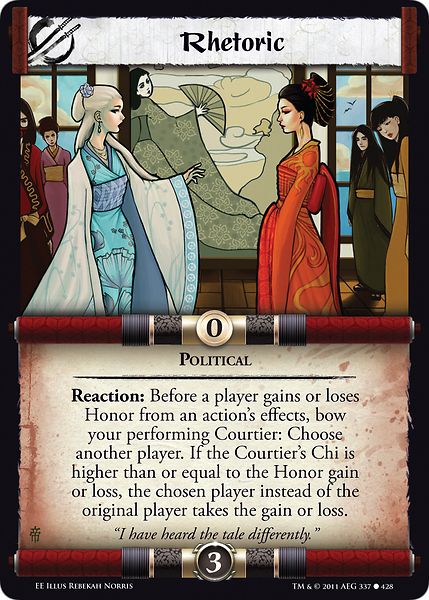
- Card Type
- Strategy
- Gold Cost
- 0
- Keywords
- Political
- Card Text
- Reaction: Before a player gains or loses Honor from an action's effects, bow your performing Courtier: Choose another player. If the Courtier's Chi is higher than or equal to the Honor gain or loss, the chosen player instead of the original player takes the gain or loss.
- Focus Value
- 3
- Legality
- Age of Conquest (Emperor), Four Winds (Gold), Rain of Blood (Diamond)
- MRP
- There is a slight difference in the timing of when you can use this card
- Deck
- Fate
Printings
Emperor Edition
- Rarity
- Common
- Flavor Text
- "I have heard the tale differently."
- Artist
- Rebekah Norris
- Card Number
- 337
- Publisher
- Alderac Entertainment Group
Diamond Edition
- Rarity
- Common
- Flavor Text
- "Trust and respect your allies, but never become dependent upon them. That leads only to failure." - Otomo Madoko's The Subtlety of Court
- Artist
- Beth Trott
- Card Number
- 243
- Publisher
- Alderac Entertainment Group
Winds of Change
- Rarity
- Common
- Flavor Text
- "The lady Itami conveys you her thanks, Doji-san," Naseru said. "With Phoenix and Crane so closely allied, I think there are interesting times to come."
- Artist
- Beth Trott
- Card Number
- 87
- Publisher
- Alderac Entertainment Group
Emperor Edition Demo Decks
- Rarity
- Fixed
- Artist
- Rebekah Norris
- Card Number
- 106
- Publisher
- Alderac Entertainment Group
Rulings
- Erratum: Reads, "Rhetoric 0G 3FV Political Reaction: Before any player gains or loses Honor, bow one of your Courtiers with Chi greater than or equal to the gain or loss to redirect the gain or loss to a different player." [MRP, Diamond Edition, 27 October 2003] Rules Archive, August 18, 2007, p. 31
Rules Q&A
- Q: If I attach Kokujin's Daisho to a Courtier with 3 Chi, can I Rhetoric the 4-honor loss to my opponent using that same Courtier? (Does the +1C bonus occur before the honor loss?)
A: Kokujin's Daisho must enter play before its trait causes you an honor loss. Consequently, its stat bonuses will also be in effect. Martin Lund, "Rules for 29 June 2004", 2 Jul 2004 - Q: So, following from this ruling, can I:
a) bow a Dipl.App. on a bowed Courtier to play Rhetoric (or any other PA the Courtier could perform),
A: [MARTY] Yes, so long as it is a PA the Courtier could perform.
Storm Heart won't cut it because your bowed Personalities can not perform actions that issue challenges. Nor could a bowed Shugenja-Courtier cast a Spell's Political Action like Rise from the Ashes. (Diamond Edition Rulebook, page 54, "Bowing")
Also, your bowed Courtier is still a bowed card and you are bound by all the normal rules about bowed cards and strongholds. You can't use abilities on the bowed card / stronghold unless it unbows them or has an explicit exemption.
All Diplomatic Apprentice does is give you an alternative way to pay the cost of bowing the Courtier Personality. Martin Lund, "Rules for 10 May 2004", 13 May 2004 - Q: When does the honor loss for playing a Dark Ring occur? Does it occur before I get to play Introspection, or do I get to Introspection before the honor loss?
A: You'll lose the honor first. Introspection happens "after" by card text. Martin Lund, "Rules for 6 May 2004", 9 May 2004 - Q: A) Petty Insults read (in part): "YOu and that player each lose Honor equal to the Gold you spent on th is card or the Coutiers' total Personal Honor, whichever is less. Your loss cannot be copied or modified."
What does Modified mean? Can it be redirected with Rhetoric? What about negated and then switched with Dirty Politics?
A: Modified means changed in anyway. No redirection, increase, decrease, or negation is allowed. Martin Lund, "Rules for 1 May 2004", 4 May 2004 - Q: Can I use a Diplomatic Apprentice to Rhetoric an honor loss/gain if it's attached to a Courtier who has chi equal or greater than the honor loss/gain?
A: Yes. Jeff Alexander, "rules for 12 March 2004", 13 Mar 2004 - Q: Relavence..If a dueling personality is about to die and is a courtier, could he Rhetoric the 3 honor loss from Jurian?
A: No. Jeff Alexander, "rules for 27 Feb. 2004", 28 Feb 2004 - Q: I have a couple rules questions.
1) Let's say I'm playing a dishonor deck. My opponent is at -19 honor and I have one turn to beat him. If I have two Doji Nagoris out, a Kolat Assassin in hand, and a Rhetoric in hand, can I Kolat Assassin one of the Nagoris, seppuku, lose 1 honor, then redirect it through the Rhetoric?
A: Yes. Jeff Alexander, "rules for 23 Feb. 2004", 24 Feb 2004 - Q: So if I Rhetoric the loss to the other player, and the defender was a Samurai or Courtier, they can not commit seppukku (assuming they survived), because we are past the targeting part of the effect, correct?
A: They cannot, but that's because a redirected Honor loss can never fulfil the requirements for seppuku. Zen Faulkes, "Rules for 5 December 2003", 5 Dec 2003 - Q: If a dishonored personality wins a battle against opposing units, can Rhetoric be used to stop the Pers from rehonoring?
A: No. There's no honor gain to redirect, because rehonoring happens "instead." Zen Faulkes, "Rules for 3 December 2003, Part 2", 4 Dec 2003 - Q: I have a Konetsu (4 chi) with a Diplomatic Apprentice (0 chi) attached. A 4 point honor gain happens. Can I Play Rhetoric, announce that I'm using Konetsu to redirect the gain to myself but instead bow the Diplomatic Apprentice, or would I not be able to because the Apprentice has a 0 chi?
A: Yes. Diplomatic Apprentice is not performing the action, it's simply taking the place of one part of the cost. Zen Faulkes, "Rules for 2 December 2003, Part 2", 3 Dec 2003 - Q: how is it possible to Rhetoric or Winds Truth and honor loss to the Shadowlands then? Wouldn't the non-ability to lose honor make the Shadowlands an Illegal Target?
A: There is no rules that all effects must resolve for an action to be legal. In fact, there ruling has been the exact opposite for a long time: actions that do nothing can be played as long as they are otherwise legal. Zen Faulkes, "Rules for 25 November 2003, Part 2", 26 Nov 2003 - Q: I lose honor from an Ambush. (5 pts) I'm at -15 before Ambush. My personality gets sent home, so I don't gain any honor from the battle. Do I: a)lose immediatly due to being at -20 b)have a chance to Rhetoric the loss and not lose[?]
A: B. "Before any player gains or loses Honor..." (Rhetoric text). Zen Faulkes, "Rules for Dr. Who's 40th Anniversary (23 November 2003)", 23 Nov 2003 - Q: When my opponent gains honor can I react with both Rhetoric and Noh Theater Troupe?
A: No. Noh Theatre Troupe is used "after" a player has gained or lost honor (card text). If you redirect the gain/loss "before" the loss or gain with Rhetoric (card text), the other player's honor never changes. Zen Faulkes, "Rules for 8 November 2003", 8 Nov 2003 - Q: Doji Jotaro tries to Rhetoric my gain so I respond with Enough Talk! Now which duel should resolve first[?]
A: Actions in L5R resolve completely, one at a time (Gold Edition rulebook, pg. 47). The last action was Enough Talk! That must finish first. Zen Faulkes, "Rules for 8 September 2003", 9 Sep 2003 - Q: Basically per the rulebook, are we to understand that Proclaiming is no longer an action?
If it considered an effect of the Recruit action?
Basically, what is its new interaction with cards such as Rhetoric, Faint Praise etc.
A: Choosing to Proclaim is not an action, it is a choice you may make, once per turn on your turn, when you announce a Recruit action - any action that has a Recruit effect.
When you do this, the Recruiting action gains the keyword "Proclaim", and the additional effect, "If he has your Clan Alignment, gain Honor equal to his Personal Honor after he enters play." Alex Jones, "Proclaim in IE not an action?", 3 Jan 2014 - Q: Hi, I've just returned to the game recently and I noticed a different wording on this card then it's used be. Before it was clear that the honor gain or loss can be from anything. But now I'm not sure if Rhetoric is usable after proclaim (I think so) and after gaining honor during the resolution segment (I don't think so).
A: Welcome back!
The wording on Rhetoric has indeed changed, as you can see at the Oracle of the Void.
Rhetoric can only react to an honour gain/loss from an action, which includes Proclaim; it can't react to Events, traits (including entering play honour gains/losses), nor battle resolution. Alex Jones, "Rhetoric", 24 Sep 2013 - Q: Given the situation in this thread, I don't understand why the Rhetoric gain would not be reduced by Invocation. I thought Rhetoric created a new timing window of "before an honor gain/loss" for the player stealing the gain. This is why you can Rhetoric a Rhetoric. Also, this here directly references the creating of a new timing window for the redirected gain/loss in the instance of Hotei's Contentment increasing the gain. If Hotei's is able to increase the gain off of a redirected proclaim, shouldn't Invocation be able to reduce a redirected gain? Or is there something different between these situations that I'm overlooking.
Thanks
A: Because I misread the trigger on Invocation when answering. Read The... Card - it applies to the Rules Team too. Original answer corrected. Jon Palmer, "Invocation vs Rhetoric", 4 Jun 2013 - Q: Player A is playing Kitsune with at least one spirit out and one active Invocation in play.
Player B is playing some clan that can run courtiers and rhetoric.
Player A proclaims, which is promptly rhetoric'ed away.
Now my question is, does the Invocation kick in and player b gains one less honor because of it? Or is the full honor gain just redirected and not technically gained?
Rhetoric: Reaction: Before a player gains or loses Honor from an action's effects, bow your performing Courtier: Choose another player. If the Courtier's Chi is higher than or equal to the Honor gain or loss, the chosen player instead of the original player takes the gain or loss.
Invocation: Limited: Until your next turn begins, before each time a player gains Honor, reduce the gain by 1 unless he controls a Spirit.
Thanks muchly
A: There is a new window for Invocation to trigger each time the player who is about to gain the honor changes. Therefore, in the situation above the gain will be reduced by 1 (and similar to the Hotei's Contentment situation, if it bounces back and forth, it will continue to be reduced). Jon Palmer, "Invocation vs Rhetoric", 3 Jun 2013 - Q: Please confirm/deny?
Me and my opponent BOTH control Hotei's Contentment.
Player A Proclaims a 3PH base Personality. Player A's Hotei's Contentment triggers, to raise the gain to 4. Player B plays Rhetoric, bowing a 4 Chi courtier. Player B's Hotei's Contentment triggers, to raise the gain to 5. Player A plays Rhetoric, bowing a 5 Chi courtier. Player A's Hotei's Contentment raises the gain to 6. Player B passes priority.
Player A gains 6 honour for his 3PH Personality.
A: Sure. Essentially the same question asked here. Jon Palmer, "Rhetoric + Hotei's Contentment", 28 May 2013 - Q: Can my opponent use Rhetoric to redirect the honor gain to himself and prevent the rehonoring? Or does the process of rehonoring negate the honor gain before such an opportunity is granted?
A: No and yes, respectively.
Both rehonoring and Rhetoric have the same timing, "Before the gain", but thanks to the Timing Sequence, Reactions like Rhetoric always come last after the Rulebook substitution effect of rehonoring. Brook Cunningham, "Can Rhetoric prevent rehonoring?", 25 Apr 2013 - Q: So I got into an argument and I'd just like a confirmation ruling please
In relation to this: http://alderac.com/forum/viewtopic.php? ... c#p1314974
If my opponent Proclaims, and passes his first opportunity to react to the proclaim, then I react with Rhetoric. Is there ANY opportunity for my opponent to react his Destructive Priorities before my Rhetoric has resolved?
Basically my opponent contests that after I react with Rhetoric, he has a chance to react to the original Proclaiming with Destructive before my Rhetoric resolves, whereas I said he can only react to my Rhetoric, and if he doesn't the Rhetoric resolves, then he has a chance to react to proclaiming with Destructive (where it'll be too late, as the Rhetoric has been resolved and applied to the honour gain).
Mod Nudge: Full card names, please.
A: Technically, both Rhetoric and Destructive Priorities react to the honor being gained, not to the use of the Proclaim reaction.
However, you're correct. Rhetoric must fully resolve in reaction to the honor gain before Destructive Priorities then gets a chance to react to the honor gain (if it passed the first time). We don't have a stack here. Jon Palmer, "Destructive Priorities + Rhetoric", 14 Nov 2012 - Q: Hey guys,
I think I know the answer to this but I just wanted to ask to make sure!
In dynasty I am at -1 honour. I Proclaim a Rengetsu, but I use a Temple Fortress to pay for him entering play.
My opponent attempts to Rhetoric the gain, and I play Rhetoric to redirect back to me. My opponent wants to play Bad Kharma to negate MY Rhetoric. Am I at -1 honour or 0 honour when I try and Proclaim?
A: The gain from Temple Fortress triggered as soon as you bowed it, while you were paying for your Personality.
You can't Proclaim until after she enters play, which occurs after paying, so at that time you would be at 0 Family Honor, in your scenario. Brook Cunningham, "Temple Fortress + Proclaim", 4 Oct 2012 - Q: This came up in a game and I wanted to be sure it was legal. I used Hanabi to gain 4 honor. My opponent reacted with Rhetoric to gain the honor instead. I had a Deeds and Words in play and I used it to reduce the honor gain from Hanabi to 0.
Is this legal? Did the play prevent my opponent from stealing my honor? Thanks in advance.
A: Nope, not legal.
Rhetoric's trigger is right before the gain or loss occurs, during the effects. However, Deeds and Words' trigger is well before that, "Before the resolution of an action". So, when the other player plays Rhetoric, the time has passed when you could've reacted with Deeds and Words and it's too late (though maybe you were playing an older copy of D&W, where the trigger was the same as Rhetoric's, making your cheatery slightly more forgiveable ). Brook Cunningham, "Rhetoric vs Deeds and Words", 12 Sep 2012 - Q: Greetings, My opponent is about to gain Honor from an action effect during my turn. I'm reacting with Rhetoric to steal his gain. Can I then react with Destructive Priorities to make my opponent lose Honor instead?
Rhetoric Political Reaction: Before a player gains or loses Honor from an action's effects, bow your performing Courtier: Choose another player. If the Courtier's Chi is higher than or equal to the Honor gain or loss, the chosen player instead of the original player takes the gain or loss
Destructive Priorities Kata • Political You have the ability, "Political Reaction: Before you gain Honor during your turn, bow your performing Courtier: Negate the gain. Choose a player. He loses 2 Honor."
A: Yes. Both Rhetoric and Destructive Priorities have (essentially) the same trigger, "Before a player gains honor."
You will be able to react with Rhetoric, then your opponent may react to the same trigger or pass, then you get another opportunity to react to the same trigger with your Destructive Priorities. Ben Higgins, "Rhetoric and Destructive Priorities", 17 Jun 2012 - Q: This question i could not find a specific reference for. The closest comparable reference is in regards to Chi death. It is stated, the action that last caused the Chi to hit 0 is also what is considered to have caused the Chi Death. If no action caused it, it is a game rule effect. Bold emphasis mine...
"Chi Death Rule: If a Personality's Chi is ever zero, destroy him immediately. The source of Chi death is the card whose costs or effects caused it, or the rulebook if it was not directly caused by a card's costs or effects (for example, if a base 2C Personality with a +1C Weapon and a -2C token loses the Weapon). Note also that the source of the effects of tokens can usually be traced back to a card's effects. This destruction for having zero Chi may only be negated or prevented by effects that specifically negate or prevent destruction for having zero Chi."
What about Dishonorable personalities, and the loss of honor from dying? The only relevant line in the rules from the section on Honorable/Dishonorable personality states is this...
"After a dishonorable Personality is destroyed, the player who controlled him or her loses Honor equal to the Personality's base Personal Honor. This is a rulebook effect, not a card effect."
No other wording is offered in the rules regarding the source of the dishonor loss. So if someone ranged attacks a dishonorable personality, the ranged attack is not the source of the dishonor? Is the player who uses the ranged attack even the source of the dishonor loss? this has implications in War of Honor, but also for cards like Rhetoric, so I want to be clear.
A: You are correct that the honor loss from a dishonored Personality dying is solely a rulebook effect, and thus cannot be Rhetoric'd.
Within the context of War of Honor, there is the special stipulation that if you announce the ability that kills a dishonored Personality, you do get "credit" for that honor loss to help you move up the Path of Victory. This stipulation exists only in War of Honor however, and still does not allow the honor loss to be Rhetoric'd in WoH games. Ben Higgins, "Rhetoric and Dishonorable Personalities...", 26 May 2012 - Q: So the question is this:
Can I play Rhetoric's reaction when playing out of the Shadow's Lair as it seems that Rhetoric checks BEFORE I lose honor. It doesn't know that I do not, right?
A: No, you cannot Rhetoric an Honor loss that does not happen.
Thanks to Timing, the prevention of the loss will remove the trigger of the loss occuring in Step A, before you have the chance to react to it, in Step D. Brook Cunningham, "Rhetoric and The Shadow's Lair", 21 May 2012 - Q: Can I announce Rhetoric targeting the honour loss off of Ambush, using a 4 Chi courtier magistrate if I have Magistrate's Stipend in play and use the reaction on the Rhetoric actions, or must I have a 5 chi courtier to even announce rhetoric?
In case Ambush's strange timing on the honour loss is an issue, would this work if an action just caused 5 honour loss?
Magistrate's Stipend Mine Bow this card: Produce 2 Gold, or 3 Gold if paying for a Magistrate. Reaction: After you announce a non-Iaijutsu action, choose your performing Magistrate: Give him +1C until the action ends.
Ambush Limited: Choose your performing unbowed Personality and target another player's Personality: Create a battlefield (not at any province). Assign your Personality to attack there. Assign the target to defend there, even if he is bowed. Other Personalities will not move there. Fight a battle there (after this action's resolution). After the battle ends, lose 5 Honor.
Rhetoric Political Reaction: Before a player gains or loses Honor from an action's effects, bow your performing Courtier: Choose another player. If the Courtier's Chi is higher than or equal to the Honor gain or loss, the chosen player instead of the original player takes the gain or loss.
Thanks, Nick
A: Yes, you may. The Good Faith Rule means that since you know you can use Magistrate's Stipend, you may announce the Rhetoric.
The timing of Ambush's honor loss isn't pertinent in this case as Rhetoric reacts to the loss itself, not the resolution of an action like many others do.
Edit: I actually missed the fact that Rhetoric is legal to play regardless of the Chi of the Courtier. It simply doesn't do anything if the Chi isn't high enough. Jon Palmer, "Rhetoric and Magistrate's Stipend", 15 May 2012 - Q: Sorry, couldn't find any latest EE based ruling on it.
Ambush Limited: Choose your performing unbowed Personality and target another player's Personality: Create a battlefield (not at any province). Assign your Personality to attack there. Assign the target to defend there, even if he is bowed. Other Personalities will not move there. Fight a battle there (after this action's resolution). After the battle ends, lose 5 Honor.
Rhetoric Reaction: Before a player gains or loses Honor from an action's effects, bow your performing Courtier: Choose another player. If the Courtier's Chi is higher than or equal to the Honor gain or loss, the chosen player instead of the original player takes the gain or loss.
Just to confirm, seeing that honor loss from Ambush happens after the battle actually ends, so it's a delayed effect on the honor loss? So that means the ambush player has no window to rhetoric the loss?
Or he can do it before the battle actually starts?
A: The trigger for Rhetoric is before the player actually gains or loses honor (not the resolution of the action causing the honor loss, as some cards are worded). Therefore, since the delayed honor loss happens after the battle, the trigger for Rhetoric is also after the battle, when the 5 honor loss is about to occur. Jon Palmer, "Ambush + Rhetoric", 10 Apr 2012 - Q: I didn't exactly find anything specifically answering this so I'll ask.
If I take an action that gains me honour (let's say Tell the Tale) and my opponent uses Rhetoric to transfer it themself, can I then use Shiro Chugo to reduce the gain by 2?
Now what if the action has a delayed honour gain or loss (let's say my opponent plays Ambush) and my opponent Rhetorics the loss to me, can I then use Shiro Chugo to reduce the loss by 2?
Rhetoric Reaction: Before a player gains or loses Honor from an action's effects, bow your performing Courtier: Choose another player. If the Courtier's Chi is higher than or equal to the Honor gain or loss, the chosen player instead of the original player takes the gain or loss.
Shiro Chugo Reaction: Before an action's resolution, choose your performing unbowed Courtier: Reduce any Honor gain or loss from the action's effects by 2.
Thank you for your time.
A: No.
Shiro Chugo's Reaction is taken "before an action's resolution", but Rhetoric is played "before a players gains or loses honour from an action's effects" - and since effects are created during the action's resolution (or after, for delayed effects), this is too late for Shiro Chugo's Reaction to be taken.
And while you may take Shiro Chugo's Reaction in response to Rhetoric, it won't achieve anything, since Rhetoric doesn't create a new honour gain or loss, it merely changes who receives it. Alex Jones, "Rhetoric + Shiro Chugo", 8 Apr 2012 - Q: This question is not about Rhetoric but more so if I can cause an unintentional honor loss from an opponent's action on myself and trigger Rugashi's Bazaar. Rugashi Bazaar text:
Murderous Intent:
Here's the question:
My non-spider opponent plays Murderous Intent on his action phase to give one of his personalities a force bonus. I play Rhetoric to redirect the honor loss to myself.
**Can I then use Rugashi Bazaar during my next turn to give a force bonus?
**Same question again but what if my opponent is playing a stronghold that says, "You do not lose honor from Spider clan and Fate cards you own."
A: Yes and no respectively.
Changing the Honor loss recipient from him to you from his action fulfills the requirement for taking Rugashi Bazaar's action.
However, if the Honor loss "does not" happen, there is no trigger for Rhetoric to even be played. Brook Cunningham, "Rugashi Bazaar with Rhetoric", 15 Mar 2012 - Q: Sort of related to: viewtopic.php?f=59&t=96689
Lets say I cause a 3 point honor loss to my opponent. She plays Rhetoric on the honor loss. Can I then react with Unimpeachable Name to reduce the honor loss to me?
I had originally thought the answer to this question was no, because of the timing sequence, but the above thread opened up the possibility (in my mind at least) that it MIGHT work.
[EDIT]: Same question, but substitute Shiro Chugo's honor loss reduction reaction for Unimpeachable Name?
A: Rhetoric does not create a new gain or loss. However, it does close the trigger of when Player A is gaining (or losing) honor, and sets up a new trigger of when Player B is gaining (or losing) honor, which can then be reacted to as normal. The honor gain or loss is still from the same source, there is simply a different player gaining or losing it.
1. No. Rhetoric modifies the gain/loss, it is not the source.
2. Yes.
3. No. See #1.
4. No. The original player will not have gained or lost honor if the recipient was changed via Rhetoric.
Regarding the second post, no, you may not Unimpeachable Name if your action was the original cause of the honor loss. Rhetoric is not causing the loss in this case, the original action is still the source. Jon Palmer, "Rhetoric", 14 Mar 2012 - Q: Reading thisruling, I had the impression that it was implicit in the ruling that an honor gain redirected by a Rhetoric performed by a dishonorable personality would rehonor the performer (instead of the gain). Was this intended?
From the CR: "Before a player gains one or more points of Honor from an action or trait that targeted, came from, or was performed by one or more of his or her dishonorable Personalities, if rehonoring the Personality is not one of that action or trait’s effects, the Personality's rehonoring is substituted for the Honor gain;[...]" (emphasis mine)
However the honor gain doesn't seem to come "from" Rhetoric: Definition of "from": "From Some things check to see if costs, effects, actions, targeting, or other game procedures come “from” a given source. The source is the card that the effect, action or targeting is printed on, or the rulebook if it is printed there" According to this definition, the honor gain comes from the action that created the gain (for example, from the Proclaim), not from the Rhetoric that merely redirected. So, a dishonorable personality wouldn't rehonor because of performing a Rhetoric that redirects an honor gain. Is this correct?
A: Excellent point, Mamoru, and entirely true.
To clarify officially what Mamoru said:
While you CAN rehonor a dishonorable Courtier before he performs Rhetoric, there's no need; he can still perform it to its full effect. The source of the Honor gain remains unchanged, only who receives it. There is never a gain "from" Rhetoric, therefore it will never rehonor the performing Courtier instead. Brook Cunningham, "Reactions to reactions to reactions...", 28 Jan 2012 - Q: OK.
Player A brings personality x into play during dynasty phase and proclaims for 3 honor.
Player B reacts with Unimpeachable name to rehonor a dishonorable courtier.
Player B then reacts with Rhetoric to steal the honor gain.
Does this sequence of events work? or would the honor gain from rhetoric simply rehonor the personality?
A: Yes, that works as you would like.
The Unimpeachable Name effects resolve fully before your opportunity to play Rhetoric even arrises.
1. Player A announces Proclaim. 1b. Before Proclaim's effects resolve, Player B reacts with UN and rehonors his intended Rhetoric performer. 2. Proclaim's effects start resolving, but... 2b. Just before Proclaim can bestow the Honor on Player A, BAM! Player B reacts with Rhetoric. Burn!
EDIT: However, as pointed out below, undertaking that sequence is not technically necessary. Rhetoric will never rehonor a dishonorable performer anyway; read on for the explanation... Brook Cunningham, "Reactions to reactions to reactions...", 26 Jan 2012 - Q: [CEEEex] Can I redirect the honor loss I would take from Gisei to my opponent with Rhetoric?
A: I agree with Techno above. 🙂 Brook Cunningham, "Sun and Moon #rules-questions", 19 Sep 2025 - Q: I'm pretty sure I already know the answer is "no", but I'm gonna ask to make sure... If I bring into play two corrupted Geisha House and use two Rhetoric to give the honor loss to an opponent, can I bring into play Bayushi?
A: You're correct that the answer is "no". Rhetoric just moves the recipient, it doesn't change the source. Also, the MRP of Rhetoric won't redirect losses from traits. Brook Cunningham, "Oracle of the Void #rules", 18 Sep 2023