Ring of the Phoenix
Legend of the Five Rings card from Tomorrow
Open in Oracle of the Void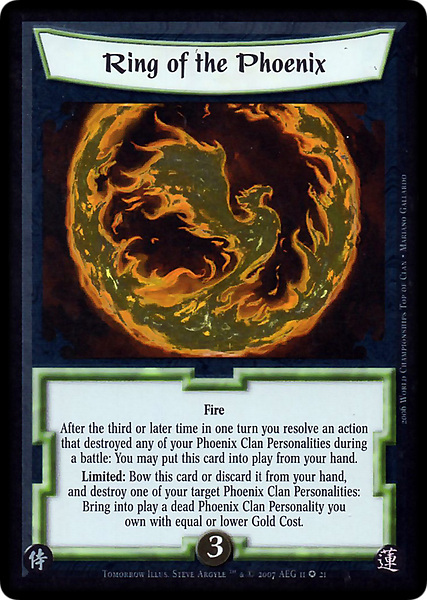
- Card Type
- Ring
- Keywords
- Unique, Fire
- Card Text
- After one of your actions resolves, if it was your third or later action this turn whose effects destroyed any of your Phoenix Clan Personalities during a battle, you may put this card into play from your hand.
You may discard this card from your hand to use its ability ignoring the cost of bowing it.
Fire Limited, , w: Destroy one of your Phoenix Clan Personalities to Recruit a dead Phoenix Clan Personality you own with equal or lower Gold Cost.
- Focus Value
- 3
- Legality
- Age of Enlightenment (Lotus), Race for the Throne (Samurai)
- Deck
- Fate
Printings
Tomorrow
- Rarity
- Fixed
- Notes
- Artist miscredited to Steve Argyle (source: Steve Argyle via intermediary Facebook post)
- Artist
- Unknown
- Card Number
- 11
- Publisher
- Alderac Entertainment Group
Rulings
- Counts towards an Enlightenment victory. [Card text] Rules Archive, August 18, 2007, p. 61
- Counts as a Ring of Fire for enlightenment. [CF, 20 July 2007] Comprehensive Rules, Samurai Edition, with specific card rulings, final version, May 2009, p. 152
Rules Q&A
- Q: Which of answers is right? The question about Ring of the Phoenix. viewtopic.php?f=59&t=63977&hilit=Ring+of+the+Phoenix OR viewtopic.php?f=59&t=74442
[Mod edit: Thread title. Please make them descriptive. -ZF]
A: EDIT: No longer under discussion, and...
Surprise! Both answers you linked are correct.
In the case of the first link, it may not be clear due to the vaguery of the question that the answer is from the point of view that Mountains of the Phoenix is intended to be the triggering action for Ring of the Phoenix. In such an instance, it does not count because after it resolves (when RotP would trigger), it has not yet destroyed anyone. So, it's not that Mountains of the Phoenix can never count for Ring of the Phoenix (it CAN be one of the previous two resolved actions, as seen in the second link), but its resolving can never be the trigger for the Ring. Brook Cunningham, "Ring of the Phoenix and Mountains of the Phoenix", 6 Mar 2009 - Q: Example: One Phoenix personality was already killed with an appropriate action. Mountains of the Phoenix are played. Before the battle resolution another personality is destroyed by its action. Reaction from Assigning Blame targets the third Phoenix personality and he commits seppuku in reaction. That is the third action that killed personality to the time when the ring of Phoenix could be played. Does killing action from the Mountains counts for the Ring in this case?
A: In this case, yes it does. Brook Cunningham, "Ring of the Phoenix and Mountains of the Phoenix", 5 Mar 2009 - Q: Color me surprised about the reversal, because this ruling about committing seppuku several times with different personalities has been stated for two months and a half.
Does this mean this ruling has been changed too?
My argument: Seppuku says: Reaction: Any number of times per turn, before you lose Honor from an action that targeted or was performed by one of your Courtier or Samurai Personalities: He commits seppuku. If the seppuku destroyed him, reduce the Honor loss to one.
I still think that any honor loss that is performed or targeted by more than one personality, has a different triggering for seppuku for each personality that performs or is targeted by the action.
E.g. I have a Doji Bob (courtier) and Kakita Jennifer (samurai) at the current battlefield. I announce Game of Sincerity. Doji Bob performs it and Kakita Jennifer is targeted by it. Therefore, I have two distinctive triggers for the seppuku: Trigger #1: before you lose Honor from an action that targeted Kakita Jennifer: She commits seppuku. If the seppuku destroyed her, reduce the Honor loss to one Trigger #2: before you lose Honor from an action that was performed by Doji Bob: He commits seppuku. If the seppuku destroyed him, reduce the Honor loss to one.
Please explain what's wrong with this example.
A: You know, I thought I had answered a question like this before. But I didn't bother digging it up, to spare myself the shame and embarrassment. So much for that, eh?
<-- There it is. There's the shame.
Anyway... the ruling that you linked is the same error as one that Bayushi Loïc made a month ago. There's nothing different about them, apart from the name of the single-honor-loss causing card (Coward! vs. Game of Sincerity), so there's no reason to think his reversal doesn't also apply to mine.
I see the logic in your example, but you can't break it down like that. Just because there are two different conditions under which the trigger applies doesn't mean there are two seperate triggers if BOTH conditions apply at the same time. The trigger is the Honor loss, which only occurs once. Brook Cunningham, "Game of sincerity, Seppuku, Ring of the Phoenix", 19 Feb 2009 - Q: I'm now thoroughly confused by the whole Ring of the Phoenix, Game of Sincerity, seppuku nonsense.
If I can only seppuku once in response to a single honor loss, how is it different when someone plays 3 Assigning Blames in response to the destruction of a single personality?
A: The difference is multiple copies. Again, with underlined emphasis and addendum in brackets,
http://rules.l5r.com/Timing#Resolving_timing_conflicts: "A player can not use the same Reaction or triggered trait twice to a single triggering occurrence from the same copy of a card, or from the rules [where there is also only effectively only one copy of said Reaction, no matter how many rulebooks you own -- BC]." Brook Cunningham, "Game of sincerity, Seppuku, Ring of the Phoenix", 18 Feb 2009 - Q: Bayushi Mamoru said It doesn't really change the answer (It's still not possible for the seppuku to count towards Ring of the Phoenix because seppuku should happen before the battle) for the original question, but it's important whether the seppuku occurs before or after the battle. (Which would mean you can't assign, kill by resolution, and then reduce the loss to 1; you'd have to choose between fighting the battle or reducing the loss) (emphasis added)
Zen Faulkes said: I think that's correct.
As I read it, the honor loss is a delayed effect that clearly happens after the battle is ended, and since the trigger for seppuku is the actual honor loss, and not the resolution of the action that cause it, the seppuku does not occur until after resolution of the battle.
A: Fellow Rules Junta member also pointed out to me that the honour loss occurs after the battle finishes, as does any Seppuku - it's a Reaction to the honour loss effect, not to the Action that creates the honour loss. Reactions to the Ambush action occur before the Battle is fought; Reactions to its effects, including delayed effects like the honour loss, occur as the effects happen. Zen Faulkes, "Seppuku and Ambush", 18 Dec 2008 - Q: Zen said here: Effects occur in order written on the card. The honor loss from Ambush is dead last. The battle is well over by then.
Respectfully, I disagree. According to the Comprehensive Rules
Battles created by a card effect that does not create an Attack Phase are treated as normal battles, except:
* Such battles are (slightly) delayed effects that begin once the action or trait that created them has resolved, and the opportunity to play Reactions to the end of the action or trait has passed, in a manner similar to additional phases and actions. [CHANGED June 3 2008]
(Emphasis mine) It doesn't really change the answer (It's still not possible for the seppuku to count towards Ring of the Phoenix because seppuku should happen before the battle) for the original question, but it's important whether the seppuku occurs before or after the battle. (Which would mean you can't assign, kill by resolution, and then reduce the loss to 1; you'd have to choose between fighting the battle or reducing the loss)
Am I right in this?
A: I think that's correct. I'll put in an exception in the wiki for the order of effects section. Zen Faulkes, "Seppuku and Ambush", 17 Dec 2008 - Q: I want to know if a Phoenix Clan Samurai can ever commit Seppuku off of Ambush and have it be considered "during a battle" for the purposes of Ring of the Phoenix.
A: No.
Effects occur in order written on the card. The honor loss from Ambush is dead last. The battle is well over by then. Zen Faulkes, "Seppuku and Ambush", 9 Dec 2008 - Q: Is the rulebook action which allows a player to destroy a personnality with the "seppuku" effect is an available action for the trait of Ring of the Phoenix?
The action says "commit seppuku" and "seppuku = Rehonor the Personality, then destroy him; these effects can not be negated", so it seems possible.
Reaction: Any number of times per turn, before you lose Honor from an action that targeted or was performed by one of your Courtier or Samurai Personalities: He commits seppuku. If the seppuku destroyed him, reduce the Honor loss to one. (Seppuku)
Ring of the Phoenix Fire After the third or later time in one turn you resolve an action that destroyed any of your Phoenix Clan Personalities during a battle: You may put this card into play from your hand.
Thank you.
A: Works for me. The Personality is destroyed by an effect of an effect of the Seppuku Reaction. Alex Jones, "Ring of the Phoenix and seppuku", 2 Sep 2008 - Q: If I play Wounded in Battle on one of my own people (not a samurai) and this -2C effect destroys him, will this count for the Ring of the Phoenix?
A: Yes. Zen Faulkes, "Ring of the Phoenix and Wounded in Battle", 30 Jan 2008 - Q: If you use the Ring of the Phoenix as a limited action to kill Houhou to bring Asako Keiki into play (for example...) do you pay 7g for Keiki or 0 gold?
A: http://rules.l5r.com/Costs_and_restrictions: "The mandatory costs of a card entering play are its Gold Cost (if any) and any other costs for entering play listed in its traits. Costs are mandatory by default."
"The Gold cost of any non-Action card type, found in the gold coin symbol, is a cost for it to enter play under any circumstance." Zen Faulkes, "Paying gold cost with Ring of the Phoenix", 7 Sep 2007 - Q: So...something that will never happen (except maybe at this crazy Enlightenment tournament I'm attending in November, but occurred to me anyway: Both my opponent and I have the Rings of Earth, Water, Void, and Air in play. First, I issue a challenge during battle with one of my Phoenix Clan personalities. My opponent focuses the Ring of Fire, I strike and lose. Now, I have resolved an action which destroyed my third Phoenix during battle, so I play the Ring of the Phoenix, yet he's won the duel so he can put the Ring of Fire into play. Has the game become an Enlightenment draw? Or is it one of those "active player decides" things?
A: http://rules.l5r.com/Challenges_and_duels: A duel is won before a Personality is destroyed. Ring of Fire goes first. Zen Faulkes, "Ring of Fire vs. Ring of the Phoenix", 5 Sep 2007 - Q: We just got a Phoenix player for SE and he asked if Ring of the Phoenix could replace Ring of Fire for Enlightenment?
A: Yes. Zen Faulkes, "Ring of Phoenix", 20 Aug 2007 - Q: Ok, I couldn't find this in the search, maybe it was on the old board, and I think I know the answer, but there has been some depate in my area.
Can you include both Ring of the Phoenix and Ring of Fire in the same deck? Can you have both in play?
Thanks.
A: You can include both, you can have both in play, but you will still need the four other element rings (void, earth, air, water) to win by enlightenment. Chris Fuchs, "Ring of the Phoenix + Ring of Fire", 20 Jul 2007 - Q: What elemental trait will my personalities have when I play ring of the phoenix using denbe's ability?
[Mod edit: Thread title typo. -ZF]
A: The Ring of the Phoenix has the Fire element keyword. Chris Fuchs, "denbe and Ring of the Phoenix", 17 May 2007