Assigning Blame
Legend of the Five Rings card from The Truest Test, Samurai Edition Banzai, Three Dynasties
Open in Oracle of the Void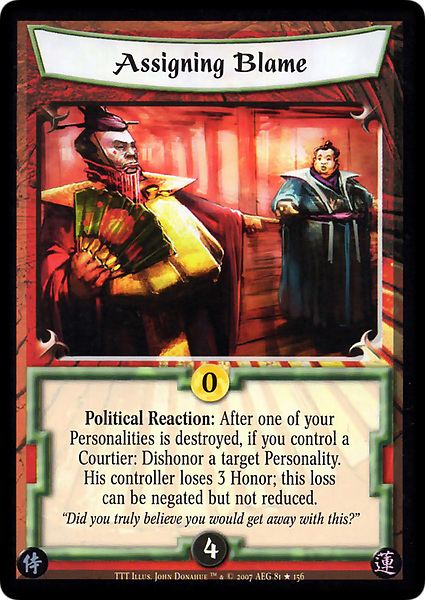
- Card Type
- Strategy
- Gold Cost
- 0
- Keywords
- Political
- Card Text
- Political Reaction: After one of your Personalities is destroyed, if you control a Courtier, dishonor a target Personality. His controller loses 3 Honor, which will not be reduced (though it may be negated).
- Focus Value
- 4
- Legality
- Age of Enlightenment (Lotus), Race for the Throne (Samurai), Three Dynasties
- Deck
- Fate
Printings
The Truest Test
- Rarity
- Rare
- Flavor Text
- "Did you truly believe you would get away with this?"
- Artist
- John Donahue
- Card Number
- 81
- Publisher
- Alderac Entertainment Group
Samurai Edition Banzai
- Rarity
- Rare
- Artist
- John Donahue
- Card Number
- 57
- Publisher
- Alderac Entertainment Group
Three Dynasties
- Rarity
- Fixed
- Flavor Text
- "You dare to feign ignorance?"
- Artist
- John Donahue
- Card Number
- 378
- Publisher
- Onyx Lives
- Publisherurl
- https://sites.google.com/view/the-onyx-lives-project/home
Rules Q&A
- Q: Misdirection affects an action taken during battle. Can this affect an Assigning Blame used at battle resolution when units are destroyed?
A: http://rules.l5r.com/Battles#Choose_Battlefield: "'During a battle' includes both the Combat and Resolution Segments, as well as the Final Steps before the battle ends." Zen Faulkes, "Misdirection and Assigning Blame", 24 Mar 2009 - Q: Example: One Phoenix personality was already killed with an appropriate action. Mountains of the Phoenix are played. Before the battle resolution another personality is destroyed by its action. Reaction from Assigning Blame targets the third Phoenix personality and he commits seppuku in reaction. That is the third action that killed personality to the time when the ring of Phoenix could be played. Does killing action from the Mountains counts for the Ring in this case?
A: In this case, yes it does. Brook Cunningham, "Ring of the Phoenix and Mountains of the Phoenix", 5 Mar 2009 - Q: As seen here.
Does the dead personality's removal prevent the opponent from reacting with Assigning Blame?
A: No.
Triggers, conditions, and leaving/entering play: "in triggers that involve a card leaving play, references to an in-play state of the card, such as its unit or location, refer to the state of the card before it left play."
Assigning Blame After one of your Personalities is destroyed...
Your When “your” and other possessive forms such as “the player’s” or “his” refer to a card, this means “controlled by that player" if the card is in play, or "owned by that player" if the card is not in play.
Assigning Blame requires that a Personality who was controlled by you before he left play has been destroyed. Things that happened after the destruction, such as removal from the game or reverting to another player's discard pile, are irrelevant. Alex Jones, "Determination and Assigning Blame", 21 Nov 2008 - Q: In order to make sure my action goes through, I use Determination before destroying one of my opponent's personalities. Can he play Assigning Blame in response, or will Determination remove the personality before he has a chance to react?
A: Both are after destruction, so Determination's delayed effect goes before the Reaction (see http://rules.l5r.com/Timing). Zen Faulkes, "Determination, Assigning Blame, created Personalities", 13 Oct 2008 - Q: Also, let's say my target was a personality created with, say, Venerable Master. Would this make a difference?
A: No, the created card has still been destroyed (http://rules.l5r.com/Glossary_D#Destroy) and the triggers are the same. Zen Faulkes, "Determination, Assigning Blame, created Personalities", 13 Oct 2008 - Q: Bayushi Saya Scorpion Clan • Samurai • Courtier Political Open: Target a Personality. After the next time this turn his controller assigns him or an action resolves that he performed, his controller loses Honor equal to his Personal Honor, then he is dishonored.
Saya targets a personality. The personality is targeted by Assigning Blame later in the turn, and becomes dishonorable. The personality's controller has the personality commit seppuku off the honor loss (in order to not have a dishonored person on the table), and the personality is rehonored in the discard pile. The honor loss is not reduced as per Assigning Blame's text.
Since the personality is now honorable (even though he's dead), can his controller lose honor equal to his current PH and become dishonorable(ly) dead, as per Saya's text?
A: Seppuku: Reaction: Any number of times per turn, before you lose Honor from an action that targeted or was performed by one of your Courtier or Samurai Personalities: He commits seppuku. If the seppuku destroyed him, reduce the Honor loss to one.
The seppuku Reaction is not performed by the personality, since it's not an ability on him, it's not an ability on a spell or item, and he's not targeted in the constraints block. Alex Jones, "Saya and seppuku", 18 Sep 2008 - Q: I looked in the search but it doesn't seem to have been answered...
A: Ah, but it has.
I will grant you, it's not that easy to find. You want the third answer down in this thread, because Fortified Camp and Assigning Blame both trigger at the same time (after your Personality is destroyed). Brook Cunningham, "Mirumoto Kei (Experienced) and Assigning Blame", 24 Aug 2008 - Q: I have a dishonored personality in play with a printed PH of 1 and an honorable courtier. I am sitting at -19 honor while my opponent is at -14. My opponent Hired Killers my dishonorable person, loses 3 honor and falls to -17. Would I have the opportunity to play Assigning Blame dropping my opponent to -20 honor before I fall to -20, or am I eliminated from the game before I get the chance?
A: Well, let's see...
The loss of Honor from a dishonorable Personality dying is a triggered effect from the rulebook:
http://rules.l5r.com/Physically_marked_card_states#Honorable_and_dishonorable: "After a dishonorable Personality is destroyed, the player who controlled him or her loses Honor equal to the Personality's base Personal Honor."
And Assigning Blame is a Reaction.
According to Timing, triggered rulebook effects happen before Reactions:
"A..., B..., C. Apply any triggered rulebook effects that are not part of actions... D..., E..., F. Reactions may now be taken following an action round procedure..."
So, in your example, you will hit -20 before you can bring your opponent down to -20.
To quote the Sorcerer Nakano from Highlander III, "You've already lost." Brook Cunningham, "Dishonorable death and Assigning Blame", 3 Aug 2008 - Q: Hi. I thought that it is easy question and could be quickly confirmed in Rules, but after seeing one paragraph in Comprehensive Rules i am rather confused...
Darling of the Season (event) Until the end of the game, each player cannot lose more than 5 points of Honor in total from other players' cards in a single turn.
Assigning Blame (action) Political Reaction: After one of your Personalities is destroyed, if you control a Courtier: Dishonor a target Personality. His controller loses 3 Honor; this loss can be negated but not reduced.
Relevant text underlined (above).
Rules, glossary Cannot - If a bonus or penalty to a stat, or a stat itself, “cannot” be raised or lowered beyond a certain value, this does not necessarily negate the whole change; only the part that would take the stat beyond that value. Raise/Rise - The phrase “cannot raise/can not rise” negates all bonus or gain beyond a certain number, but does not negate gain up to and including that number.
And now - Darling of the Season resolved some time ago, it is my turn, no honor gains or loses, and I am receiving three Assigning Blames (AB for short). How much honor should I lose ?
a) 9 (3+3+3), because Assigning Blame honor loss could not be reduced b) 8 (3+2+3), because 1/3 of honor loss from one AB is negated, and then hits the whole third one c) 5 (3+2+0), because 1/3 of honor loss from one AB is negated and then negated is whole last AB d) 3 (3+0+0), because after first AB hits there is not enough room for second.
At first glance at the rules glossary, seems to me that c) is the correct answer, but this means that there's something like "negate part of change in numbers and no this is not reduction".
Puzzled - S.
A: The result of the discussion was that the Reduce was added to the Glossary: Effects that "reduce" some number only include effects that work by directly changing the number of something. Such effects are considered to be reduction, and not negation, even if they happen to reduce the number in question to zero. Alterations due to maximums or minimums, and due to partial negation (such as from "cannot rise/fall" limits), do not count as reduction.
This means that once the player has lost five honour, any further honour losses are negated or partially negated, so the "can not be reduced" text on Assigning Blame is not relevant. Alex Jones, "Hidden Scandal (or Darling of the Season) vs Assigning Blame", 28 Jul 2008 - Q: As the active player, I choose to kill my personality first...
A: Sorry, that's not what happens.
http://rules.l5r.com/Effects#Order_of_effects: "If multiple effects are caused by a single piece of text they occur simultaneously..."
You're slightly misinterpreting this, from http://rules.l5r.com/Timing: "If the order of simultaneous triggers to an occurrence needs to be determined, the active player determines their order. Example: Two personalities destroyed simultaneously in battle resolution, A and B, each have a Reaction or trait that trigger before they are destroyed. The active player decides whether Reactions and traits triggered by A’s destruction happen before or after Reactions and traits triggered by B’s destruction." Brook Cunningham, "Assigning Blame and Mysterious Deaths interaction.", 17 Jun 2008 - Q: ...triggering assigning blame targeting my opponents six gold cost samurai.
A: In your example, your opponent's Samurai died simultaneously with your 6 cost Personality; you would react "after" that with Assigning Blame, but the opponent's Samurai is no longer around for it to target.
Now, as far as what you COULD do in this situation as the active player, imagine that the first instance of the word "before" in the italicized example is "after" and that your opponent ALSO wanted to play an Assigning Blame. You could decide that YOUR Personality's death is the one everyone is allowed to take turns Reacting to, BEFORE his. But that doesn't change the fact they both died at the same time. Brook Cunningham, "Assigning Blame and Mysterious Deaths interaction.", 17 Jun 2008 - Q: Question came up and couldn't find an answer searching the forums.
I am defending with personality X with 2 force and 0 PH. My opponent plays Shinjo's Courage with his 4 PH personality, personality Y. I have an Assigning Blame in my hand.
Which is the proper play:
1) Assigning Blame reacts immediatly after my personality is destoryed, in the middle of Shinjo's courage before the honor would be gained, making my opponent gain 4 honor, instead rehonoring rehonoring personality Y.
2) Assigning Blame reacts immediatly after my personality is destroyed, in the middle of Shinjo's courage, before the honor would be gained. Personality Y is dishonored, gaining his controller 0 honor, not rehonoring personality Y.
3) Assigning Blame reacts immeditaly after Shinjo's Courage completely resolves, dishonorng the personality, and netting my opponent 1 honor.
Mod edit: Corrected card title.
A: #2 is the correct sequence. Brook Cunningham, "Assigning Blame timing", 11 Jun 2008 - Q: k, question for clarification.
Assigning Blame. Text - Text Political Reaction: After one of your Personalities is destroyed, if you control a Courtier: Dishonor a target Personality. His controller loses 3 Honor; this loss can be negated but not reduced.
If this card is played, and the opponent has no personalities in play, can the honor loss still occur? "His controller loses 3 Honor", and the only targetable personalities to dishonor belong to the player who plays the card.
My apologies for wasting time with my newb questions~
A: If you don't have anyone to target, you can't play the card.
Of course, you have to have a Courtier to play the card in the first place.
So, if push cames to shove, you'd wind up targeting your Courtier, dishonoring him, and losing the 3 honor yourself.
Generally, it isn't a good idea to play Assigning Blame against your own Personalities, though. Martin Lund, "Assigning Blame's Honor Loss", 2 May 2008 - Q: Dishonoured personality is in an army that wins the battle and destroys an opposing personality. Instead of gaining honour for destroying opposing cards he re-honours. What is the timing on the death of the personality, and the honour gain/re-honouring(?)
A: Spelled out in detail here: http://rules.l5r.com/Battles#Resolution_Segment
"If the Attacker Wins:
"1. The Attacker simultaneously destroys all cards in the defending army." (Emphasis added.)
"2. If the attacking army's Force was greater than the defending army’s Force plus the Province Strength of the province the current battlefield is associated with, the Attacker destroys the province. This is an effect of battle resolution.
"3. The Attacker gains Honor from resolution equal to twice the number of cards in the defending army that were destroyed by the effects of resolution. Before the Attacker gains 1 or more points of Honor from resolution, if the attacking army contains one or more dishonorable Personalities, these Personalities are all restored to honorable status, and the Honor gain from resolution is negated. " (Emphasis added.) Zen Faulkes, "Rehonouring due to Battle Resolution and Assigning Blame", 20 Apr 2008 - Q: Is Assigning Blame past it's trigger by the time the personality re-honours?
A: No. Triggers at Step 1, above. Zen Faulkes, "Rehonouring due to Battle Resolution and Assigning Blame", 20 Apr 2008 - Q: Both me and my opponent control Personalities which will be destroyed by Fury of the Dark Lord. During my turn, I play Fury of the Dark Lord. As a reaction to my personality´s destruction, I play Assigning Blame on the opponent´s personality. He loses 3 Honor, his personality is dishonored, then destroyed (by Fury of the Dark Lord). Does this work? Or is his personality already out of play at the time I could play Assigning Blame?
A: The latter. Zen Faulkes, "Assigning Blame and Fury of the Dark Lord", 18 Apr 2008 - Q: What would happen if after I play Hidden Scandal the other player somehow makes me lose 5 honor, and then plays Assigning Blame on me? Do I lose any more honor? Why or why not?
A: See "Cannot".
"Cannot lose more than 5 points of honour" is read as "honour losses in excess of 5 points are negated". Negation is allowed by Assigning Blame, so you would lose 0 honour. However, reduction is not allowed, so if you had only lost 4 honour before Assigning Blame you would still lose the full 3 honour. Alex Jones, "Hidden Scandal (or Darling of the Season) vs Assigning Blame", 13 Mar 2008 - Q: okay ...
Matsu McRandom assigns to attack me with a Blade of Guile attached. I defend with Doji Whoever and Kakita Whatshisface. My opponent Sneaks and Ruthless Advances Whoever. I react with Assigning Blame. What happens?
1) Blade of Guiles trait trumps Toshi Ranbos. McRandom is not dishonored but my opponent still loses 3 honor.
or
2) Toshi Ranbo trumps Blade of Guile. McRandom is dishonored and my opponent loses 3 honor.
Thanks
Relevent Text
Blade of Guile Weapon • Shamesword After this card attaches: Rehonor this Personality. This Personality has 0 Personal Honor, and can neither gain Personal Honor bonuses nor be dishonored.
Toshi Ranbo Imperial • City • Unique During battles at this province's battlefield, effects of Political actions cannot be negated. Reaction: After Cavalry Maneuvers end: Create and attach a 1F Guard Follower to each honorable, opposed Samurai or Shugenja Personality defending at this Province's battlefield.
EDIT: Any word on this yet?
A: Much like Shiba Aikune v. Toshi Ranbo, when you have one effect that says, "X can not happen" and another effect that says, "X can not be negated," X happens.
Assigning Blame played during a Battle at Toshi Ranbo's Battlefield will trump Blade of Guile. Martin Lund, "Blade of Guile vs. Toshi Ranbo", 26 Nov 2007 - Q: One of my personalities loses a duel and is about to be destroyed as a result. I've got an Assigning Blame in my hand, and a Shosuro Adeiko and a Shosuro Jimen (non-xp) in play. I want to react to the destruction and to the end of the duel with those three cards.
As stated in the comprehensive rules, personalities are destroyed at step I. Duel ends after step J is complete. What will be the right timing window for each?
First either Assigning Blame or Adeiko (step I), then Jimen (after step J)? Or Assigning Blame (step I), and either Jimen or Adeiko (after step J)? Or any other that I fail to see.
Relevant texts:
Shosuro Adeiko reads: Scorpion Clan • Samurai • Magistrate Adeiko has +2F while opposing a Personality with lower Personal Honor. Reaction: After the effects resolve of a battle resolution, action, or trait that destroyed Adeiko or one of your other Personalities: Give a target Personality a -3F/-1C token, and an additional -1C token if he is dishonorable.
Shosuro Jimen reads: Scorpion Clan • Courtier • Unique • Poison Master Open: Target a Personality. After any action he performs this turn resolves, bow him. Political Reaction: After a battle or duel ends: Dishonor a target Personality who opposed one of your Personalities in the battle or duel.
Assigning Blame reads: Political Reaction: After one of your Personalities is destroyed, if you control a Courtier: Dishonor a target Personality. His controller loses 3 Honor; this loss can be negated but not reduced.
A: Share the Blame is played after the destruction effect is applied as the result of a duel. (Step I)
Jimen's ability is played after the duel ends. (Step J)
Adeiko's ability is played after the Action that created the duel is considered to have all its (non-Delayed) effects resolved. (Way after the Dueling sequence ends) Martin Lund, "Shosuro Adeiko during a duel", 19 Nov 2007 - Q: The Attacker gains Honor from resolution equal to twice the number of cards in the defending army that were destroyed by the effects of resolution. Before the Attacker gains 1 or more points of Honor from resolution, if the attacking army contains one or more dishonorable Personalities, these Personalities are all restored to honorable status, and the Honor gain from resolution is negated.
<<If Assigning Blame was played to dishoner one of the attacking peeps - that peep is now honorable, but no other honor is gained from Battle Resolution?>>
A: That should work out just fine for battles won by the Attacker or the Defender, since Destruction comes first, then Honor Gains / Rehonoring. It would not work with a Tie, though. That process puts Rehonoring first, and then Destruction. Martin Lund, "Destroy Army before Province", 13 Nov 2007 - Q: Simple question - when a Samurai or Courtier is targeted by Assigning Blame, and the player chooses to have the Personality commit Seppuku, can Determination be used to actually reduce the Honor loss to 1? (Assigning Blame says the loss cannot be reduced, Determination says the effect of the Seppuku cannot be negated, so my guess is that the answer is yes)
A: Determination would cause the reduction effect of Seppuku to overright the "can not be reduced" effect of Share the Blame. Martin Lund, "Determination, Seppuku, and Assigning Blame", 9 Nov 2007 - Q: Hi!
Cartographers Imperial • Scout • Unique Recon Open : Bow this card: Target a province. During the next battle there this turn, negate the effects of the first Reaction or Terrain action any other player takes.
Assigning Blame Political Reaction : After one of your Personalities is destroyed, if you control a Courtier: Dishonor a target Personality. His controller loses 3 Honor; this loss can be negated but not reduced.
Player A bows plays the Recon Action from Cartographers on Province A. Player B assigns a lone courtier to defend. Player B passes. Player A passes. Lone courtier is destroyed by resolution. Will Assigning Blame still go through or will it be negated by Cartographers? That is, has the battle ended or not?
Thanks!
A: Personalities are destroyed in Resolution Segment, which is long before the battle ends after resolution (http://rules.l5r.com/Battles#After_Resolution). Zen Faulkes, "Imperial Cartographer and Assigning Blame", 30 Sep 2007 - Q: Regarding this thread...
I think the original poster was referring to the fact that one needs to have a Courtier in play to play Assigning Blame. If the End is Near does destroy all Personalities, I don't think anybody should be in a position to play Assigning Blame. Or did I miss something?
A: Ooops. I read "able" instead of "unable." Fixing. Zen Faulkes, "The End is Near and Assigning Blame", 15 Sep 2007 - Q: Assuming The End is Near resolves successfully and destroys all personalities in play, would my opponent be unable to react with Assigning Blame(?)
A: Correct. Not legal because there are no Personalities. (Fixed.) Zen Faulkes, "The End is Near", 15 Sep 2007 - Q: during a battle player 1 kills player 2 personality at resolution player 2 reacts with Assigning Blame. Do i gain honor for killing his army before or after i loose 3 for Assigning Blame?
A: The Rules of Battle Resolution outline the order this works out in. For a won battle (not tied), all the destruction happens in the first step - before any steps involving honor gains, restoring people to honor, or destroying provinces. Martin Lund, "share the blame question", 11 Sep 2007 - Q: If player 1kills player 2 last courtier in play. He won't be able to react with Assigning Blame since there are no courtiers to target right?
A: Yes. (Well, unless he has some other awesome reaction that immediately gives him a courtier again. Feign Death might work, but that's not Samurai Legal anyway.) Martin Lund, "share the blame question", 11 Sep 2007 - Q: B. Follow one of the procedures under this heading, in order, depending on the battle’s outcome.
If the Attacker Wins:
* The Attacker simultaneously destroys all cards in the defending army. This is an effect of battle resolution.
* If his force exceeds the defending army’s Force plus the Province Strength of the province the current battlefield is associated with, he destroys the province. This is an effect of battle resolution.
* The Attacker gains Honor from resolution equal to twice the number of cards in the defending army that were destroyed by the effects of resolution. Before the Attacker gains 1 or more points of Honor from resolution, if the attacking army contains one or more dishonorable Personalities, these Personalities are all restored to honorable status, and the Honor gain from resolution is negated.
A: The order is clear:
1.) Destroy Army 2.) Destroy Province 3.) Gain Honor / Restore Personalities to Honor
Reactions are played and resolved in response to their appropriate triggers. A Reaction to a destruction that happens in the first step (Destroy Army) is played and resolved well before you move on to the second step (Destroy Province) or the third step (Gain Honor). Martin Lund, "Assigning Blame during Battle Resolution", 26 Jul 2007 - Q: in a recent tournament we had a few doubts about this card. follow this example:
some player has reached -18 family honor. He then attacks to the last province of his opponent, who assigns a courtier to defend. during battle resolution, in which the attacking player would break his opponent's last province, the opponent uses Assigning Blame.
1. What is the exact chain of effects? Who would win?
2. Can I seppuku the personality dishonored by Assigning Blame to reduce the loss?
A: The order of the effects on Battle Resolution is outlined here.
What's relevant here is that the Defending army including the Courtier gets destroyed at a distinct timing step that comes before the last Province is destroyed.
Shorthand sequence for this particular resolution: 1.) Destroy Defending Army 2.) Destroy Province [game ends]
So the player's Courtier dies, and he starts Assigning Blame as a Reaction. That will resolve before he loses his last Province, so it'll eliminate you due to Dishonor.
However, you mentioned Seppuku. You could apply Seppuku if the action targets one of your Samurai or Courtier personalities. However, Seppuku says, "reduce the Honor loss to one" while Assigning Blame says, "His controller loses 3 Honor; this loss can be negated but not reduced." That whole "can be negated but not reduced," clause will prevent you from reducing the lose with seppuku. So while you can order your Blamed personality to die with honor, it won't keep you from losing.
Hey, but at least your loyal vassal cleanses his honor, right? Martin Lund, "A few questions about Assigning Blame", 23 Jul 2007 - Q: concerning viewtopic.php?t=57785 question 3.
If you react to your personality being targeted with this action and commit seppuku, you will still lose the entire 3 honor, but still manage to rehonor your personality before destroying him, correct?
A: Correct. Chris Fuchs, "Assigning Blame + Seppuku", 3 Jun 2007 - Q: Can a personality commit seppuku in response to being targetted by Assigning Blame?
A: It targets and causes an honor loss. Yes. Zen Faulkes, "Some Honor Loss Questions", 2 Jun 2007