Shame Never Dies
Legend of the Five Rings card from Celestial Edition
Open in Oracle of the Void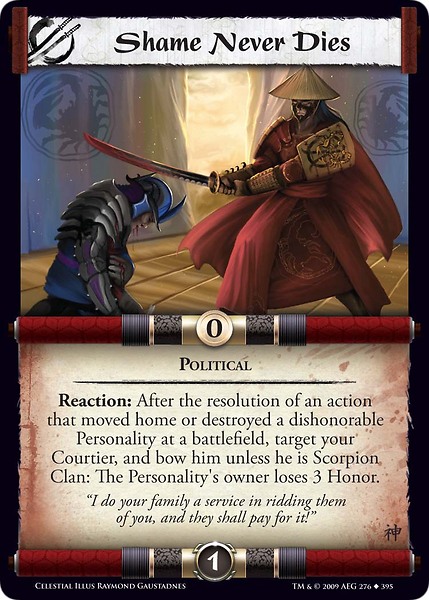
- Card Type
- Strategy
- Gold Cost
- 0
- Keywords
- Political
- Card Text
- Reaction: After the resolution of an action that moved home or destroyed a dishonorable Personality at a battlefield, choose your performing Courtier, and bow him unless he is Scorpion Clan: The Personality's owner loses 3 Honor.
- Focus Value
- 1
- Legality
- Destroyer War (Celestial)
- Deck
- Fate
Printings
Celestial Edition
- Rarity
- Uncommon
- Flavor Text
- "I do your family a service in ridding them of you, and they shall pay for it!"
- Artist
- Raymond Gaustadnes
- Card Number
- 276
- Publisher
- Alderac Entertainment Group
Rulings
- Erratum: Reads, "Shame Never Dies 0G 1FV Political Reaction: After the resolution of an action that moved home or destroyed a dishonorable Personality at a battlefield, target your Courtier, and bow him unless he is Scorpion Clan: The Personality's owner loses 3 Honor." [elestial Edition, 29 June 2009] Comprehensive Rules, Celestial Edition, with specific card rulings, final version, February 2012, p. 152
Rules Q&A
- Q: Wall of Honor Battle: Move your target opposed Personality home: Increase or decrease this province's strength by the number of units on the enemy side at the current battlefield. Gain 2 Honor.
Shame Never Dies Political Reaction: After the resolution of an action that moved home or destroyed a dishonorable Personality at a battlefield, target your Courtier, and bow him unless he is Scorpion Clan: The Personality's owner loses 3 Honor.
I wall of honor my dishonorable personality to rehonor him at home. Does Shame Never Dies care whether he was honorable when the movement happen, or does it check at resolution after the personality has rehonored?
A: The personality was dishonored when he moved home. Shame Never Dies can be played.
If he rehonored before somehow (Say an action that says Battle: Target your performing personality: Gain 1 honor. Move him home.) then Shame Never Dies would not be legal, as he was honorable when he moved home. Dan Jacobson, "Wall of Honor vs. Shame Never Dies", 26 Feb 2010 - Q: Sorry to ask another Shame Never Dies question but this one has my friend second guessing his own cards. Here is the situation.
I have a dishonored samurai. My friend plays Restoring Order. I pass my chance to play a reaction. My friend plays Shame Never Dies in reaction to my movement.
Shame Never Dies: Reaction: After the resolution of an action that moved home or destroyed a dishonorable Personality at a battlefield, target your Courtier, and bow him unless he is Scorpion Clan: The Personality's owner loses 3 Honor.
Restoring Order: Battle: Target your unbowed Magistrate Personality: Target an enemy Personality with Personal Honor lower than your Magistrate's Chi. Move the enemy Personality home. Bow him if he moved. Destroy him if he is dishonorable.
Now here come the questions. 1) When does he play the Shame Never Dies? Before Restoring Order resolves, after I move but before I die or after the entire action resolves? 2) If he plays it before I am destroyed can I then react to the honor lose from Shame Never Dies to Seppuku? Thus turning what would have been a 3 honor loss into a 1 honor loss and avoiding the honor loss from Restoring Order since im already dead when it try's to kill me?
The important part I think is his playing Shame Never Dies in reaction to my movement which happens before the destruction of Restoring Order. Regardless of who is right in this there is a second issue. Can my friend play Shame Never Dies in reaction to the destruction from Restoring Order? The action was played at the current battlefield but the destruction took place at my home.
A: Loïc has focused on what can't be done in this situation, I'll go through what does happen.
Player A has a dishonourable Samurai at a battlefield.
Player B plays Restoring Order. He targets his unbowed Magistrate and the dishonourable Samurai, in required targeting. In the action's resolution, the Samurai moves home, then because he moved, he bows and because he was dishonourable, he is destroyed.
After resolution, the timing trigger for Shame Never Dies occurs - "After the resolution of an action" - and the condition is also valid - "an action that moved home ... a dishonorable Personality at a battlefield." Player B plays Shame Never Dies, targeting (and maybe bowing) his Courtier. Player A loses 3 honour; he may not use the Seppuku Reaction, because Shame Never Dies does not target the moved or destroyed Personality. Furthermore, even if Shame Never Dies did target that Personality, taking the Reaction wouldn't help, since the Samurai is already dead, so the "If the seppuku destroyed him" clause would never trigger. Reaction: Any number of times per turn, before you lose Honor from an action that targeted or was performed by one of your Courtier or Samurai Personalities: He commits seppuku. If the seppuku destroyed him, reduce the Honor loss to one. Alex Jones, "Restoring Order + Shame Never Dies + Seppuku", 15 Dec 2009 - Q: If I send home a personality with Ramifications and they seppuku the honor loss may I still play Shame Never Dies?
A: Yes. Effects occur in order, so with Ramifications, movement occurs before seppuku does. If movement happened, Shame Never Dies can be played. Zen Faulkes, "Discretionary Valor and Shame Never Dies", 2 Sep 2009 - Q: My opponent sends home a dishonored personality using Discretionary Valor. Can I still react with Shame Never Dies(?)
A: Yes. The action moved home a dishonorable Personality. Shame Never Dies does not care how the Personality was moved, nor happened after that. Zen Faulkes, "Discretionary Valor and Shame Never Dies", 12 Jul 2009