Shiba Tsukimi
Legend of the Five Rings card from Celestial Edition, Promotional–Celestial
Open in Oracle of the Void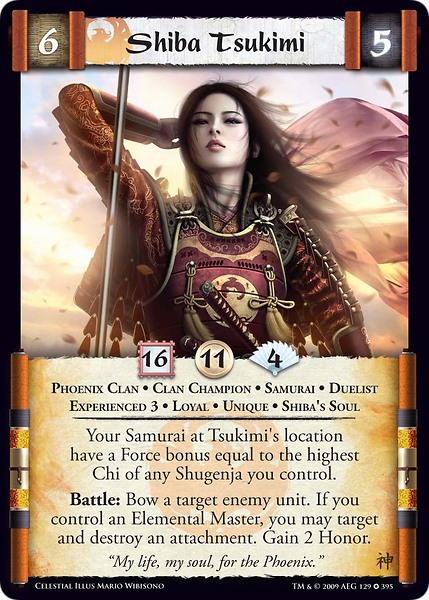
- Card Type
- Personality
- Force
- 6
- Chi
- 5
- Honor Requirement
- 16
- Gold Cost
- 11
- Personal Honor
- 4
- Clan
- Phoenix
- Keywords
- Duelist, Experienced 3, Loyal, Unique, Clan Champion, Phoenix Clan, Samurai, Shiba's Soul
- Card Text
- Your Samurai at Tsukimi's location have a Force bonus equal to the highest Chi of any Shugenja you control.
Battle: Target an enemy unit: Bow it. If you control an Elemental Master, you may target and destroy an attachment. Gain 2 Honor. - Legality
- Destroyer War (Celestial)
- Deck
- Dynasty
Printings
Celestial Edition
- Rarity
- Fixed
- Flavor Text
- "My life, my soul, for the Phoenix."
- Artist
- Mario Wibisono
- Card Number
- 129
- Publisher
- Alderac Entertainment Group
Promotional–Celestial
- Rarity
- Promo
- Flavor Text
- "My life, my soul, for the Phoenix."
- Artist
- Mario Wibisono
- Publisher
- Alderac Entertainment Group
Rulings
- Erratum: Reads, "Shiba Tsukimi 6F/5C 16HR 11G 4PH Phoenix Clan • Clan Champion • Samurai • Duelist • Experienced 3 • Loyal • Unique • Shiba's Soul Your Samurai at Tsukimi's location have a Force bonus equal to the highest Chi of any Shugenja you control. Battle: Bow a target enemy unit. If you control an Elemental Master, you may target and destroy an attachment. Gain 2 Honor." [Celestial Edition, 29 June 2009] Comprehensive Rules, Celestial Edition, with specific card rulings, final version, February 2012, p. 153
Rules Q&A
- Q: RE: viewtopic.php?f=59&t=109749
Has the answer to this question changed, since shugenja is no longer a bold-faced keyword?
(I only ask because both VTD and Tsukimi are still legal for arc play)
A: Victory Through Deference will indeed no longer remove Shugenja, but the answer still applies if the keyword is removed by Dark Harmony or Scrutiny's Sweet Sting. Alex Jones, "RE: Shiba Tsukimi and Victory through Deference", 25 Jun 2015 - Q: Hi there,
I have a question regarding Victory through Deference and given boldface keywords. For example, Tsukimi has the boldface shugenja keyword while she has a spell. Victory through Deference can remove that keyword (right?). Yet she still has the trait that gives her Shugenja while she has a spell. Does she regain the keyword immediately? Does the same go for the ability Come one at a Time gives to your lone defender?
Thank you!
A: Victory Through Deference creates an effect, lasting until the end of the turn, that removes Tsukimi's Shugenja keyword, which is granted via another effect (her trait). Since Victory Through Deference is the more recent effect, it takes preference. If Tsukimi were to lose her spell, and then attach another spell, her trait would be the more recent effect, and would again give her the Shugenja keyword.
Come One at a Time is similar - if the Personality was to cease being your lone defender, and then resume being your lone defender, it would regain the ability. Jon Palmer, "Victory through Deference, Shiba Tsukimi exp. 5", 24 Sep 2014 - Q: Shiba Tsukimi, the blind phoenix has the trait: "Tsukimi can attach Spells and has Shugenja while she has a Spell."
A Kensai's Art states, in part, "Remove an ability and a boldface keyword (if able) on a card in a target enemy unit."
If A Kensai's Art is used to remove Tsukimi's Shugenja keyword, does it stay gone or does her trait immediately recreate it?
A: It would remain removed until the end of the turn, unless Tsukimi lost her spell and then gained a spell, which would re-trigger her trait. Jon Palmer, "Shiba Tsukimi ex 5 vs A Kensai's Art", 21 Jul 2014 - Q: If i have the a fire and void shugenja in play, a) does she have the traits while in province? b) Or will only gain the traits as I'm about to recruit c) after recruit?
A: She does have the traits while in province. Traits on cards out of play affect the card they are on. Jon Palmer, "Shiba Tsukimi, the blind phoenix and element traits", 21 Jul 2014 - Q: Hello. I have been playing the L5R CCG, off and on, for about 8 years now. I truly love the game and am very happy with a lot of the things I am seeing in Ivory edition (I am especially happy about the return of the Kabuki Theater, being an honor-running player ). Recently, I have begun convincing a lot of my friends to start playing the game as well and, with these new sets of eyes pouring over the rule books, a few questions have arisen from what I previously remember or have been taught and what the newer players are reading and interpreting from the rule book. Therefore, I come to you knowledgeable folks for clarification!
The one rule that we are having a really hard time finding any concrete evidence one way or the other on is the legality of previous version of Experienced Personalities. I have done a search here, on the wiki, and on the web in general, but nothing has quelled this debate.
When I was first taught the game, I was told that Personalities follow the "previous printing" rule, just like all other cards. This rule, as printed in the Ivory Edition Advanced Rulebook, is as follows:
From my understanding, the way that you determine whether or not a previously printed card is the same as the currently printed card is to check the card title, which the Ivory Rulebook denotes as follows:
In the example, they state directly that the card title for the Personality, Hiruma Nikaru, is "Hiruma Nikaru". Therefore, by combining those two rules, one could use any card with the title "Hiruma Nikaru" as an Ivory legal card.
Combining this with Experienced Personalities has the added benefit that you could play with a Personality who had a previous Experience version. This also makes sense when we take into account that the only two benefits, really, of playing with Experienced Personalities is that you can a) have more than 3 of that Card Title in your deck as long as you obeyed the other rules of Uniqueness and did not have more than the allotted number per level of Experience (ie you could have 3 non-Experienced version as well as 1 Experience (1) version, meaning 4 total cards with the same title in the deck) and b) that you can use the overlay mechanic to replace a Personality with a lower Experience level with one that had a higher Experience level without needing to pay the Gold cost or meet the Honor Requirement.
What a friend of mine is arguing is that, due to the current rulebook and the way that he reads it, only those Experience versions that have actually been printed in the current edition of the game are legal - all their previous Experience levels are not. To me, this doesn't make sense as, for one, that is not how I was taught and secondly, this would remove both of the benefits of having the Experienced Personality at all. At that point, it might as well be an entirely different card because there will never be a lower Experience level released in the new set for the overlay mechanic and you cannot have multiple cards with the same name (but different Experience levels) if all the other versions are now illegal.
The example I personally have is Shiba Tsukimi. I play a Phoenix deck and have been using Tsukimi since she was released in Lotus. In Ivory, Tsukimi has gotten her Experience 5 version. By my understanding, this would mean that I could put in all of her previous Experience levels into my Ivory deck (following the "previous printing" rules from above). This would mean that I could, legally, have 3 non-Experienced (Lotus), 1 Experienced (Diamond), 1 Experienced 2 (Samurai), 1 Experience 3 (Celestial), 1 Experience 3.5 (Emperor), 1 Experience 4 (Emperor), and 3 Experience 5 (Ivory - 3 because the card specifically states that it is not Unique). I could, then, in effect run a dynasty deck with 11 Shiba Tsukimi-titled cards contained within it. If they came up in order, I could overlay each Experience level on top of the one previous all the way from the first non-Experienced version all the way up to the new Experience 5. This has always been the way that I was taught and understood what Experienced meant.
Per what my friend is reading, this would not be the case. I would only be allowed the 3 Experience 5 versions of Tsukimi that have been released specifically in Ivory. The only versions of her that would have ever been allowed to employ the overlay function would have been her Experience 3.5 and Experience 4, since those are the only two which were released in the same edition. I would not benefit from either of the Experience benefits as outlined above.
Obviously, I hope that you will tell me that my understanding of the rules is correct - I will be pretty sad if I have to only use one version of my favorite Personality that has ever been printed! - but in the end we are looking towards having a tournament at our local store and we really just need to know the answer to this question. If you say that I am wrong and he is right, I will eat my humble pie and tell him so and we will play with those rules from hear on. I really hope that you don't, though.
A: Experience levels have nothing to do with a card's legality in any particular format.
The only things that determine a card's legality are the Legality markings (commonly called "bugs") found in the lower right and left hand corners of a card's text box, and if a card has been banned from the format in question. Banned cards can be searched for using the Banned filter under the advanced search function of the Oracle of the Void card database.
For the current format (Ivory Edition) all cards with the purple Ivory bug in the lower left hand corner of the card are legal, with the exception of Well-Defended Farm and Exotic Farmlands, which have been hit with a recent ban.
I hope this helps explain format legality. Ben Higgins, "A question about the legality of Experienced Personalities", 21 Mar 2014 - Q: How does the interaction between Kazuki's open ability (Open: Set a target Personality's Force equal to Kazuki's.) and Tsukimi's trait (Your Samurai at Tsukimi's location have a Force bonus equal to the highest Chi of any Shugenja you control.) work?
Let's say I control both of them and a chi 3 shugenja. If I use Kazuki's ability on either of himself or Tsukimi does their force become 8 (Kazuki's base 5 plus 3 for the shugenja's chi) or 11 (Kazuki's base current force before the ability is used plus an addition three from the shugenja.)?
Thanks
A: In your scenario, after using Kazuki's ability on any Samurai target, the target's Force would be 8.
Tsukimi's continuous bonus, or any pre-existing bonus, is not re-added after changing someone's current Force. It is factored into the change beforehand. "Setting" to a value is just giving a new appropriate bonus or penalty in order to reach the value. Let's say you target a Samurai with a base 3F with Kazuki's ability in your example. The Samurai's current Force before that is 6F (3F + 3F from Tsukimi's trait). Kazuki's ability would then give him +2F, in order for his Force to become 8 and match Kazuki. Brook Cunningham, "Shiba Tsukimi and Togashi Kazuki", 31 Jul 2010