Snake Tattoo
Legend of the Five Rings card from Emperor Edition, The Fall of Otosan Uchi
Open in Oracle of the Void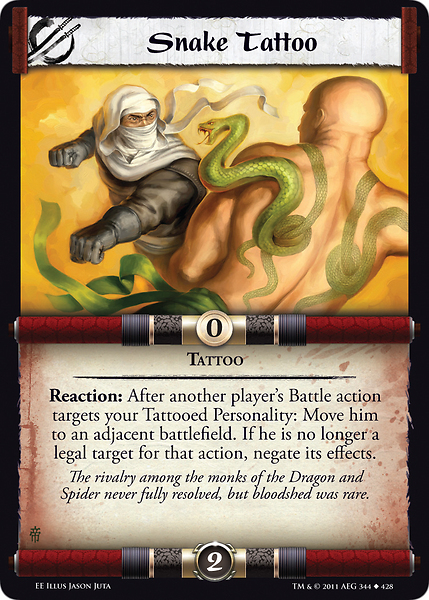
- Card Type
- Strategy
- Gold Cost
- 0
- Keywords
- Tattoo
- Card Text
- Reaction: After another player's Battle action targets your Tattooed Personality, move him to an adjacent battlefield. If he is no longer a legal target for that action, negate its effects.
- Focus Value
- 2
- Legality
- Age of Conquest (Emperor), Four Winds (Gold), Rain of Blood (Diamond)
- MRP
- This card is now a Reaction
- Deck
- Fate
Printings
Emperor Edition
- Rarity
- Uncommon
- Flavor Text
- The rivalry among the monks of the Dragon and Spider never fully resolved, but bloodshed was rare.
- Artist
- Jason Juta
- Card Number
- 344
- Publisher
- Alderac Entertainment Group
The Fall of Otosan Uchi
- Rarity
- Uncommon
- Artist
- Jon Hodgson
- Card Number
- 100
- Publisher
- Alderac Entertainment Group
Rules Q&A
- Q: Snake Tattoo: What is an example of an action or kiho that is still legal to play?
A: Generally, an action that could normally target a Personality in another battle and that targets one of your own Personalities in the current battle. E.g., Energy Transference or Written in Blood would work, *if* the casting Shugenja was in the current battle. Zen Faulkes, "Rules for 30-31 December 2002", 31 Dec 2002 - Q: Ok, Stand against the waves targets personalities without followers, as has already been ruled. What happens if one of said personalities has a Snake Tattoo? By my reading, it targets the guy with the Snake Tattoo, who then moves to a different province. Since he is no longer an opposing Personality, he's no longer a legal target for Stand, and therefore Stand is cancelled, correct?
A: The Snake Tattoo's Reaction can only be used "after AN OPPONENT targets this Personality with an action while he or she is in an army." [card text] Stand Against the Waves forces either the Attacker or the Defender to target and bow cards in his or her own army. So, the only time the Snake Reaction is legal is if your Tattooed Personality is in that player's army AND that player is your opponent for this battle -- which, barring cards like Ninube Ogoku in Open play, never happens. Jeff Alexander, "post for 9 December 2002", 10 Dec 2002 - Q: Magistrate performs TLS on Monk. Monk reacts with ST.
Would TLS destroy the Monk?
+Would it make any difference if Doji Tatsuzo targeted the monk beforehand?
Thanks
A: Once Snake Tattoo has moved the Monk to the adjacent battlefield, he is no longer a legal target for The Law's Strength, so Snake Tattoo negates the effects of The Law's Strength. Both the movement and the (conditional) destruction from The Law's Strength are negated.
Doji Tatsuzo's action allows you to ignore the Law of Presence, since it says, "even if you control no units [at the current battlefield]." It does not allow you to ignore the Law of Location. Alex Jones, "The Law's Strength vs Snake Tattoo", 4 Mar 2013 - Q: Hello, I have a question about evading actions with Snake Tattoo while facing opponent using Kyuden Kitsune exp:
Snake Tattoo: "Reaction: After another player's Battle action targets your Tattooed Personality: Move him to an adjacent battlefield. If he is no longer a legal target for that action, negate its effects."
Kyuden Kitsune Exp: "Your forests are maddening. Negate the first movement each battle into attacking armies at your provinces' battlefields from other players' actions."
So let's say that I target opponent attacking tattooed monk with some kind of kill action, and he uses: a) One Snake Tattoo to jump to unresolved, empty battlefield: a1) so he is stopped by forests, and he dies, as this was his first movement into attacking army a2) and he's not stopped by forest , as the battlefield is empty ant it is not (yet) an attacking army, as there are no personalities there b) Two Snake Tattoos: b1) so the first movement is stopped, but second goes as normal and he escapes terrible death b2) There's no need to use 2nd Tattoo, as 1st movement was not stoped
I am pretty sure that options a1 and b1 are correct, as there IS attacking army at empty unresolved battlefield, and there wee some similar questions asked on this board (as the question about ninja movements vs KKxp), but my opponent wanted to know answer to that exact matter.
A: You're right; a1 and b1 are the correct answers.
If he is attacking at the current battlefield, any movement to an adjacent battlefield would move him into an "attacking army". Even if there is no army there to start, he himself would BE the attacking army when he got there, so the movement would be stopped by those maddening forests. Brook Cunningham, "Kyuden Kitsune exp vs Snake Tattoo", 28 Aug 2012 - Q: ...can you confirm if the same things happens with regards to Inexorable and Snake Tattoo? For example - a Monk personality is targeted with a battle action and reacts with Snake Tattoo. If the Monk personality's opponent reacts with Inexorable, presumably the battle action's effects still occur even though the Monk presonality is in a different province? Presumably Inexorable will also hose Goju Yurishi's reaction also?
A: And yes, the case in the above link describing the interaction between Snake Tattoo and Yoritomo Hiromi also applies to Snake Tattoo/Goju Yurushi and Inexorable. The Tattooed Personality or Yurushi will still move, but Inexorable will prevent the negation, and the action's effects will occur as normal, since the Tattooed guy or Yurushi were legally targeted in the first place. Brook Cunningham, "Inexorable", 22 May 2012 - Q: Example is that Player A attacks a province with Yoritomo Hiromi and Player B defends with a tatooed monk.
what happen when Hiromi uses his battle ability to kill the monk and Player B reacts with Snake Tattoo. will the monk move to the adjacent battle field and there he will be destroyed or be alive since its the monk is already an illegal target.
A: The fact that the monk becomes an illegal target AFTER having been targeted has no bearing in the basic rules. Once having been legally targeted, that step is over. The only reason it matters is that becoming an illegal target after the fact is a condition of Snake Tattoo's negation. But, since the destruction effect of Hiromi's action won't be negated due to his trait, then Snake Tattoo will do nothing besides move your monk, and the action's effects will still destroy him, because he was legally targeted when that step occurred. Brook Cunningham, "illegal target and cannot be negated", 21 May 2012 - Q: viewtopic.php?f=59&t=97365
Nothing on Snake Tattoo says that your personality has to be at the current battlefield, and adjacent battlefields still exist, so what is preventing the monk from moving to a battlefield adjacent to the current battlefield from home?
http://rules.l5r.com/EE_Areas_of_the_ga ... mporary.29 "Battlefields associated with adjacent provinces are themselves adjacent." (fun fact, that line is in the wiki twice in that section)
A: My previous answer stands.
I do see your point, but there's a flaw in your logic.
Adjacency isn't... in fact CAN'T.... be determined by unstated default from the current battlefield without regard to the Personality. Consider, the current battlefield is ALSO "an adjacent battlefield" by your definition; adjacent to the ones beside it. Therefore, in the absence of specifcs such as the ones found on Never Beyond My Reach, adjacency can only be determined relative to the moving Personality's battlefield/location, and a Personality at home has no battlefield adjacent to his. Brook Cunningham, "No Hiding Place vs Snake tattoo.", 13 Apr 2012 - Q: Can a Snake Tattoo be used on a No Hiding Place? The new rule book does not talk about being at home.
A: Your example is a little vague, but let me guess that your Tattooed Personality is at home, being targeted by a Ranged Attack, and you wonder if you can react with Snake Tattoo? Well, yes you can react, but it won't do anything. An "adjacent battlefield" is one that's on either side of another battlefield, determined by adjacency of provinces. There is no battlefield "adjacent" to your home, so the Tattooed Personality would fail to move anywhere, and would then still be a legal target for a Ranged Attack modified by No Hiding Place. Brook Cunningham, "No Hiding Place vs Snake tattoo.", 13 Apr 2012 - Q: Given the fact that the Snake Tattoo reaction triggers after targetting a personality with a Battle action, is the Rule of Location satisfied if the personality moves to adjacent battlefield or is it not?
Snake Tattoo Reaction: After another player's Battle action targets your Tattooed Personality: Move him to an adjacent battlefield. If he is no longer a legal target for that action, negate its effects.
Rule of Location: A card in a unit must be at the current battlefield to be targeted by, or explicitly perform, a Battle action
A: The "if he is no longer a legal target" check happens after the Personality has moved. Therefore, in almost all cases the Rule of Location will cause the targeting to be illegal after the Personality has moved to another location. Jon Palmer, "Snake Tattoo negation vs Rule of Location", 15 Mar 2012 - Q: viewtopic.php?p=1271384#p1271384 At what point does an effect that involves a card cross to being an effect ON that card? If I take an action that gives a target personality -2F, is that an effect ON the target personality? If that action instead said "Target a player. His personalities have -2F", is that a single effect ON the target player, or does it create individual effects that are ON each of that player's personalities?
Presumably the inability to delay duels extends to Goju Yurishi (Reaction: After another player's Battle action targets Yurishi: He disappears into the shadows. Move him home. If he is no longer a legal target for the action, negate its effects on him.) allowing the process of the duel to happen and focus effects to still take place even if Yurishi is no longer a legal target for the action creating the duel? I also assume that this does not extend to the EmpEdition Snake Tattoo since it negates all effects and not just effects on one of the personalities?
A: Challenges and duels are effects, but being targeted, being chosen as a performer, issuing a challenge, being challenged or entering a duel does not change in itself the state, stats, keywords, traits or any other aspect of any Personality, so they are not effects "on" any Personality. Thus, these effects are not delayed by Halls of the Forgotten, nor negated by Goju Yurishi's Reaction.
A blanket -2F to all your Personalities changes the stats of each Personality, so for each of your Personalities, it is an effect on that Personality. Alex Jones, "Halls of the forgotten vs duels", 13 Feb 2012 - Q: If I try to use the battle action on Yasuki Palaces XP targetting an enemy attacking Tattooed personality and my opponent reacts with Snake Tattoo to move him to an adjacent battlefield. Is the personality still a legal target?
A: No. Brook Cunningham, "Snake Tattoo (EE) vs Yasuki Palaces XP", 30 Jan 2012 - Q: If the answer is no, are there any EE legal Battle actions that Snake Tattoo does not negate?
A: Yes. Brook Cunningham, "Snake Tattoo (EE) vs Yasuki Palaces XP", 30 Jan 2012 - Q: This came up in play and we wanted to make sure we did it correctly. Wrathful Ancestor was played on tattooed monk who countered with Snake Tattoo and moved to an adjacent battlefield. Does the monk still move home or is that movement negated?
Wrathful Ancestor Battle: Choose your performing unbowed Spirit and target an enemy Personality: Move him home. This movement will not be negated.
Snake Tattoo Reaction: After another player's Battle action targets your Tattooed Personality: Move him to an adjacent battlefield. If he is no longer a legal target for that action, negate its effects.
A: Your Monk would still move home.
The "This movement will not be negated" clause is not an "effect" in itself, but rather modifies the preceeding effect. Therefore, it is not negated by Snake Tattoo's blanket negation of the action's effects, and it also prevents the movement from being negated by Snake Tattoo either. Brook Cunningham, "Wrathful Ancestor vs Snake Tattoo.", 8 Jan 2012