Soul Jar
Legend of the Five Rings card from The Truest Test, Samurai Edition Banzai
Open in Oracle of the Void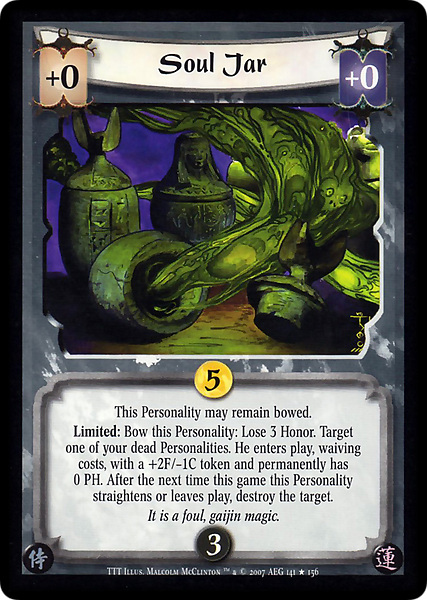
- Card Type
- Item
- Force
- +0
- Chi
- +0
- Gold Cost
- 5
- Card Text
- This Personality may remain bowed.
Limited: Bow this Personality and target your dead Personality: Lose 3 Honor. He enters play, ignoring costs, with a +2F/-1C token and he permanently has 0 PH. After the next time this game this Personality straightens or leaves play, destroy the target. - Focus Value
- 3
- Legality
- Age of Enlightenment (Lotus), Race for the Throne (Samurai)
- Deck
- Fate
Printings
The Truest Test
- Rarity
- Rare
- Flavor Text
- It is a foul, gaijin magic.
- Artist
- Malcolm McClinton
- Card Number
- 141
- Publisher
- Alderac Entertainment Group
Samurai Edition Banzai
- Rarity
- Rare
- Artist
- Malcolm McClinton
- Card Number
- 107
- Publisher
- Alderac Entertainment Group
Rulings
- Personalities brought into play by Soul Jar check the bowed or in play status of the Personality that Soul Jar was attached to when they entered play, not the status of the Personality that Soul Jar is currently attached to. [Reversal, ML, 10 March 2008] Comprehensive Rules, Samurai Edition, with specific card rulings, final version, May 2009, p. 158
Rules Q&A
- Q: Hi,
As long as Ninja Stronghold "pays" for the extra 2 gold in order to waive the Honor Requirement of a personality I want to bring into play, the following should be OK. For example, I want to use Soul Jar (or any card that allow me to waive the cost) on a personality who share my Clan Alignment.
My plan : I increase the gold cost of my dead personality to waive his honor requirement. Soul Jar allow me to waive the cost so it enters play even if my family honor is lower than the personality's honor requirement. can I do that ?
Is there any mechanical difference between "Waiving Cost" and "Ignoring Cost" ?
Parts of rules info :
"Clan Discount and Ignoring Honor Requirements Now all rules for bringing people into play, except Proclaim, apply at all times, meaning you can apply your clan discount and pay extra gold to ignore honor requirements any time you bring someone of your clan into play. This change was made to simply be more intuitive." (http://www.l5r.com/news/emperor-edition ... new-rules/)
(The EE Comprehensive Rules seem unclear/contradictory on this matter, saying "if it's the player's dynasty phase" under "Playing Personalities" and then "before each time a player brings a personality into play" [with an obvious lack of stipulations] under "Clan Alignment and Entering Play".) http://rules.l5r.com/EE_Card_types#Personalities
Card Text : Soul Jar : Limited: Bow this Personality: Lose 3 Honor. Target one of your dead Personalities. He enters play, waiving costs
Ninja Stronghold : Bow this card to put any Ninja card into play without gold cost. Variable cost cards may not be paid for in this manner.
Thanks in advance, Regards, Rémi.
A: Correct, if you're waiving the cost with a card like Ninja Stronghold you may choose to pay the extra two gold and then waive the higher cost. Jon Palmer, "Personality : Waiving Cost VS Honor Requirement", 11 Feb 2012 - Q: So...making sure I understand things correctly, given this....
Turn 1: I attach a Soul Jar to personality Alpha. I bow it, and bring dead personality Bravo into play.
Turn 2: The Soul Jar and Bravo straighten, but Alpha remains bowed (thru the "May remain bowed" clause on Soul Jar...because if he straightened, Bravo would die again). I now bow the Soul Jar and transfer it to personality Charlie.
As I understand it, even though Charlie now holds the Soul Jar, he's irrelevant to what happens to zombie Bravo. So, if he gets killed, Bravo would remain in play. It would only be personalities that he, Charlie, brought into play using the Soul Jar that would die again. Correct?
And...since Alpha, the one who originally Soul Jar'd Bravo into play, no longer has the Jar and can no longer "remain bowed", then on turn 3, he'll straighten and Bravo would die then (unless I somehow applied some other effect that allowed Alpha to remain bowed). Correct?
Finally, if, on Turn 2, I attached a second Soul Jar to Alpha and bowed him to bring in another zombie, personality Delta, then on turn 3, he can remain bowed and both zombies Bravo and Delta are fine. But if he gets killed or unbowed, then both zombies will return to the discard pile as dead. In other words, in the above scenario, the only personality who's fate really matters to the zombies is Alpha. Charlie just happens to be a by-stander holding a Soul Jar. Correct?
A: Here's how I put it in the wiki entry for Soul Jar.
http://rules.l5r.com/Rulings_S#Soul_Jar: "Personalities brought into play by Soul Jar check the bowed or in play status of the Personality that Soul Jar was attached to when they entered play, not the status of the Personality that Soul Jar is currently attached to."
Unless they're one and the same, of course. Zen Faulkes, "Understanding Soul Jars", 10 Mar 2008 - Q: If Tsuruchi Etsui experienced is taken out of play (being destroyed, for example) and then he is returned to play (Soul Jar, Death after Life for example), does his restricting trait (target cannot assign or move) resume taking effect?
A: As it uses "unless" rather than "until," it appears so. Zen Faulkes, "Tsuruchi Etsui experienced", 29 Dec 2007 - Q: So one my friends is rather fond of Soul Jars, and I am doing my best to keep up with various lines of effect and what not. So please bear with me on this - I may not have everything correct, but I'm trying.
Courtier attaches Soul Jar. Courtier bows to resurrect Samurai. Courtier shares SJ with Artisan.
Next turn, Straighten phase. Everything straightens. Since Courtier is no longer 'this personality', Samurai is not destroyed. Artisan bows to resurrect Magistrate. Artisan shares SJ with Bloodspeaker.
On my opponents Turn, Bloodspeaker with a bowed SJ attached is killed by a Hired Killers.
Are Samurai and Magistrate also destroyed due to their resurrection on previous turns by SJ? or Are Samurai and Magistrate still in play since 'This personality' refers to Bloodspeaker, and Bloodspeaker did not use the SJ to resurrect anyone.
If the Soul Jar had been passed back to Courtier instead of Bloodspeaker, is the answer now different?
Thank you!
A: Let me put it to you this way:
It doesn't matter who was holding the Soul Jar then - only who is holding it now.
If the guy currently holding Soul Jar leaves play or straightens then all the "Soul Jar Zombies" that particular Soul Jar brought into play go away. All of those " After the next time this game this Personality straightens or leaves play, destroy the target," delayed effects trigger whenever anyone who is actually holding the Jar straightens or leaves play - even if that personality never held the Soul Jar when it actually used its ability. Martin Lund, "Understanding Soul Jars", 28 Nov 2007 - Q: Is this correct?
A: No.
First, I am reasonably sure there is no rule that "this Personality" by default refers to the performer. See http://rules.l5r.com/Special_wording_ru ... _to_things
Second, although previous posts have emphasized that "this Personality" has a specific definition, context still matters. "This Personality" means the card something is attached to -- except when it can't mean that. Because, say, the card is destroyed (like Companion Spirit). That's the First Cardinal Rule.
I appreciate the desire for consistency, but the Soul Jar ruling has been stable for many months now. Please think carefully before making additional posts on this topic. Thanks! Zen Faulkes, "Re: Soul Jar, Again", 27 Nov 2007 - Q: Can I react with Bayushi Kyuichi when the Soul Jar is used?
A: http://rules.l5r.com/Glossary_R#Resolve: "It stops resolving when its sequence of effect activation has ended, even if the application of some effects has been delayed." Yes. Zen Faulkes, "Bayushi Kyuichi + Soul Jar Token", 27 Nov 2007 - Q: Is it possible, that because of the timing of the straighten effect I have in play an unbowed ShugA with a Soul Jar attached and Dead Chump?
If this is the case, it follows that I could then, on a subsequent turn, bow the ShugA with Soul Jar attached and end up with two dead personalities in play, both of which would be removed the next time ShugA straightens?
A: After a short rules conference, it was determined that this is what will happen. Chris Fuchs, "Shiba Arihiro and Soul Jar", 25 Sep 2007 - Q: (I)f I attach Soul Jar to a personality, he bows to bring a guy back (via Soul Jar's effect) and the bow Soul Jar to move it to another personality who is Straight, the brought back personality immediately is destroyed?
A: No. The Personality didn't "straighten." A transition from bowed to unbowed must happen to trigger the effect. Zen Faulkes, "Soul Jar Followup", 6 Aug 2007 - Q: If the Personality Soul Jar moved to is bowed, then the brought back personality will stay?
A: Yes. Zen Faulkes, "Soul Jar Followup", 6 Aug 2007 - Q: What exactly happens if I bow Soul Jar to move it to another personality?
A: Comprehensive Rules, Glossary, This: "On an attachment, 'this Personality' refers to the Personality in the attachment's unit." Zen Faulkes, "Soul Jar Question", 6 Aug 2007 - Q: Will the destruction of the targeted personality by the destruction or straightening of the personality that Soul Jar is attached to trigger Shosuro Adeiko's reaction(?)
A: If that was what you wanted to know, why didn't you ask that in the first place?
Yes. The destruction is an effect of the action on Soul Jar. Adeiko looks for an action. Zen Faulkes, "Soul Jar Revisited", 5 Aug 2007 - Q: Soul Jar: When you straighten the personality that has the Soul Jar attached, would the destruction of the targeted personality be a cost of straightening or a delayed effect of the original Soul Jar action?
A: Individual effects do not have costs unless the effect specifically says something is a cost. Entire actions have costs. Zen Faulkes, "Soul Jar", 4 Aug 2007