Strike of the Dragon
Legend of the Five Rings card from Samurai Edition, Rise of the Shogun, Promotional–Samurai
Open in Oracle of the Void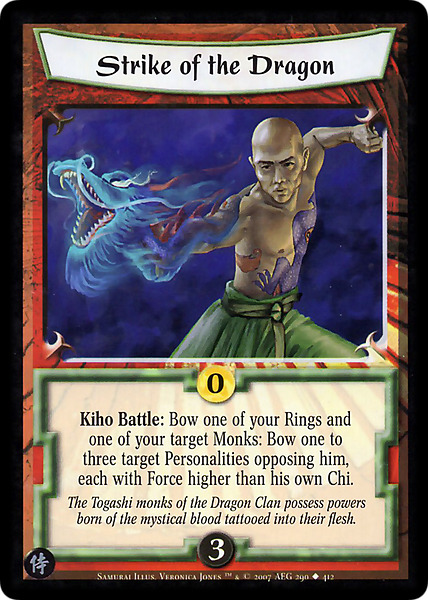
- Card Type
- Strategy
- Gold Cost
- 0
- Keywords
- Kiho
- Card Text
- Battle: Bow your performing Monk, bow one of your Rings, and target one to three enemy Personalities each with Force higher than his own Chi: Bow them.
- Focus Value
- 3
- Legality
- Age of Enlightenment (Lotus), Race for the Throne (Samurai)
- Deck
- Fate
Printings
Samurai Edition
- Rarity
- Uncommon
- Flavor Text
- The Togashi monks of the Dragon Clan possess powers born of the mystical blood tattooed into their flesh.
- Artist
- Veronica V. Jones
- Card Number
- 290
- Publisher
- Alderac Entertainment Group
Rise of the Shogun
- Rarity
- Uncommon
- Flavor Text
- "There is nothing worth the price of war, save the redemption of one's honor." - Togashi Matsuo
- Artist
- Veronica V. Jones
- Card Number
- 147
- Publisher
- Alderac Entertainment Group
Promotional–Samurai
- Rarity
- Promo
- Flavor Text
- The Togashi monks of the Dragon Clan possess powers born of the mystical blood tattooed into their flesh.
- Artist
- Veronica V. Jones
- Publisher
- Alderac Entertainment Group
Rulings
- Erratum: Reads, "Strike of the Dragon 0G 3FV Kiho Battle: Bow one of your Rings and one of your target Monks: Bow one to three target Personalities opposing him, each with Force higher than his own Chi." [MRP, Samurai Edition, 25 July 2007] Comprehensive Rules, Samurai Edition, with specific card rulings, final version, May 2009, p. 159
Rules Q&A
- Q: If my opponent has two Personalities at the current battlefield, one of them being a Clan Champion, and I target both of them with Strike of the Dragon, can my opponent use Seat of Power to keep the Clan Chamption from being targetd?
A: No, because the card does not get to change the number of targets, and there is no other Personality to be targeted "instead."
http://rules.l5r.com/Glossary_I-J#Instead: "In effects that substitute targeting, if the new target has to be a "legal" target, then failure to find a new legal target -- one that satisfies the requirements of the original targeting plus any additional requirements on targeting from other sources -- means the original targeting happens normally." Zen Faulkes, "Seat of Power + Strike of the Dragon", 5 Dec 2007 - Q: Link. Pronouns and pronoun-like terms, like "him," "it," "them," or "that Personality," refer to the last possible thing mentioned in the text that the term would logically refer to.
How does one judge what constitutes a 'thing' for reference by a subsequent pronoun?
(brought up to possibly clarrify rulings around Strike of the Dragon & others)
A: Card context. Chris Fuchs, "Costs: Mandatory costs; Special Wording Rules: Pronouns", 17 Sep 2007 - Q: Strike of the Dragon pt1a & pt1b Strike of the Dragon pt2
(Strike of the Dragon) Kiho Battle: Bow one of your Rings and one of your target Monks: Bow one to three target Personalities opposing him, each with Force higher than his own Chi.
Taking it in sequence, without seperating the distinct parts of cost/effect sentences:
Kiho Battle: Bow one of your Rings and one of your target Monks: (singular, costs target) Bow one to three target Personalities (plural, effects target(s)) opposing him, (masculine, singular, pronoun, cost target reference) each (non-pronoun, multiple, effect target reference) with Force higher than his (masculine, singular, Ruled: effects target reference?) own Chi.
In order to find where the Rules Team are coming from, some of my local playgroup & I proposed different reasons to support the current ruling: 'Each' implies pronoun, therefore it is the last possible thing mentioned that 'his' could refer to. Unable to find anything to support this. 'His' & 'own', together, implies reference to 'each'. Again, unable to find anything that directly supports this. Removing or adding 'own' in this case does not appear to change the meaning of the text definitively, except to emphasise the alternating singular & plural references. I believe if this were the right method of parsing, then the text would say 'their own' instead of 'his own', in order to precisely specify that it is the one to three effects target(s) that are being referred to.
Which specific rules are the Rules Team are using to parse this card & work out which reference relates to each target? (if they are different to the rules I am looking at in order to understand the card, I wish to know. This was the case with Temple to Shinsei + Kyuden Asako)
A: The whole sentence after "one to three target personalities" defines what a legal target is. Each target must be opposing your performing personality, and each target must have force higher than his own chi, referring to the target. Chris Fuchs, "Strike of the Dragon pt3", 17 Sep 2007 - Q: Strike of the Dragon Kiho Battle: Bow one of your Rings and one of your target Monks: Bow one to three target Personalities opposing him, each with Force higher than his own Chi.
Does 'his' refer to the (one to three) personalities targetted for effects, or to the performing Monk referred to in 'opposing him'?
Also; searching the rules forum for previous questions on this topic, I discovered the search engine ignores the term 'Dragon' & other clan animals. Just sayin' ...
A: I know I just answered this... must have been a casualty of the forum issues.
To legally target a personality opposing your performing monk, said personality must have force higher than his own chi. You may target one to three such opposing personalities, who will then bow when the kiho effects resolve. Chris Fuchs, "Strike of the Dragon : him, his & subsequent referral", 22 Aug 2007