Strike the Center
Legend of the Five Rings card from Khan's Defiance
Open in Oracle of the Void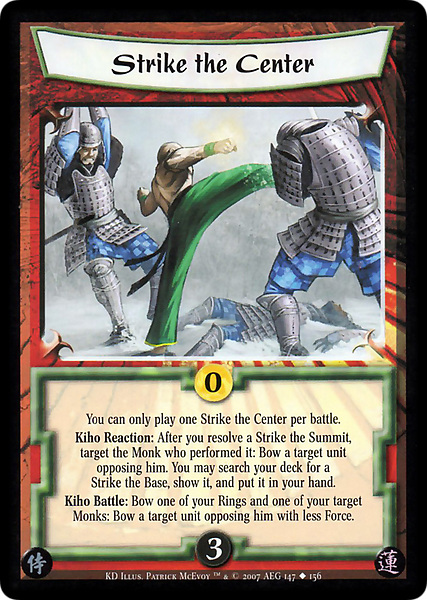
- Card Type
- Strategy
- Gold Cost
- 0
- Keywords
- Kiho
- Card Text
- You may only play one Strike the Center per battle.
Reaction: After you resolve Strike the Summit's action, choose the Monk who performed it as this action's performer, and target an enemy unit: Bow it. You may search your deck for a Strike the Base, show it, and put it in your hand.
Battle: Bow one of your Rings and your performing Monk and target an enemy unit with less Force than his: Bow the target. - Focus Value
- 3
- Legality
- Age of Enlightenment (Lotus), Race for the Throne (Samurai)
- Deck
- Fate
Printings
Khan's Defiance
- Rarity
- Uncommon
- Artist
- Patrick McEvoy
- Card Number
- 147
- Publisher
- Alderac Entertainment Group
Rules Q&A
- Q: This is probably an amazingly simple and/or boneheaded question on my part, but I can't find an answer to this despite remembering, for some reason, a ruling on this issue.
The reactions on Strike the Summit and Strike the Center allow the acting player to fish a Strike the Center or Strike the Base, respectively. Tonight, however, someone played a Strike the Summit, fished a Strike the Center, and then tried to use that copy of Strike the Center as a reaction to his Strike the Summit. I thought there had been a ruling declaring that, in order for a reaction on a card to be played legally, the reacting card had to be in hand when the action it is reacting to was played. My opponent and another player both claimed that this was not the case, and cited instances of this happening at a Kotei they were involved in (Atlanta). Is my memory faulty, has the ruling changed, or were my fellow players trying to pull a fast one on me?
A: A Reaction action card must be in hand at the time its trigger occurs.
In the case of Strike the Centre, this is "After you resolve a Strike the Summit". There is no requirement that the Reaction action card is in your hand at any earlier point.
See http://rules.l5r.com/Timing. Alex Jones, "Timing and the Strike Chain", 15 Mar 2008 - Q: Kiho Battle: Bow one of your Rings and target one of your unbowed Monks: Move home a target Personality opposing him. Bow the Personality if he moved. You may discard a card: If you do, search your deck for a Strike the Center, show it, and put it in your hand.
A: So before Strike the Summit has completely Resolved the player taking the Action has gotten the chance to add Strike the Center to his hand.
Now comes the chance to play Reactions "after resolving" Strike the Summit. The Active Player goes first and then it continues around the table in Turn Order.
If the Active Player is the one who controls Gate Guardsman, he can play the Reaction. The Additional opportunity to take a Battle Action becomes a Delayed Trigger that will resolve later.
Now the player with Strike the Center can play it as a Reaction and get Strike the Base.
Again, the Active Plater gets first Reaction to Strike the Center resolving and it passes in Turn Order.
The player with Strike the Base plays it as a Reaction.
Again, the Active Plater gets first Reaction to Strike the Center resolving and it passes in Turn Order.
Everybody passes a whole lot.
Once there are no further Reactions to the original Battle Action (Strike the Summit), the controller of Gate Guardsman takes his additional Battle Action.
Now, if the player of Strike the Summit were the Active player, he'd effectively be able to play his enter Strike Chain before Gate Guardsman ever got to React to Strike the Summit.
Either way the additional Action from Gate Guardsman isn't going to break up the Strike Chain. Martin Lund, "re:East Hub vs. Gate Guardsman applied to reactions", 3 Aug 2007