Bayushi Hisako
Legend of the Five Rings card from Khan's Defiance, Samurai Edition Banzai
Open in Oracle of the Void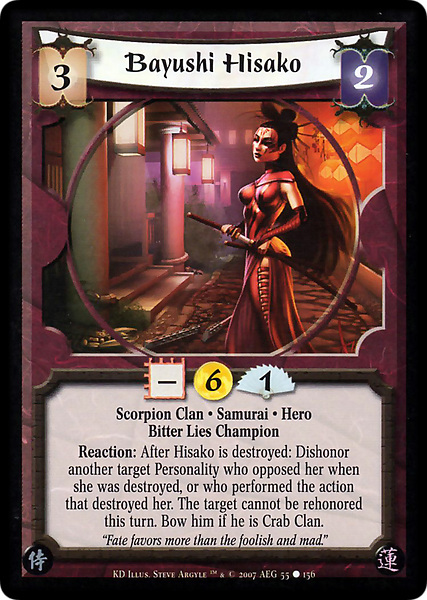
- Card Type
- Personality
- Force
- 3
- Chi
- 2
- Honor Requirement
- -
- Gold Cost
- 6
- Personal Honor
- 1
- Clan
- Scorpion
- Keywords
- Bitter Lies Champion, Hero, Samurai, Scorpion Clan
- Card Text
- Reaction: After Hisako is destroyed, target a Personality who was opposing her when she was destroyed or who performed the action that destroyed her: Dishonor the target. Negate the target's rehonoring (this turn). Bow him if he is Crab Clan.
- Legality
- Age of Enlightenment (Lotus), Race for the Throne (Samurai)
- Deck
- Dynasty
Printings
Khan's Defiance
- Rarity
- Common
- Flavor Text
- "Fate favors more than the foolish and mad."
- Artist
- Steve Argyle
- Card Number
- 55
- Publisher
- Alderac Entertainment Group
Samurai Edition Banzai
- Rarity
- Starter
- Flavor Text
- "Fate favors more than the foolish and mad."
- Artist
- Steve Argyle
- Publisher
- Alderac Entertainment Group
Rulings
- Will prevent Honor gains from winning a battle. [CF, 14 July 2007, ML, 23 July 2007] Comprehensive Rules, Samurai Edition, with specific card rulings, final version, May 2009, p. 124
- Ability can be used regardless of bowed / unbowed status when destroyed, because ability is used after destruction. [ZF, 18 September 2007] Comprehensive Rules, Samurai Edition, with specific card rulings, final version, May 2009, p. 124
Rules Q&A
- Q: One Crab with 45 Force attacks my Province (Province Strength 7). Bayushi Hisako defends. Everbody passes. I use Hisakos action. Is my province destroyed?
A: http://rules.l5r.com/Battles#Resolution_Segment: "Compare the total Force of each army. ... Any changes to army force after this point... do not alter the outcome." (Emphasis added.) Zen Faulkes, "Bayushi Hisako bows a Crab", 11 Mar 2008 - Q: Bayushi Hisako faces an army of dishonorable personalities. She is destroyed. My opponent was under the impression that this would prevent all rehonoring of enemy personalities. I disagree with this, believing that the attempted honor gain would rehonor all personalities except for the one that is targeted by Hisako.
A: http://rules.l5r.com/Physically_marked_ ... shonorable: "Before a player with one or more dishonorable Personalities in his or her army gains Honor from allying with that army (see Invite Allies) or from destroying opposing cards in battle resolution, all such dishonorable Personalities are rehonored and the Honor is not gained." It's not an "instead" kind of situation. You rehonor everyone except the one that can't be rehonored. Zen Faulkes, "Bayushi Hisako", 7 Jan 2008 - Q: The attacking army (now) contains one dishonerable personality and two honorable personalities. Under normal circumstances, we would negate the 6 honor gain (for destroying 3 cards) and rehonor the dishonorable personality. Bayushi Hisako's text prevents this personality from being rehonored this turn. So does the Attacker gain 6 honor since he could not rehonor his dishonorable personality? or - is there no honor gain as the dishonored personality attempts to rehonor and it is negated by Hisako's text.
A: The latter. Zen Faulkes, "Bayushi Hisako + Gaining Honor from Battle Resolution - 2", 18 Sep 2007 - Q: * The Attacker simultaneously destroys all cards in the defending army. This is an effect of battle resolution.
* If his force exceeds the defending army’s Force plus the Province Strength of the province the current battlefield is associated with, he destroys the province. This is an effect of battle resolution.
* The Attacker gains Honor from resolution equal to twice the number of cards in the defending army that were destroyed by the effects of resolution. Before the Attacker gains 1 or more points of Honor from resolution, if the attacking army contains one or more dishonorable Personalities, these Personalities are all restored to honorable status, and the Honor gain from resolution is negated.
A: Hisako's reaction is triggered after step 1. Honor would be gained during step 3. Her reaction is clearly before honor is gained. Chris Fuchs, "Bayushi Hisako + Gaining Honor from Battle Resolution", 18 Sep 2007 - Q: In reference to viewtopic.php?f=59&t=60986
Bayushi Hisako:
Reaction: After Hisako is destroyed: Dishonor another target Personality who opposed her when she was destroyed, or who performed the action that destroyed her. The target cannot be rehonored this turn. Bow him if he is Crab Clan.
Hisako can still use her reaction to dishonor a personality that kills her with a limited duel due to the text in Bold above, Correct? Granted, this isn't the text that the original poster was focusing on, but I just want to be sure.
A: As long as the duel was performed by someone, yes. Chris Fuchs, "RE: Bayushi Hisako and "Opposed"", 28 Aug 2007 - Q: (For) a duel that occures during the Action Phase (like Impromptu Duel), (Bayushi) Hisako's destruction can't trigger her Reaction?
A: Correct. Zen Faulkes, "Bayushi Hisako and "Opposed"", 28 Aug 2007 - Q: (H)er destruction in duel that occurs during Battle (like Warrior Challenge or First and Final Strike) COULD trigger her Reaction?
A: Correct. Zen Faulkes, "Bayushi Hisako and "Opposed"", 28 Aug 2007 - Q: In reference to this, please forgive again my poor understanding of the comprehensive rules, so fascinating but quite hard to learn, but I don't understand precisely why, in the case of a tied battle, the controler of the army destroying Bayushi Hisako would gain some honor nonetheless. Below let's suppose that one Hisako is destroyed while defending so that the Attacker may gain honor from resolution.
Mr Lund suggested to check out the Battle Resolution entry in the L5R Comprehensive Rules (emphasis mine) : "If the Armies tie: the Attacker and Defender simultaneously rehonor any dishonorable personalities in their own army, and then destroy all cards in their respective enemy leader's army. The destruction is an effect of battle resolution. If no personalities in his army were restored to honor or remained dishonorable during resolution, the Attacker gains Honor from resolution equal to the number of cards he destroyed this way. The Defender then does the same if none of his personalities were restored to honor or remained dishonorable during resolution."
After destroying all cards in both armies but before checking whether the Attacker actually gains Honor from resolution, Hisako's Reaction is played. It dishonors a (now destroyed) Personality who was attacking. Since Hisako's Reaction can't target a dead Personality, let's assume that one of the honorable attacking Personalities somehow survived the massive destruction from battle resolution before Hisako's owner uses her Reaction, targeting this lucky veteran. Maybe it can be done with Death after Life since this Reaction may be played after the bloody slaughtering of both armies...
At the time this Personality is dishonored, we are still in Resolution Segment so this Personality is "dishonorable during resolution" ; to be correct, this Personality has become "dishonorable during resolution" but has she really remained "dishonorable during resolution" ? Indeed I'd like to think so but even if it is true, is it really what matters most here ? If that is not the one point that says why the Attacker gains or doesn't gain honor from resolution, may I be bold enough to ask what is the main explanation to the fact that "Hisako's reaction won't prevent any Honor gains", please ?
As you must have noticed, I am a little bit confused with battle resolution. Maybe I didn't understand correctly the question in the previous thread or some of the rules about resolving tied battles. I hope this second question is not too much an annoyance...
Thanks by advance for your brightful explanations.
A: 99.9% of the time, the solution is simple: In a tied battle all personalities are destroyed simultaneously. Outside of exceptional circumstances, there are no legal targets for Hisako's ability in play by the time the Reaction would trigger. Everyone died and left play.
I suppose if you had some special anti-death effect like Hida Daizu XP you might still have a legal target.
Even then he wouldn't qualify as someone who "remained dishonorable during resolution." He became dishonorable as reactions were played to destruction. He did not start out dishonorable and then remain so. The "remained dishonorable during resolution," clause is there for the hedge case where someone would have been restored to honor at the appropriate time in Battle Resolution, but an effect of some sort prevented that from happening. Martin Lund, "Re: Bayushi Hisako in Battle Resolution", 24 Jul 2007 - Q: "Reaction: After Hisako is destroyed: Dishonor another target Personality who opposed her when she was destroyed, or who performed the action that destroyed her. The target cannot be rehonored this turn. Bow him if he is Crab Clan."
Should this be taken as "An army that destroys Hisako during battle resolution gains no honor for this battle" or does one gain honor following her Reaction going off?
A: If there is a clear winner and loser in a Battle Resolution, then yes, Hisako's death and subsequent Reaction will happen before any restoration to honor or honor gains from Battle Resolution. That means you can prevent prospective Honor Gains for a victorious Attacking or Defending army that ran over Hisako.
However, in the case of a Tie restoration to Honorable Status happens before armies are destroyed (thereby ensuring everyone dies as Honorably in battle). In that situation Hisako's reaction won't prevent any Honor gains.
For more information, check out the Battle Resolution entry in the L5R Comprehensive Rules Martin Lund, "Bayushi Hisako", 23 Jul 2007