Traveling Magistrate
Legend of the Five Rings card from The Truest Test
Open in Oracle of the Void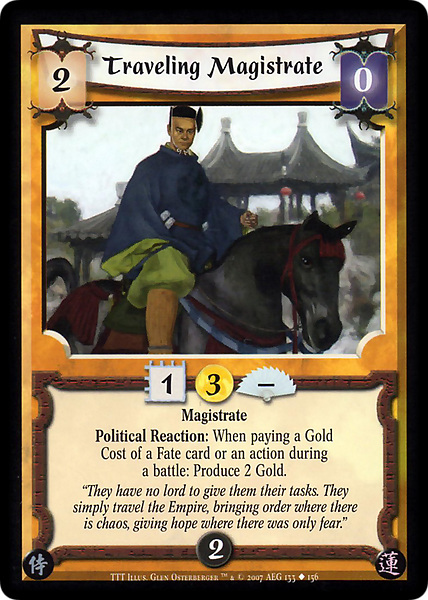
- Card Type
- Follower
- Force
- 2
- Chi
- 0
- Honor Requirement
- 1
- Gold Cost
- 3
- Personal Honor
- -
- Keywords
- Magistrate
- Card Text
- Political Reaction: When paying a Gold Cost of a Fate card or an action during a battle: Produce 2 Gold.
- Focus Value
- 2
- Legality
- Age of Enlightenment (Lotus), Race for the Throne (Samurai)
- Deck
- Fate
Printings
The Truest Test
- Rarity
- Uncommon
- Flavor Text
- "They have no lord to give them their tasks. They simply travel the Empire, bringing order where there is chaos, giving hope where there was only fear."
- Artist
- Glen Osterberger
- Card Number
- 133
- Publisher
- Alderac Entertainment Group
Rulings
- Ability can be used for any Fate card at any time, or any action on any card only during a battle. [ZF, web, 27 May 2007] Rules Archive, August 18, 2007, p. 47
Rules Q&A
- Q: I don't understand the ruling made here.
In the wiki, we have : Modifiers attached to a phrase in the form of "a [modifier] X or a Y" or "a [modifier] X and a Y" modify only the first thing in the phrase; they do not carry over the "a." Example: "A Shadowlands Shugenja or a Monk" does not imply that the Monk has to be Shadowlands.
Traveling Magistrate reads : Political Reaction: When paying a Gold Cost of a Fate card or an action during a battle: Produce 2 Gold.
it really seems to me to be a case of "When paying a Gold Cost of a X or a Y [modifier]", so the modifier, because of this a isn't carried over the X.
A: The modifier is outside of the "a X or a Y" clause. If the modifier were between either of the "a X" or "a Y" clauses, then you would be correct. Chris Fuchs, "Conjonction and parsing.", 29 Aug 2007 - Q: Link to original post
(quoted from ChrisF, bolded emphasis changed) Modifiers attached to a phrase in the form of "a [modifier] X or Y" or "a [modifier] X and Y" modify both things in that phrase. Example: "A Shadowlands Shugenja or Monk" means "a Shadowlands Shugenja or a Shadowlands Monk." If "a Monk or a Shadowlands Shugenja" is meant, it will be written that way. Likewise, "a Shugenja or Monk without attachments" means "a Shugenja without attachments or a Monk without attachments."
(most recent ruling) Fate card during battle, or action during battle.
(card text from Traveling Magistrate) Political Reaction: When paying a Gold Cost of a Fate card or an action during a battle: Produce 2 Gold.
Shouldn't 'a Fate card' followed by 'an action' mean that the two are considered using the bolded portion of text? (compare with the bolded text in the linked topic)
A: In this case, it is "X or Y [modifier]" where X = Fate card, Y = action, [modifier] = during battle. Chris Fuchs, "Traveling Magistrate", 29 Aug 2007 - Q: Based upon this ruling:
viewtopic.php?t=58576
Could the rules team please review this ruling:
viewtopic.php?t=57530&highlight=traveling+magistrate
Thanks!
A: There's no modifier in Traveling Magistrate's text. Zen Faulkes, "Traveling Magistrate follow-up", 25 Jun 2007 - Q: i'm not 100% sure on how to parse traveling magistrate.
is it
a. When paying a Gold Cost of a <fate card> or <an action during battle> : pay 2
OR
b. When paying a Gold Cost of a <fate card or an action> during battle: pay 2
that is to say, paying 2 for a fate card: anytime or only during battle?
thanks.
A: Any Fate card at any time, or an action only during a battle. Zen Faulkes, "Traveling Magistrate", 27 May 2007