Trusted Counsel
Legend of the Five Rings card from Hidden Emperor 3
Open in Oracle of the Void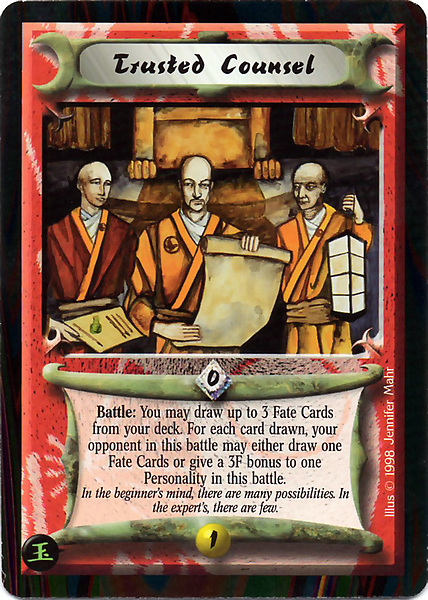
- Card Type
- Strategy
- Gold Cost
- 0
- Card Text
- Battle: Draw zero to three cards. For each card drawn, the enemy leader may either draw a card or give +3F to a Personality at the current battlefield.
- Focus Value
- 1
- Legality
- Hidden Emperor (Jade)
- Deck
- Fate
Printings
Hidden Emperor 3
- Rarity
- Uncommon
- Flavor Text
- In the beginner's mind, there are many possibilities. In the expert's, there are few.
- Artist
- Jennifer Mahr
- Publisher
- Wizards of the Coast
Rules Q&A
- Q: Player A pays for a follower using a corrupt holding. His opponent hits him with a Corruption's Price, killing the personality that should receive the follower. I found the rulings that the follower is discarded (not in the archive, however, which is unfortunate).
A: Not every question ever asked can, or should, be in the Archive. Zen Faulkes, "Rules for 1 July 2003", 2 Jul 2003 - Q: Player A attacks, B has no defending units. A plays Trusted Counsel. [Can] B draw the cards?
A: Yes. There is always a Defender and Attacker in an Attack Phase. Zen Faulkes, "Rules for 1 July 2003", 2 Jul 2003 - Q: 1) Corruption's Price
Player A pays for a follower using a corrupt holding. His opponent hits him with a Corruption's Price, killing the personality that should receive the follower. I found the rulings that the follower is discarded (not in the archive, however, which is unfortunate).
Now the question is: If player A needs more than one holding to pay for the follower, does he have to pay the full cost even if he knows the attachement is invalid already?
A: Yes. Jeff Alexander, "post for 27-28 May 2003", 29 May 2003 - Q: 2) Trusted Counsel
Battle: You may draw up to 3 Fate Cards from your deck. For each card drawn, your opponent in this battle may either draw one Fate Cards or give a 3F bonus to one Personality in this battle.
Player A attacks, B has no defending units. A now plays Trusted Counsel. There is an discussion now whether B can draw the cards or not, based on different interpretations of this part of the rules:
A reference to "an opponent" in relation to a battle means "a player with units in the opposing army." A reference to "your opponent" or "the opponent" in this context means either "the Attacker" or "the Defender," as appropriate, regardless of whether or not the player has units present.
As non of the participating players are native english speakers, we need some official statement here :)
A: The Glossary makes a distinction between "the" or "your" opponent, which forces there to be only one, and "an" opponent, which allows one out of potentially several. That is the key. If the grammar only allows one opponent, then you always have one.
Trusted Council uses the term "your opponent". That will always be the Attacker or the Defender. Jeff Alexander, "post for 27-28 May 2003", 29 May 2003 - Q: I have been playing outside my country for a few days and a lot of people played this card:
Trusted Counsel Battle: You may draw up to 3 Fate Cards from your deck. For each card drawn, your opponent in this battle may either draw one Fate Cards or give a 3F bonus to one Personality in this battle.
They used it when they have a unit in a battle, and his opponent had no units at the battle.
The first time they played, I tried to draw three cards they said I cannot. They said there was a ruling about it, and i let them. I have now checked but i can' t find that rule.
And also, does it satisfy relevance if it no opposing units? Because: It does not come form a card or token in the battle It does not move or create a card in the battle dosen´t target card, tokens , provinces or the battle.
An dit doesnt say opposing, just opponent.
Perhaps I am thinking too much.
If it is like they said, can you explain, please?
A: Trusted Council is like Mushin: it implicitly breaks the Rule of Relevance because it would never be legal to play it otherwise.
Trusted Council still needs to follow the Rule of Presence, though...but that rule only governs whether its player can play it in the first place. The Rule of Presence does not apply to his opponent -- his opponent is not taking any actions.
And since Trusted Council refers to "your opponent", that will always be the Attacker or the Defender, whether he has units there or not.
You could have drawn cards. (You could also have given +3F to one of the Personalities attacking you. Probably not wise, but still legal.) Jeff Alexander, "post for 8 April 2003", 9 Apr 2003 - Q: Previously, "opponent" has been used to refer to other players with units in the battle. (I can't find where I put the references to such use -- stupid memory-based filing system -- so I leave the singular honor of finding them to yourself. :-]) Given that, if I were to play Trusted Counsel while attacking a Province and no other units besides my units were in the battle, only I could draw cards. Is this correct?
A: Nope. From the SW rulebook, pg. 42 -
A reference to "an opponent" in relation to a battle means "a player with units in the opposing army". A reference to "your opponent" in relation to a battle means either "the Attacker" or "the Defender", as appropriate, regardless of whether the player has units present.
So, the opposing player gets to draw cards or give force bonuses all the time, even if he has no units there. Vaughn Derderian, "Rules for December 27th", 27 Dec 2000 - Q: My opponent announces Trusted Counsel (TC) during a battle. I want to react to it with Draw Them Out (DTO). 1) if my opponent did not draw any cards prior to TC, can I even announce DTO? 2) can I play DTO between the first and second card-draws of my opponent with his TC? 3) if the answer to 2) is yes, can my opponent just decide not to draw any more cards with TC (thus ignoring DTO's discard effect)?
In other words, is the number of cards drawn with TC decided once at the beginning of its resolution, or are there 3 separate, consecutive decisions whether to draw or not?
If there are separate decisions, do I have to choose "draw or boost" after each decision, or do I have to make all my choices once my opponent has finished drawing? Do I have to choose the number of cards I want to draw in advance, or can I make successive decisions based on the cards I am drawing one by one?
Trusted Counsel Battle: Draw zero to three cards. For each card drawn, the enemy leader may either draw a card or give +3F to a Personality at the current battlefield.
Draw Them Out Reaction: Before a player who has already drawn Fate cards this turn draws one or more Fate cards due to his own card effects: The next five Fate cards that player draws this turn (including the ones about to be drawn) are discarded immediately after being drawn. Lose 1 Honor.
A: 1. You may not react to Trusted Council with Draw Them Out unless the opponent has already drawn cards this turn.
2. The cards are drawn at once, so no, you may not react "between" them. Jon Palmer, "Draw Them Out vs. Trusted Counsel", 30 Oct 2012