Unexpected Betrayal
Legend of the Five Rings card from Khan's Defiance, Samurai Edition Banzai
Open in Oracle of the Void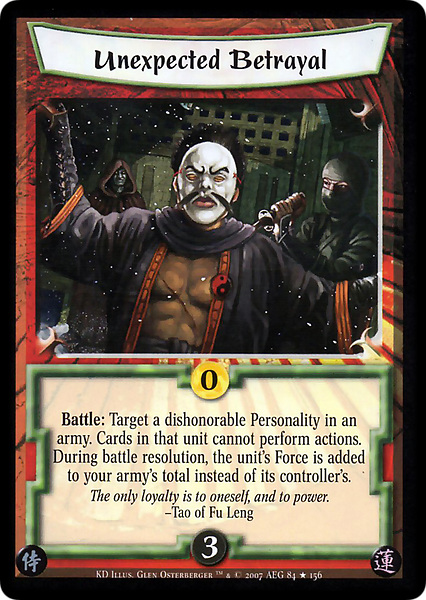
- Card Type
- Strategy
- Gold Cost
- 0
- Card Text
- Battle: Target a dishonorable Personality: Cards in his unit may not perform actions. During this battle's resolution, his unit's Force is added to your army's total instead of its controller's.
- Focus Value
- 3
- Legality
- Age of Enlightenment (Lotus), Race for the Throne (Samurai)
- Deck
- Fate
Printings
Khan's Defiance
- Rarity
- Rare
- Flavor Text
- The only loyalty is to oneself, and to power. - Tao of Fu Leng
- Artist
- Glen Osterberger
- Card Number
- 84
- Publisher
- Alderac Entertainment Group
Samurai Edition Banzai
- Rarity
- Rare
- Artist
- Glen Osterberger
- Card Number
- 100
- Publisher
- Alderac Entertainment Group
Rulings
- Cannot add any force when there are no units in an army. [ML, 27 July 2007; 12 September 2007] Comprehensive Rules, Samurai Edition, with specific card rulings, final version, May 2009, p. 166
- If played by you on a Personality you control, its last effect will do nothing, even if that Personality was previously or is subsequently targeted by an opponent's Unexpected Betrayal. [ML, 26 July 2007] Comprehensive Rules, Samurai Edition, with specific card rulings, final version, May 2009, p. 166
Rules Q&A
- Q: I have a dishonored Shugenja at a battle. Unexpected Betrayal has been played on him. I control a samurai at the battle. Can I play master of the rolling river with the shugenja, with determination so I can in good faith expect my action to suceed, or am I prevented from paying the cost of bowing and there by not able to announce the action in good faith that it will be sucessful.
The essence of the question is this: Does determination look strictly at effects or does it allow you to pay costs that you would otherwise be unable to pay, in that case have a shugenja bow as a cost even though they are prevented from preforming actions.
Thank you.
A: Determination reads, "The action cannot have its effects negated or have its targeting changed."
Determination does not interact with costs (unless targeting was involved, and even then it would only prevent the targeting from sliding around). Zen Faulkes, "Determination "rule of good faith" question", 13 Apr 2009 - Q: Okay if I have a Togashi Dai, Togashi Kazuki, Bowed ring of void and a unbowed Harmonious temple. My opponents first action is to Unexpected Betrayal's my Togashi Dai, For my action can I use the battle action on Harmonious temple I target Kazuki and my bowed ring of void. Can Togashi Dai use his trait to pay the cost of bowing instead of void?
A: Perform: A Personality or Follower is performing an action if its controller is the player taking the action and any of these things is true: * The action comes from an ability on the Personality or Follower. * The action comes from an ability on an Item or Spell in the Personality’s unit. * The Personality or Follower was targeted by targeting in the ability’s constraints block (between the two colons).
This list does not include "using a trait to pay a cost of an action". Togashi Dai is not performing the action on Harmonious Temple when he bows to pay the cost. Alex Jones, "Togashi Dai and Unexpected Betrayal", 4 Dec 2008 - Q: Here is the highlighted rule from the more recent rules discussion: Glossary, Army: This is similar to the rules for absent stats; if anything in the game needs to know the Force, number of units, or other numerical aspect of an "army" with no units, it is always zero.
I don't mean to resurrect a dead discussion, but I am now confused. Does the new ruling governing armies with zero units change what the ruling should be for unexpected betrayal?
A: The thing is, there are more rules in the Glossary entry for Army than just the highlighted one from the recent discussion that you mention. There is also:
http://rules.l5r.com/Glossary_A#Army: "A side with no units is not an army. Specifically, its force total is zero, regardless of effects that modify “army” Force."
Unexpected Betrayal is an effect that modifies an army's Force. No army = no modification, as per the above. Brook Cunningham, "Unexpected Betrayal with no 'army'", 12 Jun 2008 - Q: In reading the recent question about someone using an unexpected betrayal in an attempt to regain his personalities force, I am stumped. I understand that it won't do any good, that is not my concern. What is my concern is that Unexpected Betrayal states that the target unit's cards cannot perform actions. Wouldn't the second Betrayal be considered performing an action, since it targets? Wouldn't that be the clincher in saying '' this won't work'' ?
A: The Personality isn't targeted in the constraints block (indeed, Unexpected Betrayal has no constraints block), so he isn't performing it. Brook Cunningham, "Multiple Unexpected Betrayal", 12 Apr 2008 - Q: Bob is attacking Tom with Hida X who is dishonored at the time fo the attack.
Tom with his first action plays Unexpected Betrayal. Bob then plays Unexpected Betrayal on his own personality. Both players then pass.
Is this a legal play? Does the personality contribute to Bob or Tom's army?
Text: Battle: Target a dishonorable Personality in an army. Cards in that unit cannot perform actions. During battle resolution, the unit's Force is added to your army's total instead of its controller's.
The "your army's total" and "controller's" would seem to be in conflict.
Thanks, Nick
A: Please Search before asking.
It was pretty far down the list, but this question was already covered here. Brook Cunningham, "Multiple Unexpected Betrayal", 12 Apr 2008 - Q: If I Unexpected Betrayal an opposing unit and then lose all presence on my side of the battlefield does the Unexpected Betrayal unit still add it's force to my "army"?
A: viewtopic.php?f=59&t=59722 viewtopic.php?f=59&t=61612 Zen Faulkes, "Unexpected Betrayal + "Army"", 31 Dec 2007 - Q: I play Unexpected Betrayal. Can my opponent utilize Seikitsu Mountains too move the unit home(?)
A: Yes. http://rules.l5r.com/FAQ#What_performs_an_action.3F Zen Faulkes, "Unexpected Betrayal/Seikitsu Mountains", 2 Dec 2007 - Q: (D)oes his force still contribute?
A: No. http://rules.l5r.com/Glossary_I-J#Instead
Force wouldn't be added to controller's army, so it can't be added to yours instead. Zen Faulkes, "Unexpected Betrayal/Seikitsu Mountains", 2 Dec 2007 - Q: Relevant text: Unexpected Betrayal Battle: Target a dishonorable Personality in an army. Cards in that unit cannot perform actions. During battle resolution, the unit's Force is added to your army's total instead of its controller's.
If I use Unexpected Betrayal on my opponent's card and afterwards it is moved into another battle, would it still contribute force to my army if I have one at said battlefield?
And as a side-note, would it make any difference if my opponent's traitorious card was moved home and then moved into another battle?
A: The effect lasts until the end of the turn. It doesn't matter which Battlefield the betrayer winds up in or how many times he gets sent home. Martin Lund, "Unexpected Betrayal and multiple battles", 26 Nov 2007 - Q: If I´m defending a province with a sorrow´s path and I target one of my opponent´s attacker with Unexpected Betrayal. Could he use him as a target to be destroyed by sorrows path???
Unexpected Betrayal Battle: Target a dishonorable Personality in an army. Cards in that unit cannot perform actions. During battle resolution, the unit's Force is added to your army's total instead of its controller's.
Sorrow's Path Singular
Before a battle at this Province resolves: The Attacker targets one unit or three cards in the attacking army. Destroy the targets.
Thanks
A: Yes. Being destroyed by Sorrow's Path is not performing an action. Chris Fuchs, "Unexpected Betrayal + Sorrows Path", 7 Oct 2007 - Q: If I Unexpected Betrayal my opponent's personality and then my opponent uses Unexpected betrayal on the same personality who's army does the personality add force to?
relevant text Battle: Target a dishonorable Personality in an army. Cards in that unit cannot perform actions. During battle resolution, the unit's Force is added to your army's total instead of its controller's.
Would the fact that I'm not the controller of the unit mean that a second unexpected betrayal would not prevent me from gaining the force?
A: See viewtopic.php?f=59&t=59373
Fixed. Zen Faulkes, "Double Unexpected betrayal", 3 Oct 2007 - Q: I am sure this has been asked but I couldn't find it. My question is can you Seiketsu Mountains home personalities that have been targeted by Unexpected Betrayal?
Thanks.
[Mod edit: Coloured text removed. Coloured text -- particularly red -- is reserved for mod use. Thanks! -ZF]
A: Yes. The action on Seikitsu Mountains is not performed by any personalities. Chris Fuchs, "Unexpected Betrayal and Seiketsu Mountains", 24 Sep 2007 - Q: A. Compare the total Force of each army. Whichever army has the most Force wins (see Force total). A side with no units has zero force for purposes of this comparison, and does not count as an army for effects that alter the force of an “army”.
The winning army’s leader (the Attacker or Defender) is the winner of the battle.
If both armies have the same Force and both armies contain one or more units, the battle is a tie.
Any other result (such as an army with total unit force of zero versus a side with no units) has no defined outcome.
A: This is a case of one side having 0 Force and 1 unit vs. another side with no units - and thus has no defined outcome. No one dies, wins, loses, or ties. Martin Lund, "Unexpected Betrayal Revisited", 12 Sep 2007 - Q: In reference to this, if I make no mistake Mr Lund's answer means that, if I played an Unexpected Betrayal on a personality in my opponent's army but when resolution begins I have no unit left on my side, then the unexpected traitor will stop betraying my opponent and he still contribute Force to my opponent's army as though I hadn't played Unexpected Betrayal on him because "there is no army on [my] side for Unexpected Betrayal to cause that Unit to contribute to. The effect would fail."
I'd like to underline a point that makes me overconfidently wonder whether this answer might not be correct. Please forgive the foolish arrogance of youth.
Indeed I read that in the glossary "I" : Instead of [...] 3. If the new X is negated, or fails to happen for a reason other than negation (“do not” wording, absence of relevant game elements), the old Y doesn’t happen. Example: In “target enemy unit adds Force to your army instead of the enemy army,” if you have no army (i.e. no units) then the unit still does not add Force to the enemy army.
Unexpected Betrayal reads: Battle: Target a dishonorable Personality in an army. Cards in that unit cannot perform actions. During battle resolution, the unit's Force is added to your army's total instead of its controller's.
In the given example, it seems that : X = "the unit's Force is added to my army's total" ; Y = "the unit's Force is added to my opponent's army's total".
It also seems that X "fails to happen for a reason other than negation" therefore "the old Y doesn’t happen", does it ? It looks like quite much the example above, in the third point of the "Instead of" point in the glossary. So, does the unexpected traitor still contribute Force to my opponent's army or to no army please ?
Thanks for your most precious help.
A: You're right. I got #2 and #3 backwards in terms of X and Y.
X is contributing to the enemy army.
Y is contribution to the normal army.
If you couldn't contribute to the normal army, you can't contribute to the enemy army.
If you can't contribute to the enemy army, you don't go back to contributing to the normal army.
I'll make the necessary adjustments.
Also, don't feel any need to be too formal addressing me. The rules are what they are, and I'm certainly not above making a mistake now and then - especially with all the MRPs and rules changes floating around. I'm not going to take it personally. Martin Lund, "Re: Unexpected Betrayal", 1 Aug 2007 - Q: A. Compare the total Force of each army. Whichever army has the most Force wins (see Force total). A side with no units has zero force for purposes of this comparison, and does not count as an army for effects that alter the force of an “army”.
A: Unexpected Betrayal would qualify as an effect that alters the force of an "army," and thus there is no army on your side for Unexpected Betrayal to cause that Unit to contribute to. The new effect would fail.
This would not, however, cause the Betraying Unit to revert to contributing to the original army, as per the Glossary: Martin Lund, "Unexpected Betrayal", 27 Jul 2007 - Q: nstead of
1. “X instead (of Y)” refers to the substitution of an old targeting, effect, cost or other game element (Y) with a new one (X).
2. If the old Y is negated, or fails to happen for a reason other than negation (“do not” wording, absence of relevant game elements), the new X doesn't happen.
Example: In “you may bow a personality instead of losing Honor,” you cannot use this to bow a Personality if the Honor loss has already been negated, or if an existing trait says that you do not gain or lose Honor.
3. If the new X is negated, or fails to happen for a reason other than negation (“do not” wording, absence of relevant game elements), the old Y doesn’t happen.
Example: In “target enemy unit adds Force to your army instead of the enemy army,” if you have no army (i.e. no units) then the unit still does not add Force to the enemy army.
A: - Marty Lund Deputy Rules Monkey Martin Lund, "Unexpected Betrayal", 27 Jul 2007 - Q: I have a 2 Force Unit in battle. (2 Force total)
My opponent has a 3 Force Unit and a Dishonored 4 Force Unit. (7 Force total)
As an action, I play Unexpected Betrayal:
Battle: Target a dishonorable Personality in an army. Cards in that unit cannot perform actions. During battle resolution, the unit's Force is added to your army's total instead of its controller's.
My opponent passes. I pass.
Based on my reading of the card, during resolution my army total force is 6, and my opponent's is 3, thus I win the battle. Is the betraying unit destroyed? Can his force contribute to his own destruction?
A: It plays out exactly how your read it from the card.
The Betraying unit can easily contribute to its own destruction due to the Force swing provided by Unexpected Betrayal.
Just remember that even if it contributes Force to your army, the Unexpected Betrayal says nothing about changing who controls the card or what side it is on. It is still part of the other player's Army, not yours. (And that's why it dies if that Army loses the fight). Martin Lund, "Unexpected Betrayal + Battle Resolution", 26 Jul 2007 - Q: Is it because the Crab Samurai effectively contribute "Zero" force to his side and 4 Force to the enemies side, resulting in the enemy out-forcing the Crab?
A: The card text of Unexpected Betrayal clearly states that the target's force is added to the action player's army force total instead of the target's army force total. Chris Fuchs, "Unexpected Betrayal - Still waiting on a ruling.", 2 Jul 2007 - Q: Can a dishonored personality targeted with Unexpected Betrayal still issue a challenge using Mirumoto Sensei and bowing the weapons it has attached?
A: No. Lotus rules, pg. 47: "Actions that cause a Personality controlled by the player who took the action to issue a challenge are performed by that Personality." Zen Faulkes, "Unexpected Betrayal", 15 Jun 2007 - Q: (C)an the same personality be targeted with Overwhelmed?
A: By the player playing Overwhelmed, no. By the enemy leader, yes. Zen Faulkes, "Unexpected Betrayal", 15 Jun 2007 - Q: Does the ruling dealing with Unexpected Betrayal (an army exists even with zero units) mean that Broder Skirmish triggers even if there are no units opposing you at resolution?
It seems odd but I would like to know why not (assuming no) so I can explain it to my players.
A: No, as nothing is actually destroyed. This also applies if they manage to negate their army's destruction somehow. Chris Fuchs, "Border Skirmish", 24 May 2007