Unspoken Threats
Legend of the Five Rings card from Samurai Edition, Heaven & Earth, Promotional–Samurai
Open in Oracle of the Void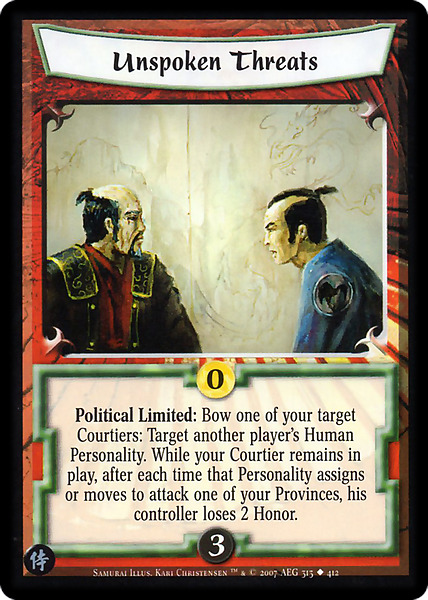
- Card Type
- Strategy
- Gold Cost
- 0
- Keywords
- Political
- Card Text
- Limited: Bow your performing Courtier and target another player's Human Personality: While your Courtier remains in play, after each time the target is assigned or moves into an attacking army at one of your provinces' battlefields, his controller loses 2 Honor.
- Focus Value
- 3
- Legality
- Four Winds (Gold), Race for the Throne (Samurai), Rain of Blood (Diamond)
- Deck
- Fate
Printings
Samurai Edition
- Rarity
- Uncommon
- Artist
- Kari Christensen
- Card Number
- 313
- Publisher
- Alderac Entertainment Group
Heaven & Earth
- Rarity
- Uncommon
- Flavor Text
- "For both our sakes, Akodo, grant us safe passage."
- Artist
- Kari Christensen
- Card Number
- 86
- Publisher
- Alderac Entertainment Group
Promotional–Samurai
- Rarity
- Promo
- Artist
- Kari Christensen
- Publisher
- Alderac Entertainment Group
Rulings
- Erratum: Reads, "Unspoken Threats 0G 3FV Political Limited: Bow one of your target Courtiers: Target another player’s Human Personality. While your Courtier remains in play, after each time that Personality assigns or moves to attack one of your Provinces, his controller loses 2 Honor." [MRP, Samurai Edition, 25 July 2007] Comprehensive Rules, Samurai Edition, with specific card rulings, final version, May 2009, p. 167
Rules Q&A
- Q: If I target another's player personality with Unspoken Threats the controller lose 2 honor each time he/she bows or attack with this personality, it's clear. My question is:
Does the personality causes the lose or is the Unspoken Threats?
A: The card does not say where the loss comes from, so it comes from the card describing the loss: Unspoken Threats. Jeff Alexander, "post for 5 May 2003", 6 May 2003 - Q: Does the "assigns or moves to attack" on Unspoken Threats include movement between the defenders provinces, or only from home to the province.
Example: I bow a Courtier and target my opponent's personality. My courtier remains in play throughout. On my opponent's turn, he declares an attack, and assigns his personality to attack Province 'A'. Loses 2 honor. I assign a personality to defend at Province 'B'.
My opponent decides to resolve battle at Province 'A' first. For my first action, I play Reinforce the Gates, and move his personality to oppose mine at Province 'B'. Does this movement cause him to lose another 2 honor?
Unspoken Threats Political Limited: Bow one of your target Courtiers: Target another player’s Human Personality. While your Courtier remains in play, after each time that Personality assigns or moves to attack one of your Provinces, his controller loses 2 Honor
Reinforce the Gates Battle: Even if you control no units at the current battlefield: Target an unopposed unit there. Move the unit to a target battlefield where it would be opposed
A: The personality is moving to attack a new province; his controller loses another two honour. Alex Jones, "Unspoken Threats & movement between battles", 22 Apr 2008 - Q: I bow a Courtier-A to play Unspoken Threats on Daigotsu Masami. On opponents turn, she attacks with Daigotsu Masami (loses 2 honor due to the Unspoken Threats), then uses Chuda Ikumi's battle action to put Daigotsu Masami in the ground. my Courtier-A is in play. I play my turn, Courtier-A is still in play. Opponents next turn, she uses Daigotsu Masami's Limited Action to put him into a province, and in the Dynasty Phase, into play.
Is my Unspoken Threats still in effect on Daigotsu Masami, as my Courtier-A is still in play?
A: Yes.
http://rules.l5r.com/Glossary_W: "While (i)ndicates a condition that applies if something is true over a given period. 'While he is dishonorable, he has +2F' means that for the duration of the effect he gets +2F at any time he is dishonorable. If he becomes honorable, and then dishonorable again, during this period he would get the +2F." Zen Faulkes, "Unspoken Threats & Daigotsu Masami", 9 Apr 2008 - Q: Unspoken Threats
Political Limited: Bow one of your target Courtiers: Target another player’s Human Personality. While your Courtier remains in play, after each time that Personality assigns or moves to attack one of your Provinces, his controller loses 2 Honor.
Does it mean:
a) He loses 2 honor every time he assigns to a battle or moves to attack. (meaning he loses honor if he assigns the peep as a defender)
b) He loses 2 honor every time he assigns to attack or moves to attack.
A: The latter.
"to attack one of your Provinces" qualifies "assigns or moves" not just "moves." Martin Lund, "Unspoken Threats", 12 Sep 2007 - Q: when this action is played on a personality, does his controller lose honor when assigning to defend?
not sure because it's split by the 'or' word and there has been two different rulings:
http://www.alderac.com/forum/viewtopic.php?f=59&t=60493 http://www.alderac.com/forum/viewtopic.php?t=57530&highlight=traveling+magistrate
Unspoken Threats Political Limited: Bow one of your target Courtiers: Target another player’s Human Personality. While your Courtier remains in play, after each time that Personality assigns or moves to attack one of your Provinces, his controller loses 2 Honor.
A: http://rules.l5r.com/Special_wording_rules#Conjunctions
Modifiers attached to a phrase in the form of "a [modifier] X or Y" or "a [modifier] X and Y" modify both things in that phrase. Example: "A Shadowlands Shugenja or Monk" means "a Shadowlands Shugenja or a Shadowlands Monk." If "a Monk or a Shadowlands Shugenja" is meant, it will be written that way. Likewise, "a Shugenja or Monk without attachments" means "a Shugenja without attachments or a Monk without attachments."
Assigns to attack or moves to attack.
Correcting the Travelling Magistrates post. Chris Fuchs, "Unspoken Threats", 14 Aug 2007 - Q: Unspoken Threats: is it each time the Personality assigns to attack, or just each time he assigns?
A: Comprehensive Rules, Conjucntions: "Modifiers attached to a phrase in the form of 'a [modifier] X or Y' or 'a [modifier] X and Y' modify both things in that phrase. Example: ... 'a Shugenja or Monk without attachments' means 'a Shugenja without attachments or a Monk without attachments.'
Attacking only. Zen Faulkes, "Unspoken Threats", 31 Jul 2007