Yogo Adi
Legend of the Five Rings card from Second City
Open in Oracle of the Void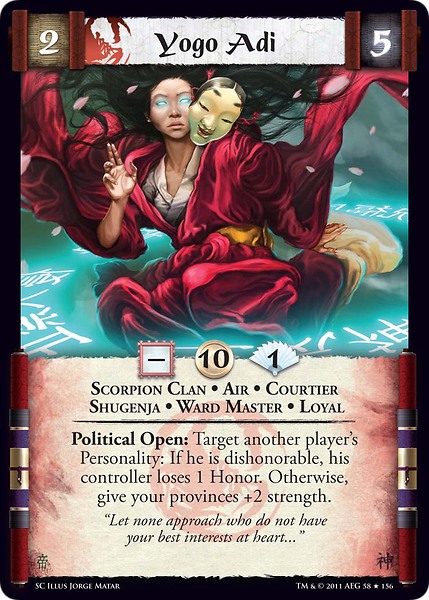
- Card Type
- Personality
- Force
- 2
- Chi
- 5
- Honor Requirement
- -
- Gold Cost
- 10
- Personal Honor
- 1
- Clan
- Scorpion
- Keywords
- Loyal, Air, Courtier, Scorpion Clan, Shugenja, Ward Master
- Card Text
- Political Open: Target another player's Personality: If he is dishonorable, his controller loses 1 Honor. Otherwise, give your provinces +2 strength.
- Legality
- Age of Conquest (Emperor), Destroyer War (Celestial)
- Deck
- Dynasty
Printings
Second City
- Rarity
- Rare
- Flavor Text
- "Let none approach who do not have your best interests at heart..."
- Artist
- Jorge Matar
- Card Number
- 58
- Publisher
- Alderac Entertainment Group
Rules Q&A
- Q: We got into a bit of an argument about the minutia of the wording of the ability of Yogo Adi in a recent game.
Relevant Text:
Political Open: Target another player's Personality: If he is dishonorable, his controller loses 1 Honor. Otherwise, give your provinces +2 strength.
My opponent, who was playing Adi, argued that since the 'otherwise' clause is a separate sentence from the 'if he is dishonorable' clause that Adi's player gets the province strength boost regardless. I told him that this didn't magically change the meaning of the word 'otherwise' and after some back and forth he let it drop but clearly wasn't happy about it. So to settle the issue I'm asking here: Does the fact that 'otherwise' is in its own sentence change what seems (to me) to be the obvious reading of an either-or situation? (Either the target is dishonorable and his controller loses 1 Honor or your provinces get +2 strength)
A: Your opponent is clutching at straw.
"Otherwise" here means, "If he is not dishonourable". Alex Jones, "Yogo Adi and 'otherwise'", 22 Jun 2012